
KC begrudgingly approves Four Light high rise plan — including $17 million parking garage
Kansas City gave the green light to a plan for a new luxury tower that will join the skyline, but not without pause. Resistance among some City Council members to perks that officials approved years ago reflected a shift in City Hall’s attitude toward giveaways for big developers building inside the growing downtown loop.
The Kansas City Council voted on Thursday to approve a development plan for what is now a parking lot next to the downtown B&B movie theater, 1400 Main St., that will pave the way for the future 25-story Four Light tower, a $156 million project that would add 293 apartment units and 17,000 square feet of retail space.
Four Light will be the fourth of the Cordish Companies’ “Light” luxury high-rises, which have transformed the Kansas City skyline and added hundreds of new housing units in the Power & Light District.
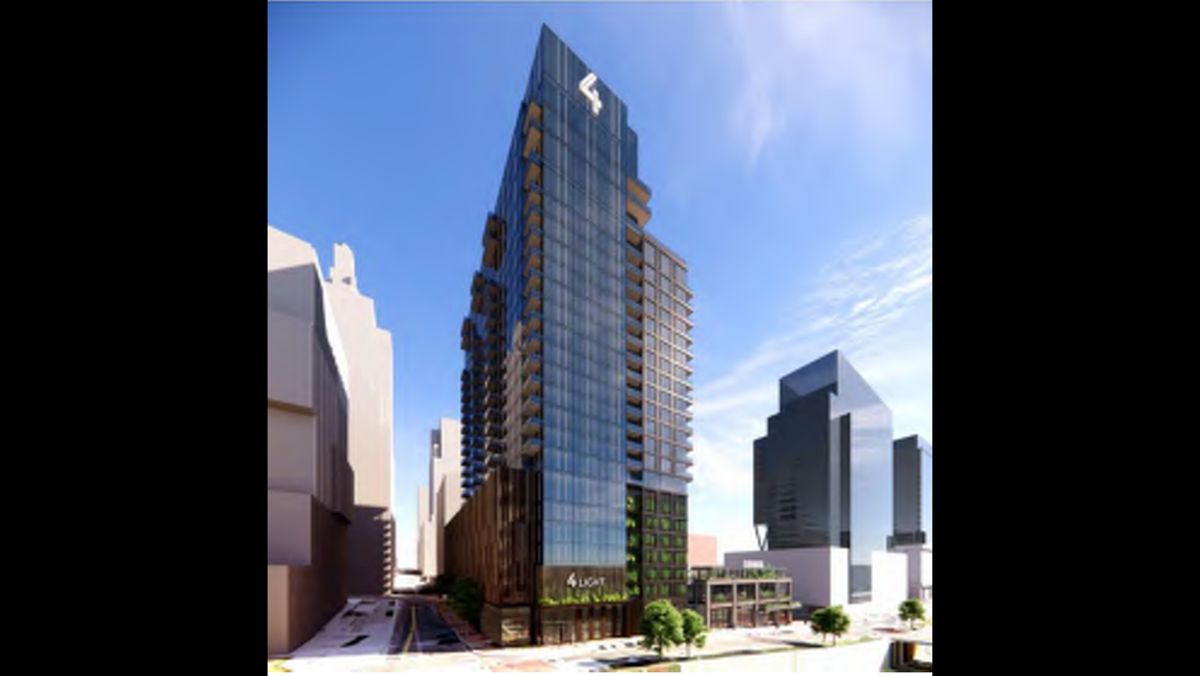
The plan declares the site to be an “undeveloped industrial site” in need of rehabilitation and opens up incentives for the project through the city’s Planned Industrial Expansion Authority. Tied to the proposal are tax breaks and incentives the City Council previously approved back in 2018 for Cordish’s Light towers, including the city kicking in $17 million for a parking garage.
That deal was approved before current council members took their seats, save for now-mayor Quinton Lucas. While the council is sticking with the city’s obligations, avoiding a dispute over breaking an existing agreement, some officials have said they would likely take a different approach to offering incentives for such a development today — given the continued growth downtown.
The 2018 agreement with Cordish was itself a renegotiation of a plan for Lights that dates back to the mid-2000s, a time when there was much less development downtown. Many new businesses and thousands of residents have since moved in.
Lucas said Thursday that as plans for redeveloping the Power & Light District were coming together, the city entered into substantial agreements with developers that allowed for an unlimited number of Light towers with subsidized parking garages, maximum tax incentives and “frankly almost anything else that they had wanted.”
The logic at the time, Lucas said, was that no one wanted to invest in downtown, and that was the balance the city made about 20 years ago. Later, in the 2010s, the city was able to negotiate out of “never-ending Lights,” limiting the number to six, while adding requirements for affordable housing and making something out of what was once a “poor deal,” he said.
The 2018 agreement allowed Cordish to meet the affordable housing requirements with its downtown Midland Lofts project. It also calls for the developer to pay over $5 million back to taxing bodies instead of taxes over 25 years on Four Light.
There have been extensive debates within City Hall about how to reduce incentives so the city isn’t just saying developers are entitled to whatever they want to build long-term, Lucas said.
Fourth District council member Eric Bunch signaled that it might be time for another renegotiation with Cordish. Bunch said he and Fourth District At-Large council member Crispin Rea have been speaking with Cordish representatives about future projects and that there will be an opportunity to have a conversation about parking and possibly reduce the city’s commitment.
“When these types of things come up and we’re hamstrung by a previous City Council’s decision, we get frustrated by it, so when we have that opportunity, let’s be careful so we are not beholding future city councils to decisions that seemed okay at the time, but have serious financial or policy implications for future councils that they have no control over,” Bunch said.
Third District At-Large council member Melissa Patterson Hazley said she recognized that when the agreement was made, the city was “a little bit desperate.”
“We gave away, probably, well I know, much more than we would today,” she said.
But the city has reached a point where it should revisit its approach in the area now that downtown is more developed and the Main Street streetcar is in place, she said.
“Incentives are supposed to drive development such that you don’t need incentives anymore,” Patterson Hazley said.
The council’s final vote to move the Four Light plan forward was 9-4, with District 3’s Melissa Robinson, District 5’s Darrell Curls, District 6’s Johnathan Duncan and District 1’s Nathan Willett voting no.
Duncan called the agreement “onerous” as it offers incentives for housing that the vast majority of Kansas City residents cannot afford.
Curls said that as the city subsidizes projects in some places, other areas seem to be left behind. Robinson said that the project site does not meet the definition of an underdeveloped area, while there are many other places across the city that would.
Lucas defended past and current council members’ attempts to balance investment across the city, but said he recognizes that they can do more.
Construction on Four Light could begin in the spring.
This story was originally published January 10, 2025 at 4:50 PM.