
Shawnee Mission NW football player died from heat stroke complications, autopsy says
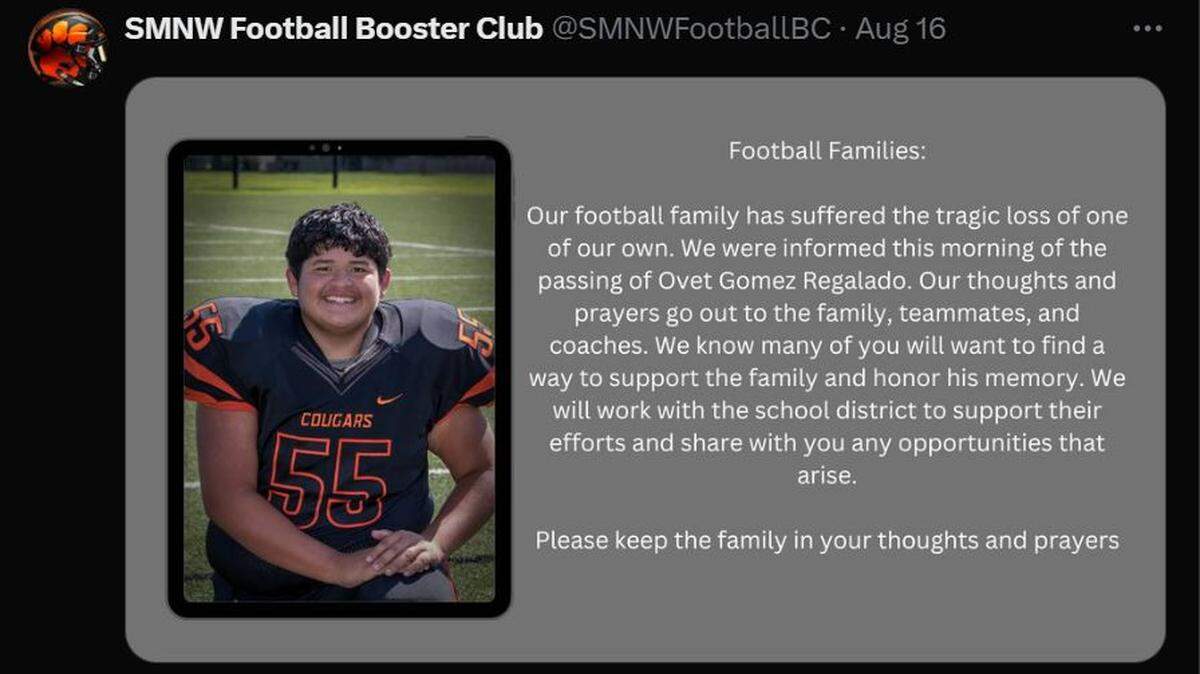
Ovet Gomez Regalado, a 15-year-old Shawnee Mission Northwest student, died in August from complications of heat stroke after collapsing during football practice, an autopsy concluded.
Emergency responders were called to the school on Aug. 14 at 5:15 p.m., arrived at 5:32 and transported the rising sophomore to a local hospital. Gomez Regalado died on Aug. 16.
The autopsy, conducted by the Johnson County Medical Examiner’s Office, said Gomez Regalado suffered a hyperthermic event, which means his body temperature became abnormally and dangerously high, after participating in a 15-minute exercise.
Staff reported Gomez Regalado was pale, sweating profusely and asking for water before he then collapsed.
The temperature outside during the evening practice was reported as 92 degrees, with humidity above 70% and a heat index of at least 112 degrees. A heat advisory had been issued for that afternoon.
Gomez Regalado’s body temperature was recorded at 104.6 degrees after ice bags were placed on him to cool him down. A core body temperature above 104 degrees is defined as heat stroke.
At the hospital, his temperature cooled to 98.1 degrees, but he had an altered mental status and fatigue with lactic acid buildup in the bloodstream, the report says.
Gomez Regalado was admitted to the pediatric intensive care unit where his health continued to decline, and his family only sought comfort care measures. The medical examiner’s report described the maner of death as an accident.
The report diagnosed Gomez Regalado with rhabdomyolysis, which it described as “a serious, potentially life-threatening condition that can be seen in situations of severe muscle exertion especially at higher temperatures.”
It said the condition causes “muscle breakdown,” which it said “can have catastrophic effects on organs such as the heart, liver, and kidney,” and noted his kidneys and liver were severely injured. His brain, heart and lungs were swollen, and he experienced multisystem organ failure, the report said.
Gomez Regalado had a history of obesity at 384 pounds and a reported sickle cell trait, according to the report, which it described as contributing factors.
Latest on other investigations
Shawnee Police and the Johnson County Medical Examiner’s Office have been jointly investigating Gomez Regalado’s death, and the Shawnee Mission School District conducted an internal investigation.
The medical examiner’s report said the police department was looking into “concerns of improper practice procedure.” It suggested the investigation may have concluded by saying, “These concerns were investigated by law enforcement, not the Medical Examiner’s Office.”
Shawnee Police did not respond Friday to The Star’s request for comment. On Monday, public safety information officer Emily Rittman responded, saying “the Shawnee Police Department’s investigation is closed with no further action taken.”
In a written statement, Shawnee Mission district spokesperson David Smith said the medical examiner’s report “reopens the painful wounds that came as a result of his premature death”.
“His absence is deeply felt in the Northwest community, and nowhere more profoundly than by his family, including his brother, who continues to attend Northwest,” Smith said.
“The entire Shawnee Mission School District remain heartbroken over the loss of Ovet and we continue to support each other through this difficult time,” Smith said.
In previous Star reporting, Smith said the district has a “standard protocol” that “would involve following up to understand what happened.” Emails asking for updates on the district’s investigation and the protocols used for such an investigation did not provide clear answers, with Smith at first responding that the district did not, in fact, have “a specific protocol for investigating ‘serious incidents.’”
Later, he clarified that, “In a situation like this, we do everything in our power to understand what happened, and why. We talk to everyone, and we look at everything that we can, to get the clearest understanding possible. I don’t see that as being specific, but it is certainly comprehensive.”
In Friday’s statement, Smith said the results from the district’s investigation are confidential since they involve private and sensitive student and personnel information. But he said the investigation found the actions of school staff in accordance with Kansas State High School Activities Association rules and school emergency action protocols.
KSHSAA does not investigate student deaths, or assess any disciplinary action. The association opts to work with the school district and law enforcement when necessary. In an email, KSHSAA assistant executive director Jeremy Holaday said there is no “set fine or punishment for something of this magnitude.”
“If any investigation shows us that there are breakdowns in procedure or policy, we would want to look at that as how we can improve from our end or did we learn something from a specific situation that our sports medicine advisory committee would want to address,” Holaday said in the email.
The family’s GoFundMe has raised more than $33,000 and is still receiving donations.
Previous reporting from The Star’s Sarah Ritter and Ilana Arougheti was used in this article.
This story was originally published October 11, 2024 at 5:06 PM.