
Stray goats have been roaming Kansas City’s riverfront. Why are they so hard to catch?
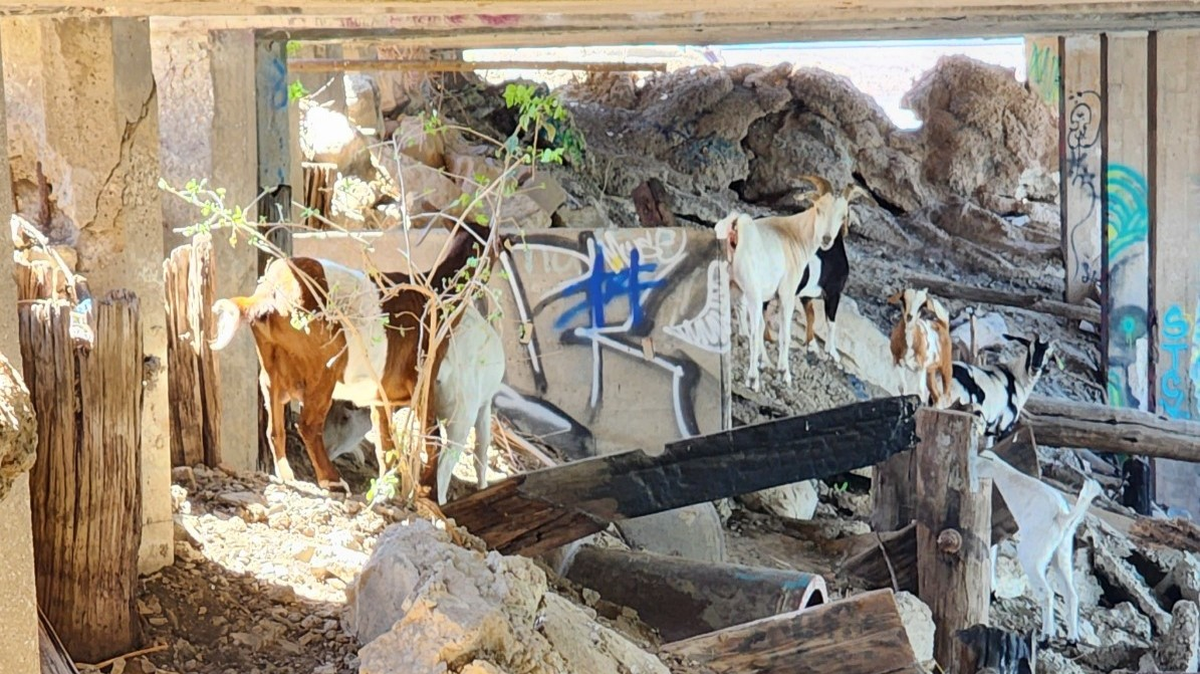
Goats have been roaming the Berkley Riverfront in Kansas City — and nobody seems to know who they belong to.
“It’s been a month and we still have goats,” said Meredith Hoenes, a spokesperson for Port KC.
Her group, which helps to facilitate development on the riverfront and elsewhere, brought in several dozen goats from Heirloom Farm in Pleasant Hill in mid-July to graze on weeds and other vegetation along the Riverfront Heritage Trail.
Goats offer an eco-friendly way to clear overgrown foliage without harming native plants.
Here’s the problem: The Heirloom Farm goats that Port KC hired in July were rounded up and taken home at the end of that month.
The goats still roaming are fugitives — but from where, no one can tell.
“This is a new one for me,” said Ryan Johnson, KC Pet Project’s chief of animal services. “Our team has been out there checking on them pretty much every day. … We’ve tried multiple times to do these capture efforts, but depending on where the goats are located, they pretty much have free range.”
Johnson said his officers have caught three goats so far, and he’s now hatching an ambitious plan to capture the remaining seven. Here’s what to know about the goats and the city’s efforts to round them up.
How many goats are still at large on Kansas City’s riverfront?
Johnson believes there are seven goats still roaming the riverfront after his team caught three in recent weeks. They started appearing around the time the riverfront grazing project was coming to a close.
“Two showed up at the beginning of August,” Hoenes of Port KC said. “A few days later it was five goats. The farm we contracted with was aiding Animal Services for about a week, but with little luck. Five turned to eight, and we’ve had reports of people claiming there were 12 goats.”
At first, officials thought the two bonus goats had escaped from another grazing project near City Market. But neither that project nor Heirloom Farm were missing any goats.
“We noticed extra goats beginning to move into our grazing area closer to the project end, but we were unsuccessful in figuring out whom they belonged to or where they came from,” Heirloom Farm owner Brianne Orr said.
“We were thankful to be able to retrieve all of ours, and we did try to capture the strays as well, but they are just so spooked by all the chaos downtown.”
The job of wrangling the goats has now fallen largely to the city’s Animal Services department, which is operated by KC Pet Project. And on Wednesday, Johnson plans to make what he hopes will by the final push to round up the rest of the goats with some help from his officers and Port KC employees.
Why is it so challenging to capture the stray goats?
So far, the riverfront goats have proven elusive. The three caught so far were difficult to corral, and Johnson says the whole group is reluctant to allow humans closer than around 50 feet.
“They’re very standoffish with us,” he said. “They really favor the steep, rocky banks right there (beside) the river.”
Goats are naturally skilled climbers, giving them access to areas humans can’t traverse. And they’re often elusive during the day, coming out to graze at dawn and dusk when the weather is cooler.
“We’ve been lucky enough to have had them confined to a fenced area a few times, and then we can get one to run up into the van,” Johnson said of the three captures his team has made so far. But to nab the remaining seven, he plans to assemble a larger team and stronger barriers.
Next week, animal service officers and Port KC employees will gather at the riverfront to physically herd the goats into a movable makeshift enclosure made from vehicles, trailers and wooden pallets. The group will convene at dawn, when the goats are out grazing, and hope to round them up before morning joggers and dog walkers hit the riverfront trail.
What happens when the goats are captured?
It’s still not known exactly who the goats belong to. While one of the three captured so far had a numbered ear tag, it offered no clues about the goat’s origins. Johnson’s team even consulted the U.S. Department of Agriculture, with no success.
Unless an owner comes forward, we may never know where the goats come from. Once captured, the animals will serve a five-day waiting period at KC Pet Project’s campus — specifically in the livestock field, affectionately named “the farm.”
If no one claims the goats during those five days, they will then be put up for adoption. The three captured so far were adopted out pretty quickly, Johnson said, so he doesn’t anticipate struggling to find the additional goats new homes.
In the meantime, he’s most concerned with the goats’ safety. He advised the public to keep their dogs on leashes when strolling the Riverfront Heritage Trail so they don’t chase or harass the goats.
He also asked the public to let KC Pet Project know if any goats appear injured or are wandering onto the nearby train tracks so animal services officers can intervene. You can reach KC Pet Project by calling 816-683-1383.
Do you have more questions about pets, livestock or wildlife in Kansas City? Ask the Service Journalism team at kcq@kcstar.com.
.jpg)