
Why your property taxes may still increase under Missouri’s senior tax freeze program
Recent updates to Missouri’s property tax freeze program for seniors have made many more homeowners eligible for the program.
But state laws and county-level policies mean that even if you are accepted into the program, your tax bills won’t stay exactly the same year after year.
There are a handful of scenarios that could cause your tax amount to grow or your “base year,” meaning the year your tax amount gets frozen in, to reset. Some of them have to do with changes in your own life, like getting a renovation done or separating from a spouse. The others depend on your county’s taxing jurisdictions and Missouri’s state debts.
Here’s a closer look at these circumstances, and what you can do to minimize their impact on your tax bill.
New construction on your home
Let’s say you want to add a sunroom to your house or make other improvements. Under the senior tax freeze plan, you’re free to do so — but your tax payment may increase to reflect the new, higher value of your home.
“If an eligible taxpayer makes new construction and improvements to such eligible taxpayer’s homestead, the real property tax liability for the taxpayer’s initial credit year shall be increased to reflect the real property tax liability attributable to such new construction and improvements,” the new updates to Missouri law read.
The law doesn’t define what counts as “new construction and improvements,” so that definition will be up to county assessors and collections officials to decide. We don’t yet know whether necessary structural repairs or upgrades will count as “improvements” that could increase your tax bill under the program.
Annexation by a new taxing jurisdiction
A taxing jurisdiction is a public service that covers a specific geographical area, like a school district, the coverage area of a fire department, a local library district or a water service district.
Each home falls under an overlapping combination of all these districts, and together they determine the property tax rate you pay on your home. But what happens when these geographic areas change?
Under Missouri’s new provisions, annexation by a new taxing jurisdiction can increase your property taxes even if you’re enrolled in the senior tax freeze program.
Here’s an example: Let’s say your local elementary school closes down. As a result, the other nearby elementary schools will increase the size of their coverage areas to ensure everyone in the community still has a place to send their young children. That’s what the law means by “annexation” — another school’s area will expand to include your neighborhood.
But that other school may need a larger budget than your local, now-closed school did. If that’s the case, your taxes could go up in order to help fully fund its services — even if your taxes are supposedly “frozen” under the state program.
Debt obligations and the blind pension
While the property tax freeze program covers the amounts levied by most taxing jurisdictions, there are a few categories that will continue to change on every homeowner’s bill — regardless of whether they’re enrolled on the senior tax freeze program or not.
The two to keep an eye on: debt obligations and the state Blind Pension, called the “state tax” on property tax bills.
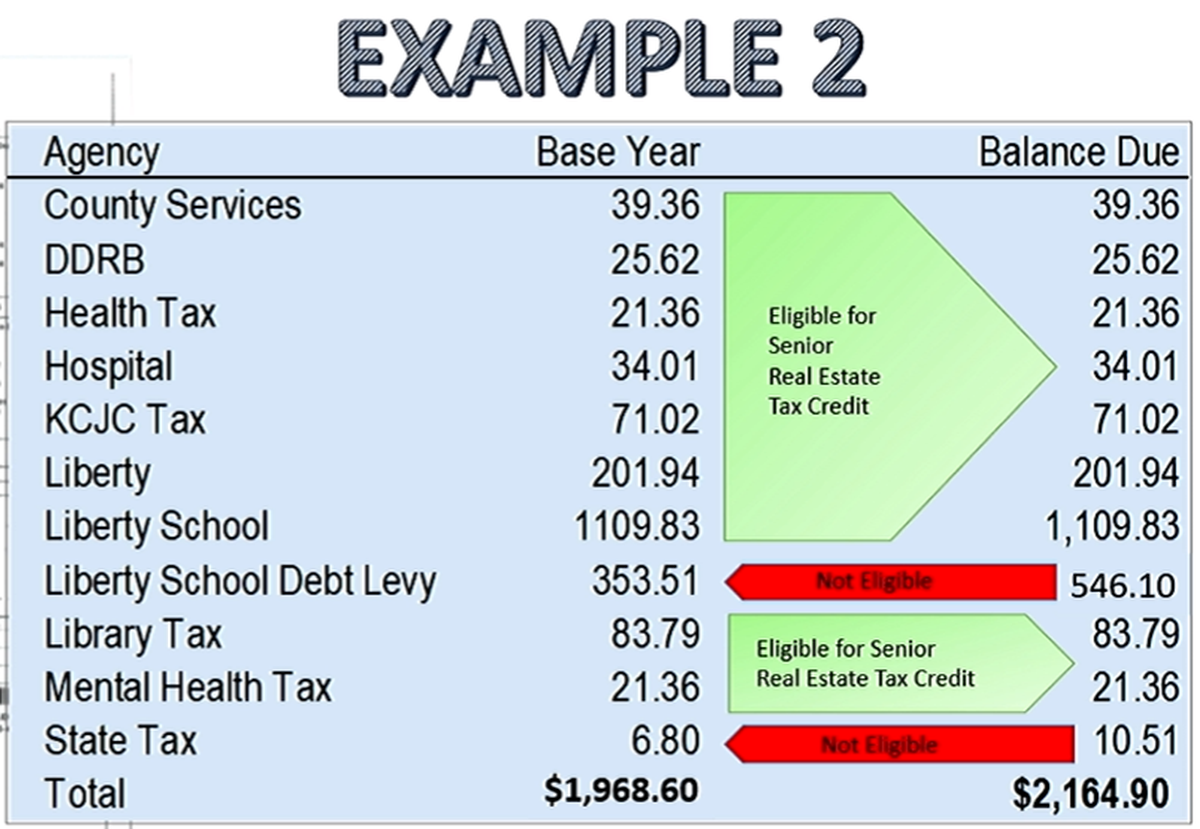
“Both of those are considered constitutionally protected, so they are not eligible for this program,” said DeEtta Jabobs, a Clay County administrative services officer, in a presentation to county commissioners last week. “Those two taxes will continue to increase.”
These items on your tax bill generally don’t make up a huge portion of the total amount. But because they’re enshrined in Missouri’s constitution, the tax freeze program legislation can’t modify them.
“Unfortunately, based on the questions we’re getting, there’s a lot of confusion about what their tax bill is going to look like,” Jacobs added. “A lot of (homeowners) believe it’s going to be exactly the same as it was in 2024, or in their base year.”
Departure of the eligible applicant
A major change Missouri legislators recently made to the senior property tax freeze program was by redefining who counts as an “eligible taxpayer.” The guidelines now state that homeowners must merely be responsible for paying the taxes on their home, that it must be their primary residence and that they must be at least 62 years old.
But this age restriction introduces a challenge for some couples who own a home jointly if one partner is 62 or older, but the other is not.
In this situation, the older partner can apply for the senior property tax freeze program and get their home’s tax amount mostly frozen — with the exception of scenarios like new construction, annexation by a new taxing jurisdiction or certain constitutionally-protected taxes increasing.
But if that older partner later dies or moves away, the younger partner may have to reapply for the program as a new applicant — and could see their taxes re-freeze at a new, much higher amount.
Counties are still working on how to resolve this thorny problem. Jackson and Platte County officials haven’t responded to requests for comment on how they plan to prevent divorced or widowed homeowners from seeing a huge increase in their taxes.
But Jacobs said that Clay County is advising couples to add the younger partner to the program application once they turn 62 in order to avoid a sudden tax increase if the spouse who originally applied for the program dies.
“The last thing we want is to spring that on someone who is grieving a loss,” she said.
Here’s an example: Let’s say that Mike is 62 and his husband, Tim, is 60. Mike can apply for the senior tax freeze program this year, and get the property taxes on the couple’s home frozen at their 2024 bill amount of $1,000.
Two years from now, Tim will turn 62 and become eligible for the program also. The couple could do nothing and keep their taxes frozen based on Mike’s eligibility — but if Mike dies 10 years later, in 2036, Tim will then have to apply to the tax freeze program for the first time.
In this scenario, even though his home would have been enrolled in the program for more than a decade, Tim would suddenly have his taxes frozen at a 2036 amount — which could be far more than $1,000.
Clay County’s solution: Mike and Tim should modify their tax freeze program application with the county as soon as Tim turns 62. That way, if Mike moves away or dies, the program eligibility can be transferred into Tim’s name without restarting the clock on when the household became eligible.
There are still some kinks to work out in this system — for instance, both partners need to have their names on the deed to the house in order to add the younger partner to a Clay County application when they turn 62. But this system at least allows the frozen tax amount to transfer between joint homeowners in case tragedy strikes.
We don’t know yet how other counties intend to handle this issue. Reach out to your county collections office for more information on its specific implementation of the program.
Do you have more questions about the senior property tax freeze program in Missouri? Contact the author of this piece directly at nwallington@kcstar.com.
.jpg)