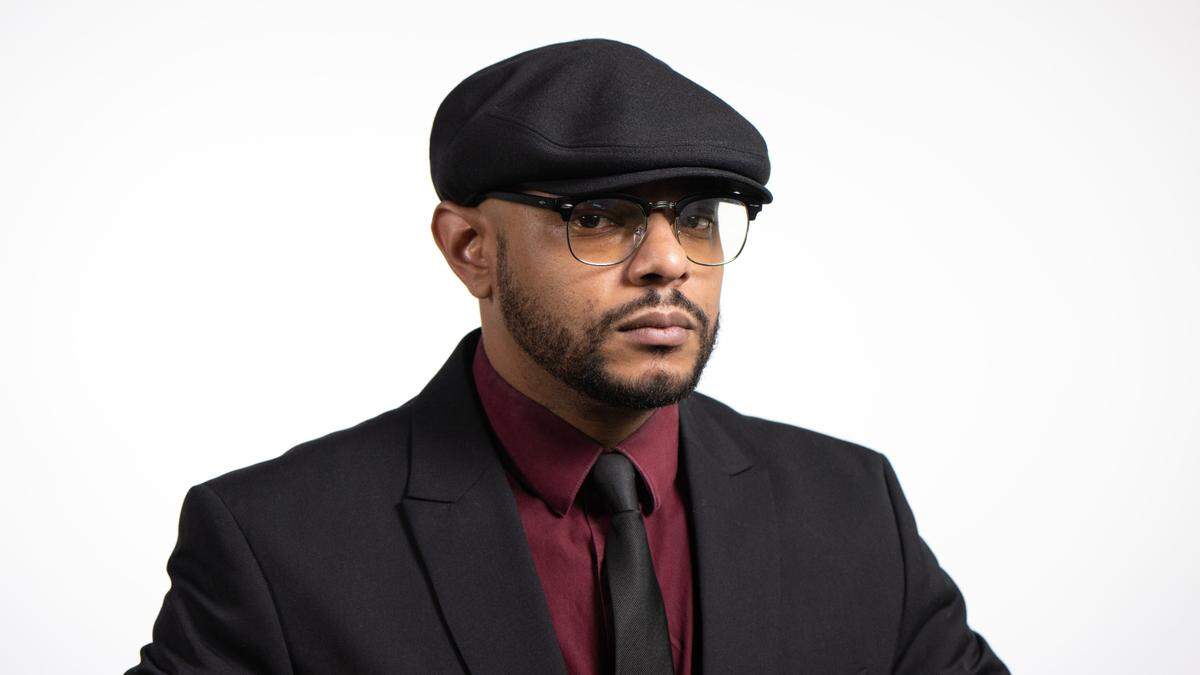
Cowboys have always been Black. This KC rancher wants everyone to know that history
Trae Q.L. Venerable wears a lot of hats, both literally and figuratively. This all-around Black Kansas City outdoorsman, educator, author, rancher and horseman is proud of his extensive cowboy hat collection and not because it’s a hobby. He’s a cowboy, like his daddy and his daddy’s daddy. The men on his mother’s side were cowboys, too, so he grew up ranching in a life rich in cowboy culture.
Hollywood got it wrong, depicting an all-white, horse-and-cow-wrangling Old West. And Lil’ Nas X and Beyonce wearing cowboy hats, boots and singing country western is not as much of an aberration for Black Americans as folks have made it seem.
Cowboys were Black and, for several years now, Venerable has been working at making sure everyone knows this American history.
Growing up with the full farm life experience, Venerable, a 29-year-old Olathe native, knew from a young age that the job of a cowboy was hard work: Waking up at the crack of dawn to feed livestock, working the land, tending to crops, cleaning and maintaining buildings in any weather.
But he didn’t have much interest in embracing the lifestyle until he got to middle school.
“When I was younger, I actually didn’t care much about the cowboy stuff,” said Venerable. “It wasn’t until one day I had this revelation of how cool this culture is and that it needs to be preserved, and how hard my family has fought to preserve it.”
Venerable’s family owns a main ranch in Hartville, Missouri. They also lease two smaller properties in the surrounding KC area to accommodate the over 700 cattle and over a dozen horses housed on the property. As Venerable prepared recently for an upcoming horse show, located two hours outside of Kansas City, he was well aware that he would be one of only a few, if not the only, Black ranchers there.
But since Kansas City was a central stop for settlers from the East traveling west to mine, farm and ranch, it makes sense that descendants of cowboys, who also were key to the Wild West story, might be settled in this area today. Many of those men we know as cowboys today were Black. That’s why Vernerable, and others like him from the Kansas City region and elsewhere, are out to tell the truth about America’s cowboys and the role of Black Americans in forming the West.
Kansas City native Ivan McClellan, a professional photographer, grew up loving cowboy culture but didn’t see much representation from people who looked like him. McClellan, author of “Eight Seconds: Black Rodeo Culture: Photographs” has gone on to document the Black rodeo experience.
Like Venerable, McClellan knows the importance of Black children knowing about the existence of Black cowboys and their place in the building of America.
Black cowboys were legendary
In 2017, Venerable started his series of children’s books call “Grandpa I Just Wanna be a Cowboy” that introduces young readers to notable Black figures from the Wild West like Bass Reeves and Nat Love.
Both Reeves and Love were expert horsemen and marksmen who gained respect and notoriety in the West through their skill and work ethic. Born into slavery, Reeves became one of the first Black deputy U.S. Marshals in the West. He was renowned for bringing over 3,000 criminals to justice. Some historians and authors have said Reeves was the inspiration for the fictional radio, television and movie character “Lone Ranger,” the masked Texas ranger who fought outlaws in the American Old West. On the screen, the Lone Ranger was always a white man.
Venerable says that studies, like one discussed in the Smithsonian Magazine, show historians estimate that after the Civil War when the Wild West really began to flourish, “around one in four cowboys were Black.” But despite that, Black cowboys have not been included in the current popular narrative, thanks in part to exclusionary practices in Hollywood.
Venerable, who works for the Kansas City National Security Campus as a health, safety and environment engineer, said he believes those numbers to be much higher.
The truth, historians say, is that trail riding and tending to cows was a dirty, dangerous job that paid very little, so it was often done by former slaves or the sons of former slaves. Those Black riders greatly impacted the world of rodeo. The technique known as bulldogging (grabbing cattle by their horns and wrestling them to the ground) was created by William “Bill” Pickett, a Black rodeo rider and cowboy, whose parents had been enslaved.
The word “cowboy” is derived from the fact that the men who tended to the cattle on ranches owned by white families were demeaningly referred to by the white ranch owners as “cow boys.”
“The technical definition of a cowboy is just someone who tends to cows or a horseman,” said Venerable, who also wrote the book “MidWest CowPoke,” which was released in 2018 and details his experiences as a Black cowboy. “To me, being a cowboy is embarking on everything you do and doing it to the best of your abilities. It means embracing being a pioneer and blazing new territory to put your mark on.”
Kansas City, which was a prime stop on the Santa Fe, California and Oregon trails into the West, has a long history with this Western culture. One of the biggest events in the city every year is the American Royal, a livestock show, rodeo, and barbecue competition.
Feeling out of place
McClellan remembers his grandmother taking him, as a child, to the American Royal. He loved being around the horses and the excitement of the event but always remembers feeling out of place.
“I remember it being a very white place and a place I didn’t particularly feel comfortable,” said McClellan. “Nothing ever happened but it didn’t feel like home.”
Understanding that most people simply don’t know about the contributions of Black cowboys and ranchers, Venerable tries to educate whenever possible.
Venerable, who most of the time can be found wearing jeans, one of his cowboy hats and a pair of animal skin boots from his boot collection, feels a deep cultural connection to his look. Although he can usually find humor in those who see his appearance as something out of the ordinary, he recalls the many times people have misrepresented his attire as just some fresh fashion trend he was undertaking.
“I try to bring enlightenment to people about Black cowboys when I can, but I deal with a lot of microaggressions,” he said. “People would come up and say to me that they like my costume or it is early for Halloween. It is so offensive.
“I never really let myself get too upset, until someone tells me Black cowboys aren’t real or didn’t exist. Then my blood begins to boil.”
Venerable says that once the image of the modern cowboy became glamorized by Hollywood, the image of Black cowboys began to disappear. He remembers when the film “Django Unchained” was released and the impact it had on him finally seen a film adaptation of a Black cowboy who rose from slavery and learned the ways of the West to build a future.
Being a cowboy isn’t just about the hat or the boots, Venerable said. For him it’s about the character of a person who works hard to accomplish their goals.
In recent years, the interest in Black cowboy culture has grown because of music projects such as Lil Nas X’s 2018 hit song, “Old Town Road,” and Beyonce’s country-themed “Cowboy Carter” album that was released earlier this year. The films “The Harder They Fall” and Jordan Peele’s “Nope,“ about a Black family living on their inherited horse ranch in Agua Dulce, California, also added to the buzz.
Growing up, McClellan never saw a Black cowboy and believed he was always bound to be the odd man out at events like Kansas City’s American Royal. Years later though, as a professional photographer, a friend invited him to a Black rodeo. That was 2015.
He’d never heard of such a thing and was unsure what to expect. What McClellan saw that day changed his outlook and rekindled a love of western and cowboy culture that he hadn’t felt since he was a child.
“I saw thousands of Black folks riding horses, women riding around barrels at 50 miles an hour with their braids blowing out behind them and acrylic nails holding the reins. It was Black culture mixed with western culture in a way that was exciting to me.”
.JPG "image_6483441 (87).JPG")
Documenting cowboys and rodeos
After that experience, McClellan found himself drawn to the Black rodeo. He returned several times to that first Black rodeo, and before he knew it, he was tracking down others and capturing the essence of the rodeos he had dreamed of as a kid in his photographs.
McClellan said he believes that rodeos still carry a stigma as “white people stuff,” but he is confident that once first-time Black rodeo goers experience it, they’ll be hooked.
“The smell of food, smoked turkey legs, fried chicken and barbecue. The music with hip-hop, blues and R&B mingling together. All of it felt familiar but a completely brand-new thing. Everybody needs to experience one,” he said.
Now a resident of Portland, Oregon, McClellan is doing his part to introduce Black rodeo to more people. He founded the Eight Seconds Rodeo, the biggest all-Black rodeo in the Pacific Northwest. It’s held annually in Oregon, but McClellan says he wants to one day bring it home to Kansas City.
And his photography project, well, it has become a book, “Eight Seconds: Black Rodeo Culture: Photographs.”
.JPG "image_6483441 (88).JPG")
McClellan wanted to show the world that Black western culture exists and is thriving. He traveled around the country with the goal of shedding light on the world of Black cowboys and elevating stories that are just now being told.
A Portland director, Charles Perry, is making the documentary film “The Black Cowboy.”
For both Venerable and McClellan, education and experience are key to longevity in their effort to preserve and share the Black cowboy culture. The first step is letting kids know that Black cowboys do exist and they have been around for a long while.
That’s happening in Kansas City, where local organizations like the Show Me Riders, a saddle club, has been introducing horsemanship to the urban core and fostering a love of equine-related activities for years.
Gerald McClendon, a retired U.S. Army veteran of 30 years, was a Show Me Rider for over a decade and brings horses and ponies to the Historic 18th and Vine Jazz District during First Friday events so that children can see him with them up close. The 60-year-old horseman is proud to be apart of the metro’s small group of Black horse enthusiasts working to bring in a new generation of riders.
.JPG "image_6487327 (23).JPG")
“I have been doing this for years and love to be able to give the kids this opportunity,” said McClendon. “I think we have to press the importance of giving kids the chance to experience riding because, after they are exposed, they don’t want to stop.”
The creator of Horses R Us, a Pleasant Valley ranch offering horse boarding and riding lessons, McClendon has bought and sold horses since 1998. He currently owns seven horses and four ponies.
McClendon is happy to see the growing number of Black horse owners in the KC area. He personally knows more than 70 of the owners and estimates that hundreds of other Black residents are riders but don’t own their own animal.
“Black cowboy culture is a hot topic right now, and I don’t think it is a frying pan moment. And I think this will be here for a while,” Venerable said. “I tell stories of Black cowboys, ranchers and pioneers that have never been told before, because that’s what we have to do to preserve history and engage not just our community but a lot of other communities, too.”
This story was originally published July 15, 2024 at 5:30 AM.