
Does Evergy trim trees before they fall on power lines? How to report potential hazards
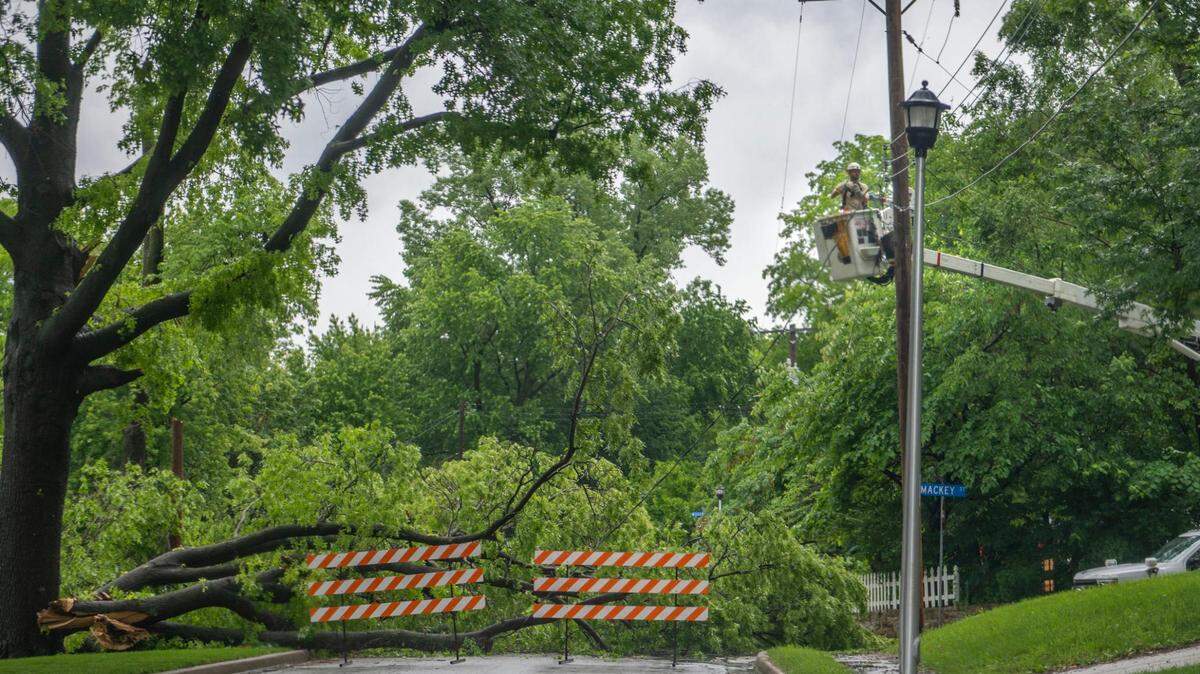
His official title is Director of Distribution Contractor Operations — but most of his colleagues at electricity giant Evergy know him as the “tree guy.”
David Martin oversees the crews that do maintenance on trees and other vegetation throughout the company’s service area in eastern Kansas and western Missouri. It’s all part of a year-round mission to prevent power outages caused by falling limbs, downed trees, climbing vines and other natural hazards.
“We have a small army of folks out there every single day doing that preventative maintenance,” Martin told The Star. “If you don’t see them, it’s easy to think it’s not happening. But it is happening every single day.”
As storm season arrives in the metro and plunges whole neighborhoods into darkness, The Star has heard from readers wondering what Evergy does to curb power outages before they happen.
Here’s a closer look at how the company trims and removes problem trees before they bring down power lines.
How does Evergy’s tree maintenance program work?
Evergy’s service area across Kansas and Missouri contains around 35,000 miles of power lines — and keeping trees away from them all is no easy feat.
Martin told The Star that Evergy contracts with local tree service companies to remove hazards along roughly 6,000 miles of lines per year. They cycle through the full network of wires every five to six years.
Any dead branches or trees that look liable to fall, limbs growing too close to electrified wires and trees with serious defects like internal rot or splits from lightning are marked for trimming or removal.
Eight Evergy supervisors plan maintenance routes and dispatch the company’s 175 contracted crews, which employ around 500 workers. The company also contracts with around 50 tree inspectors. Their job is to assess each tree on the route and determine whether it poses a risk to electrical wires in the area.
If a tree qualifies for a full removal, Evergy first must get permission from the landowner before taking it down. Martin said that while local governments and public entities generally agree to the company’s plans, around 80% of private landowners never give their permission to have their tree removed. Many never answer Evergy’s requests at all.
As a result, the company removes around 35,000 trees per year — but the number the company wants to remove annually is closer to 175,000. Evergy also trims around 315,000 more trees every year along its pre-scheduled maintenance routes.
Customers can also call in potential hazards to be removed before they cause an outage.
How do I report a hazardous tree in my area?
If you have a dead, hanging or hazardous branch or tree near power lines in your area, you can tell the company about it by calling 888-471-5275. You can also submit an online request on Evergy’s website for an inspector to check out the hazard in person.
The hazard you report can be anywhere in Evergy’s service area. Martin says he has an employee whose job is to monitor the company’s database of customer submissions in order to prioritize where they send crews first.
“We would prioritize those based on the immediacy of the hazard, regardless of how many customers are going to be impacted,” he told The Star. That means a severely damaged tree or a dangling branch can get moved to the front of the line so crews can get it down before it falls.
Evergy currently maintains a 7-14 day turnaround time for the company to visit and assess dangerous tree conditions, although this can vary in the aftermath of severe weather events.
Two thirds of the calls Martin’s division receives aren’t hazards to electrical wires — instead, a branch might be getting close to “comms wires” carrying internet or phone service. These wires are important, but they won’t cause a widespread power outage if they go down.
Still, it’s difficult for the average person to tell the difference between a charged electrical wire and other types of wires on the same utility pole. For that reason, Martin advised customers to let Evergy come out and assess the hazard for themselves.
“The public does a good job of letting us know when there is a hazard,” he said. “I’d rather folks over report things than not report them at all.”
Tell the Service Journalism team about your experiences with tree maintenance and power outages in the Kansas City area at kcq@kcstar.com.
.jpg)