‘It’s rare what we have’: These Vietnam vets share sorrow, brotherhood in Kansas City
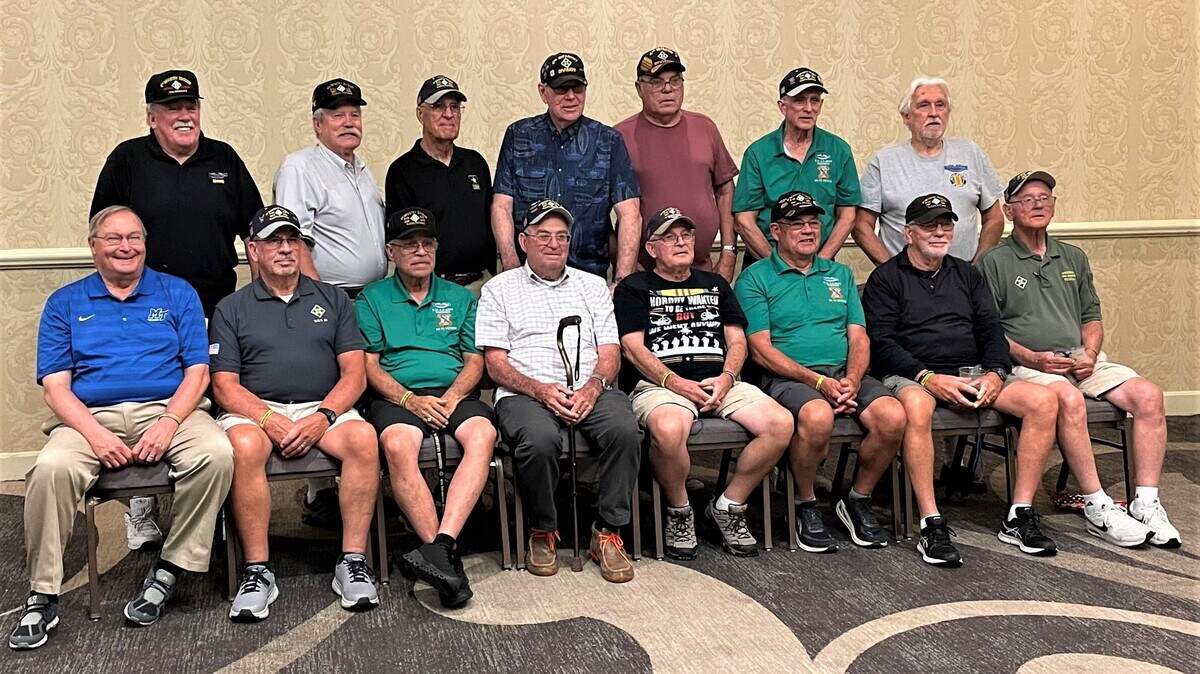
As a conga line of septuagenarian veterans snaked gingerly across the dance floor of the Kansa Ballroom at the Hilton Kansas City Airport hotel, the surviving members of B Company, 2nd Battalion, 8th Regiment, 4th Infantry Division stood around a circular table in a conference room across the hall and paused for a moment of silence. It had been three years since they’d last met, and they were down five men, COVID-19 having done to Porter, Starkey and the others what firefights in the thick jungles of Vietnam could not.
They’d come to Kansas City for last week’s national reunion of the 4th Infantry Division Association, and they’d participated in several of its organized events: field trips to Fort Leavenworth, the National WWI Museum and Memorial and the Steamboat Arabia.
But they also maintained an arm’s-length detachment from the larger group. They shared with the veterans dancing to “Locomotion” over in the ballroom the general experience of fighting in the 4th Infantry Division, but the division numbered in the thousands; 2,500 alone were killed in action. These men, the men of B Company, were all part of the same small combat unit in the Central Highlands of Vietnam from late 1967 to early 1969. They had fought on the same bloody battlefields. They had watched the same men die.
“It’s rare, what we have here,” said Steve Wittenberg, who’d come from Delaware. “You gotta understand, in Vietnam, that’s a one-year tour of duty. When it’s your time to leave, a helicopter comes in, somebody hollers out your name, you jump on the bird and you’re gone. Most of the time you don’t say to your fellow infantrymen, ‘Give me your name and address, I’ll call you.’ So a lot of people, they lose touch after the war.”
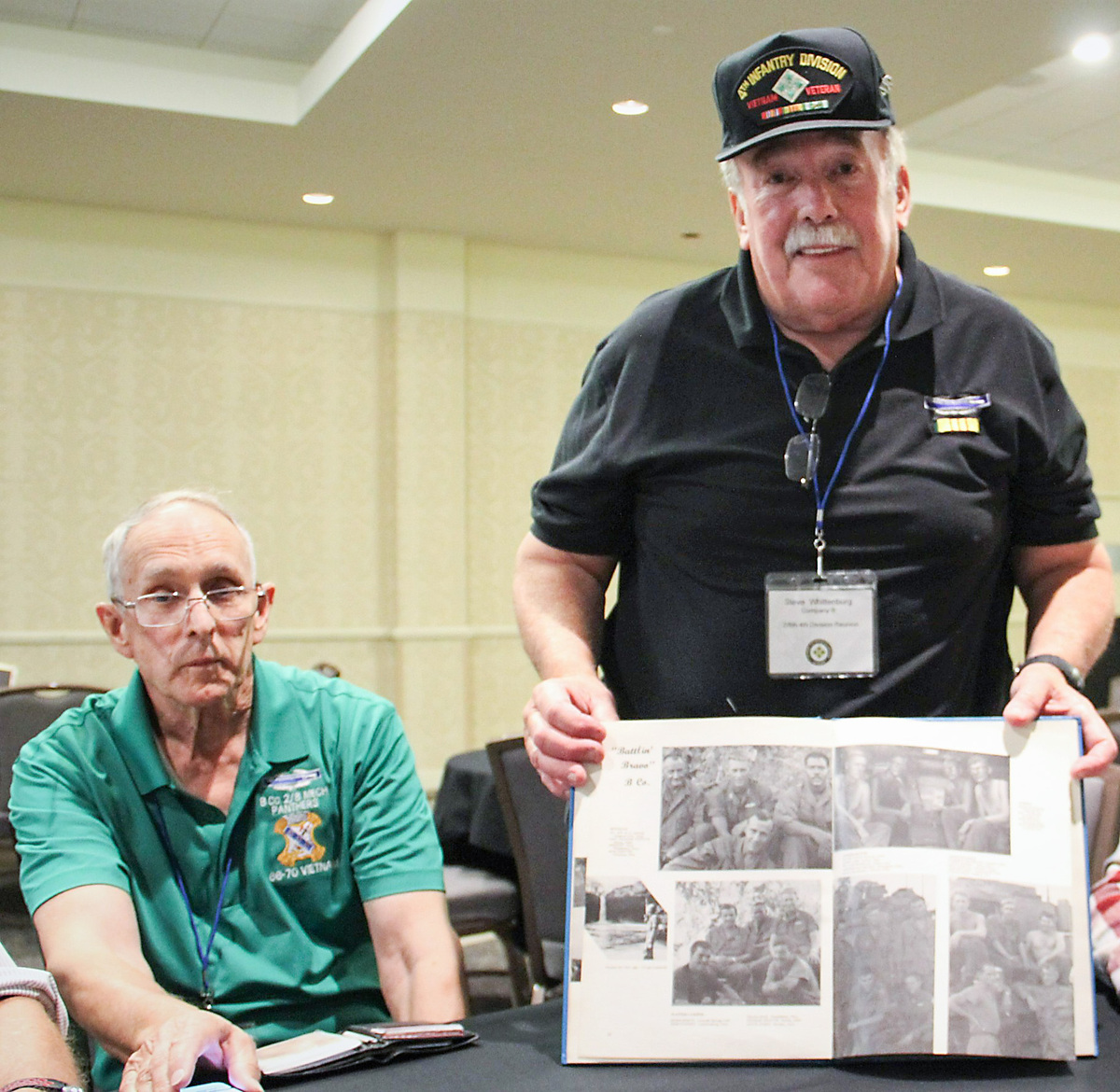
Were it not for Larry Dobbs, a medic in the 2nd Battalion, their company likely would have drifted apart like so many others. Dobbs, whose parents published high school photo albums and yearbooks, was given permission by the battalion commander to take pictures of A, B and C companies for a photo album to be distributed back home. “Probably one of the only yearbooks ever made in a combat zone,” Wittenberg said.
Fifteen years later, Wittenberg bumped into Mike Hughes, another member of B Company, by chance at a New York City parade honoring Vietnam veterans. They started talking about how to get B Company together again and realized that the yearbook listed the names and hometowns of the company’s soldiers. They began using it as a kind of Rosetta stone to track people down.
After four months of calls to information operators across the country, they’d found 70 of the company’s approximately 110 soldiers. They gathered the following year at the Vietnam Veterans Memorial Wall in Washington, D.C., and have been regularly traveling to meet up ever since, often at the 4th Infantry Division Association’s annual reunion but not always.
About 25 men from B Company made the trip to Kansas City, from all over the country: California, Montana, Virginia, Ohio, Chicago, Connecticut. Most wore navy blue military hats with service pins fastened to the sides. Some brought their wives.
“We never used to allow the wives,” Wittenberg said. “We didn’t feel we could talk about a lot of the things we talk about in front of them. Over the years, though, it got to where there were a few we couldn’t hold back. And now it’s part of it — part of the therapy of this.”
Mostly they brought stories, which they passed around along with chocolate cake and refreshments after the business of paying tribute to their fallen comrades was done. They recalled the contents of their C-Rations, military-issued meal supplies dropped by helicopter. “The ones I ate, I’m pretty sure they were left over from the Korean War,” joked Bill Douglass, who’d driven up from El Dorado, Kansas.
Dave Ciosek, a platoon leader who later flew helicopters for the CIA and reached the rank of colonel, offered a reasonable and slightly disgusting explanation for how their entire company contracted amoebic dysentery. He waved away dissenters who posited alternative theories.
Wittenberg pointed on a map to the Central Highlands. “You see how close it is to Cambodia,” he said. “Mr. Nixon told the world we didn’t go there. But we absolutely did. It wasn’t like you were looking for trouble, but if you got shot at from there, you were gonna go pursue.”
All the wisecracking and interrupting died down when John Shaeffer spoke. Shaeffer was their XO, or executive officer, the highest-ranking man in the company. In a soft but steady voice, Shaeffer told a story about B Company intercepting a North Vietnamese unit on its way to Pleiku during the Tet Offensive. An all-day battle outside a large tea plantation ensued.
“That was really … that was really quite something,” Shaeffer said. He pointed at the men gathered around the table, the boys he’d led on that day 54 years ago. “Bill was there, you were there, he was there, he was there, he was there.” He paused. “Those North Vietnamese, that unit, they didn’t make it to Pleiku.”
After the war, B Company members became long-haul truckers and insurance salesmen, UPS workers and bankers. Some stayed in the service. Many came to hold critical views of America’s foreign wars and the politicians who pursued them.
“Republican or Democrat, these days you get elected because you are rich — that is just how it works now,” said Andy Womack, who served as a Tennessee state senator from 1988 to 2000. “Which means the people making decisions don’t understand wars, because they’ve never participated in one. And the truth is, once we go into these places, whether it’s Vietnam or Afghanistan or Iraq, we don’t know how to get out.”
“I contend we’ve screwed up from Korea on,” said Douglass. “I watched us leave Afghanistan last year and to me it looked just the same as us leaving Vietnam.”
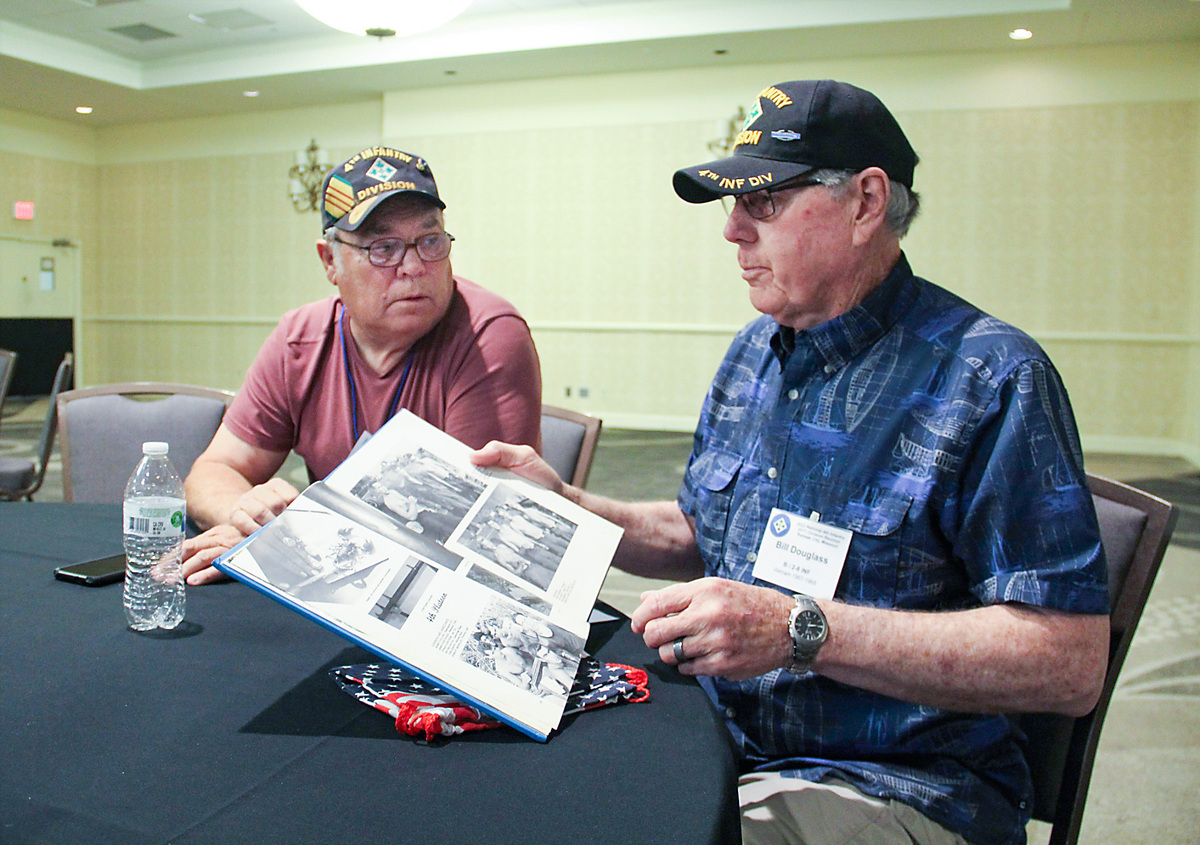
Douglass had brought up from El Dorado a briefcase filled with rolled-up maps and fading Polaroids, some of which he thought twice about sharing with the visitor. “You probably wouldn’t enjoy looking at photos of dead people,” Douglass said quietly, stashing them back in his briefcase.
But other photos were portals to happier memories, like a shot of Douglass holding a 50-caliber gun while astride an armored personnel carrier. Planted on the military vehicle is the state flag of Kansas, twisting in the wind.
“My brother Bobby Douglass was quarterback at KU at the time,” said Douglass, who himself played defensive end for the undefeated University of Arkansas Razorbacks national championship team of 1964. “And I wrote him a letter saying that our XO had a Mississippi flag and another guy had a Texas flag and I didn’t have anything. So he called the governor of Kansas, who had that sent to me.”
It was getting late. The 4th Infantry Division Association reunion had a few more days of events on the schedule, but several members of B Company were leaving Kansas City the following morning. Goodbyes were exchanged, along with reassurances that they would see one another next year in Dayton.
“The Vietnam Veterans of America, the organization, they put out a newsletter every two months, and in the back is a section called Taps, which is the names of those who’ve passed away,” Wittenberg said. “And I’ve been watching it the last five years, and it is very rare to see somebody’s name who made it past the age of 80. Is it Agent Orange? Is it distress? Is it that we just watched Afghanistan go down the toilet like ours did? We don’t really know. So we’re thrilled to have these reunions. Because we don’t think we got a lot of time left.”