
On The Vine: ‘Ain’t I a Woman?’

“Well, children, where there is so much racket there must be something out of kilter.”
You know Sojourner Truth? In 1851 she’s said to have delivered that line as part of her aptly-named “Ain’t I a Woman?” speech at the Women’s Rights Convention in Akron, Ohio.
At the core of Truth’s extemporaneous speech was the germ of intersectionality (about 140 years before Kimberlé Williams Crenshaw coined the term).
Truth’s point: women can achieve greatness — change the world — and her Blackness made her no less of a woman; entitled her to no less than what they were fighting for.
“That man over there says that women need to be helped into carriages, and lifted over ditches, and to have the best place everywhere. Nobody ever helps me into carriages, or over mud-puddles, or gives me any best place! And ain’t I a woman?”
Truth’s words have stuck with me this week, following a weekend of women’s rallies across the metro. There were two visibly prominent ones: One we covered, the other we did not. The rally we did not cover was one organized by a handful of Black-led women’s groups.
We weren’t aware until after the fact there were two distinctly different rallies, the nuances surrounding the organization of which, was of immense importance. No one made us aware of the Reale Justice Network’s rally. However, we also did not go out of our way to be aware, and the result was a lack of a core collective voice.
Black women have, historically been left out of these conversations. They’ve been actively ignored and worse used simply for optics or to perpetuate a narrative while their voices go unheard.
Intersectionality within the women’s movement has been an issue for years — about a hundred-plus if you could ask Sojourner Truth.
Did you know that she probably never even said, “Ain’t I a Woman?” Really, the speech she gave was likely much different (you can read all about that here). Historians — most notably Princeton University professor Nell Irvin Painter — believe that a white abolitionist named Frances Dana Barker Gage, who was present that day in 1851, not only changed Truth’s words but, according to The Sojourner Truth Project, chose to represent her speaking in a stereotypical southern black slave accent, rather than the distinct upper New York State low-Dutch accent Truth would have used.
History is a mirror.
Around the block
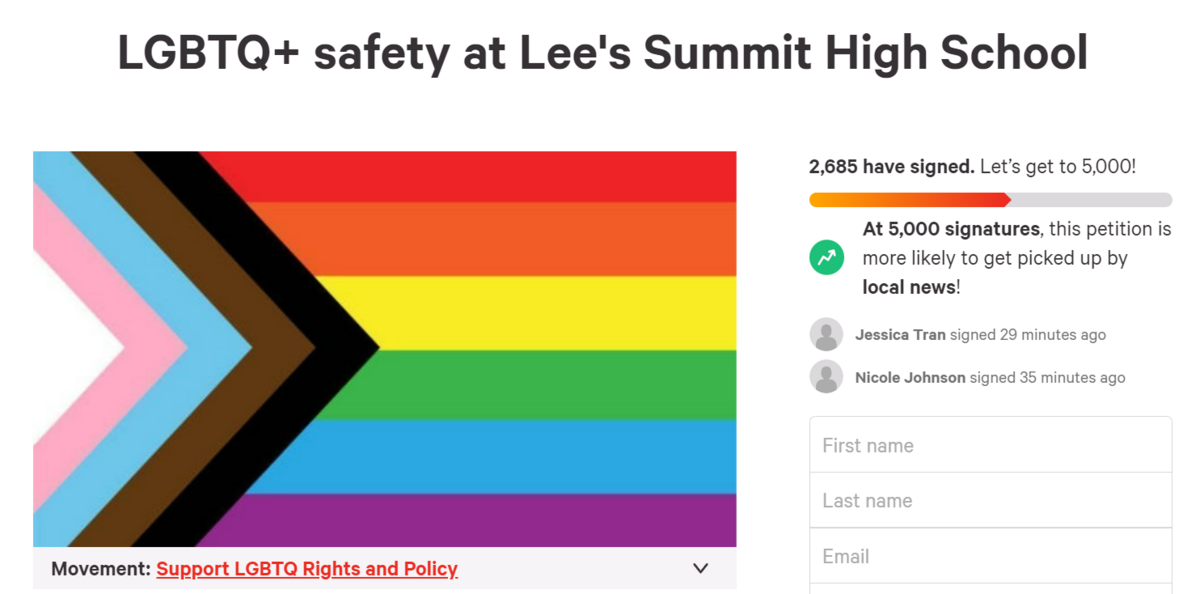
Lee’s Summit students walk out of class after alleged fight, bullying of LGBTQ student
Maybe it’s been a while since I’ve been in public school, but students have been wilin’ lately... not that adults are any less hateful.
Sarah Ritter writes for The Star:
Hundreds of students walked out of Lee’s Summit High School on Monday in support of a gay student who has allegedly faced harassment and bullying, leading to a recent fight that left one student injured.
Danny Lillis, a senior who is gay, said that since the beginning of the school year, he and his friends have been targeted and bullied by another group of students.
“They have given them a hard time for Danny being gay, for him wearing makeup to school, for him expressing himself,” said Melanie Davies, mother of Lillis’ friend Malani Hohlbaugh.
Lillis said that the group of students had routinely spouted hateful remarks and thrown food at them. He claimed that he went to administrators at least four times to report the incidents, “crying, saying ‘I don’t feel safe’ repeatedly. And nothing changed.”
Check this out too...
‘It is dangerous’: Johnson County city closer to banning LGBTQ conversion therapy
It’s not OK for this Missouri university to let a known sex offender back on campus
Missouri’s new strategy to remove Planned Parenthood from Medicaid: health inspections
Beyond the block
Remote Work Has Vastly Improved the Black Worker Experience
No comment.
Matthew Boyle reports for Bloomberg:
Working remotely has its downsides: Cramped apartments, endless Zoom calls, juggling child care duties. But for many Black workers in white-collar jobs, getting out of the office has resulted in a vast improvement in their employee experience.
Over the past year, Black workers in so-called “knowledge” roles, like graphic design or data analysis, are more likely to say they’ve been treated more fairly, value their co-workers more and feel more supported by management, according to a survey by the Future Forum, a research consortium created by software maker Slack Technologies.
The survey of more than 10,000 people saw a 26 percentage point increase in Black respondents reporting “I am treated fairly at work” from a year ago, and similarly big jumps in other questions about their work lives. Overall, Black workers in the U.S. said their job experience was steadily improving, while responses plateaued among other racial groups in the most recent survey.
Give this a read...
For the culture

Books by Black authors that celebrate love, culture and joy
I don’t know about you, but I am tired. I’m tired like sleep can’t fix. I’ve been looking for things that provide a jolt and keep coming back to the fleeting moments explorations of Black joy and stories seem to offer in spades.
I’m also trying to read more, get lost in words and work my mind differently rather than relying as much on my couch and TV. I’m currently ready Yaa Gyasi’s “Homecoming,” though I’m almost to the end and will be on the prowl for what’s next.
So, naturally, I stumbled upon this list from Cosmopolitan offering a few titles of Black books that hopefully have in spades exactly what I’m looking for.
- “Loud Black Girls” by Elizabeth Uviebinené and Yomi Adegoke
“Children of Blood and Bone” by Tomi Adeyemi
“Manchester Happened” by Jennifer Nansubuga Makumbi
“My Sister, the Serial Killer” by Oyinkan Braithwaite
“Like a Mule Bringing Ice Cream to the Sun” by Sarah Ladipo Manyika
“Seven Days in June” by Tia Williams
“The Girl with the Louding Voice” by Abi Daré
“Love in Colour” by Bolu Babalola
Sign off
Did someone forward this newsletter to you? You can sign-up here. If you’d prefer to unsubscribe from this newsletter, you can do so at any time using the “Unsubscribe” link at the bottom of this message.