
Kansas City’s John McMeel, who brought ‘Doonesbury,’ Dear Abby to millions, dies at 85
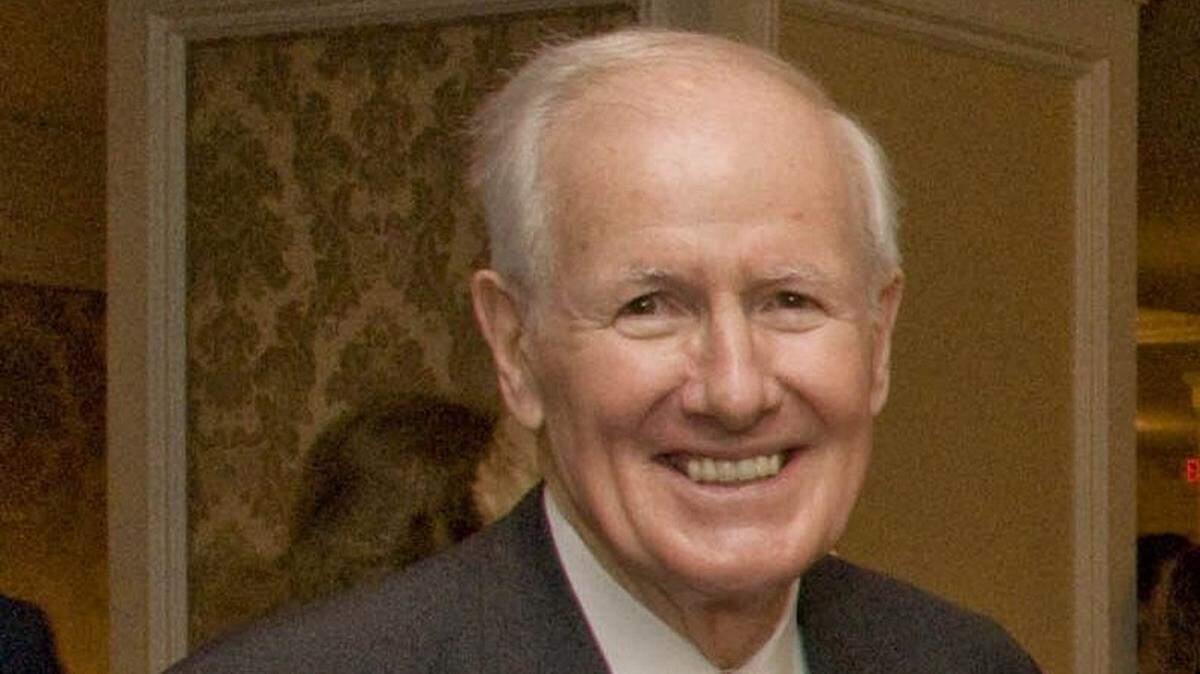
John P. McMeel, a newspaper syndicator who enlivened American funny pages with the distribution of comic strips such as “Doonesbury,” “Calvin and Hobbes” and “Cathy” and delivered the writings of columnists including Abigail Van Buren and Garry Wills to millions of readers across the United States, died July 7 at his home in Kansas City. He was 85.
His company, founded as Universal Press Syndicate and now called Andrews McMeel Universal, announced his death this week but did not cite a cause.
McMeel, a law school dropout once dubbed “Deals McMeel” for his gift for salesmanship, started his syndicate with friend Jim Andrews in 1970. With an early coup — the first cartoonist they signed was Garry Trudeau, then a student cartoonist for the Yale Daily News and later of “Doonesbury” fame — their operation grew into the world’s largest independent newspaper syndicate.
By McMeel’s account, that success hardly seemed foreordained when the two entrepreneurs opened their operation in the basement of Andrews’ Kansas City rental home.
“When we started out, it was just our two families running the company. We were going up against big staffs and a lot of money from tabhe likes of Tribune Media, the New York Times, Scripps Howard, United Media, King Features Syndicate (owned by Hearst) and others,” McMeel said in a 2005 interview with the publication U.S. Business Review.
“Our goal was to differentiate ourselves and go for features more-established syndicates wouldn’t be interested in,” he continued. “We rolled the dice more. It was ‘survive or die’ from the beginning, and it paid off.”
They called their operation Universal Press Syndicate, because they thought “the name sounded impressive,” the company said. Andrews was credited with recruiting Trudeau when he was penning a college newspaper strip called “Bull Tales,” with characters including a right-leaning football player called B.D.
Later renamed “Doonesbury,” Trudeau’s creation became a landmark of cartooning as one of the first newspaper comic strips to plunge headlong into politics. While other fixtures of the funny pages trafficked in tame, even childlike humor, “Doonesbury” addressed matters such as drugs, divorce and the AIDS epidemic — sometimes to the vexation of editors, who on occasion declined to print installments that they judged to have crossed the bounds of propriety.
In 1975, five years after McMeel and Andrews introduced Trudeau to U.S. newspaper readers, he received the Pulitzer Prize in editorial cartooning. “Doonesbury” was carried by nearly 2,000 newspapers at its peak, at least partly as a result of McMeel’s promotion.
“His blarney was legendary,” Trudeau said, according to the syndicate’s announcement of McMeel’s death, “but behind it was a deep regard and respect for the artists he championed. That loyalty was mutual; many of us fondly called him ‘boss’ for decades.”
Other cartoonists in McMeel’s stable included Bill Watterson of “Calvin and Hobbes,” Gary Larson of “The Far Side,” Tom Wilson of “Ziggy,” Lynn Johnston of “For Better or for Worse” and, after years of courtship, Jim Davis of “Garfield.”
Cathy Guisewite, the creator of “Cathy,” a strip that centered on a hapless character struggling to find her way as a modern woman, told The Washington Post on Wednesday that McMeel helped her reach millions of readers at a time when almost no comic strips touched on contemporary women’s concerns.
He “blindly believed … that I could be a voice for women going through a time of huge transition in the late 1970s, and John was like the cheerleader of all cheerleaders,” she said. “He sold my work to newspaper editors who had kind of no idea what was coming at them, and he convinced them to take a chance on me.”
“Because he was willing to stand behind cartoonists with different, edgier voices,” she added, “he really opened up the comic pages for a whole new generation.”
The writers syndicated by McMeel and Andrews over the years included Seymour Hersh, who received a 1970 Pulitzer Prize for his reporting on the My Lai Massacre in Vietnam; conservative columnist William F. Buckley Jr.; film critic Roger Ebert; and Erma Bombeck, a humorist who drew laughs and insight from suburban domestic life.
They snagged Pauline Phillips, better known as Abigail Van Buren of the “Dear Abby” advice column, by surprising her at her Beverly Hills home the day after a phone conversation in which she invited them to “stop by” if ever they were “in the neighborhood.”
“I look out my window and I see these two guys trudging up my driveway,” Van Buren told The Star years later, in a 1995 story celebrating the 25th anniversary of the company. “I liked both of them immediately. I said, ‘You’d probably like to see my list (of papers that carry ‘Dear Abby’), so I pull out this printout and it just cascades down to the floor and they’re like, ‘Oh, my Lord.’ Working with them is like being a part of their family.”
John Paul McMeel was born Jan. 26, 1936, in South Bend, Indiana, where his father was the doctor for the University of Notre Dame football team. His mother was a homemaker.
The younger McMeel received a bachelor’s degree in business from Notre Dame in 1957 before enrolling in and then dropping out of the law school at Indiana University. He moved to New York City and began selling newspaper features for what was then the Hall Syndicate.
During a visit home, he met Jim Andrews, then a Notre Dame student who was renting a room from Mr. McMeel’s mother. Andrews later became managing editor of the National Catholic Reporter in Kansas City before the two men established their syndicate.
Andrews was 44 when he died of a heart attack in 1980, a tragedy that devastated McMeel. “We were closer than brothers,” he later said.
Andrews’ wife, Kathleen, went on to become chief executive of the syndicate’s publishing division. (She died in April.) McMeel served as president until 2000 and was chairman emeritus at the time of his death. The company today includes digital entertainment, book publishing, calendar and greeting-card divisions.
In 1966, McMeel married Susan Sykes. Besides his wife, of Kansas City, survivors include three daughters, Maureen McMeel Carroll and Suzanne McMeel Glynn, both of Kansas City, and Bridget McMeel Rohmer of Los Angeles; and nine grandchildren.
McMeel earned the loyalty of his artists by allowing them to retain a degree of creative control that few other syndicates would have allowed. When Watterson objected to lucrative merchandising agreements on the grounds that they would cheapen “Calvin and Hobbes,” Mr. McMeel said, the company returned the rights to him.
“It is the custom for columnists to complain about their syndicates, but I can’t,” Mary McGrory, a longtime columnist for The Washington Post and the old Washington Star, once wrote, expressing her affection for McMeel and Andrews. “Mine is the syndicate with a soul.”
This story was originally published July 22, 2021 at 9:33 AM.