His family survived Tulsa Race Massacre. Kansas City area man wants the story told
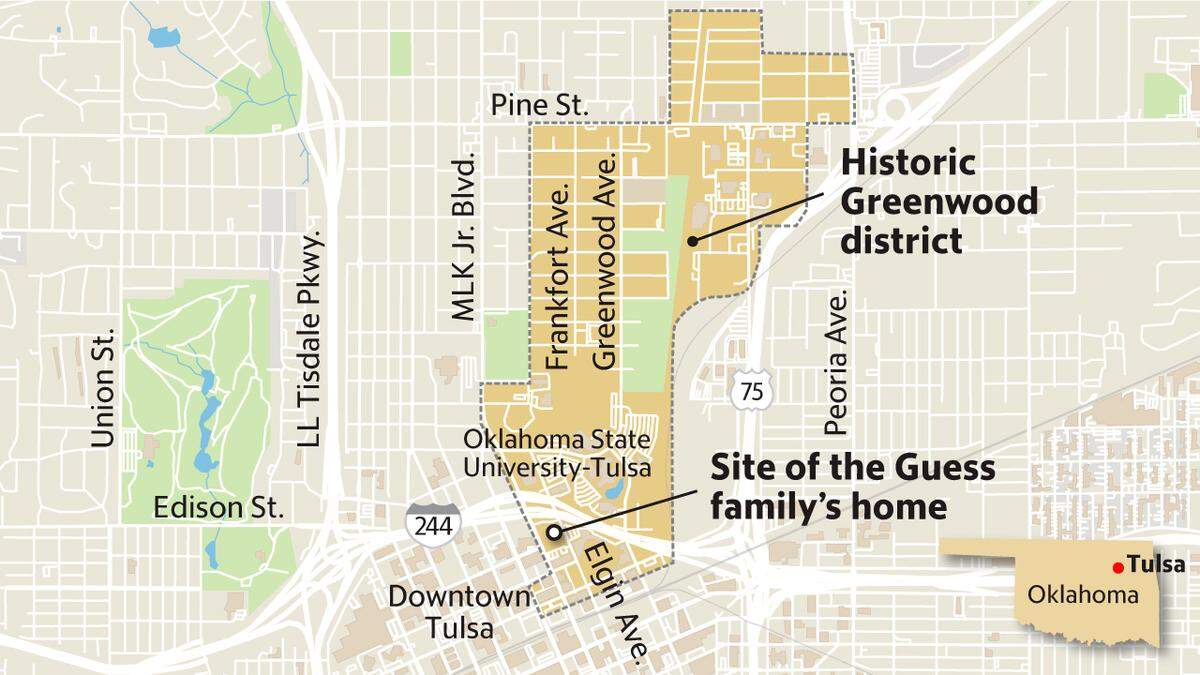
The two girls and their parents huddled in their two-bedroom home, squeezed under a bed or hiding in a closet as gunshots rang out and their neighborhood burned down around them.
It was May 31, 1921, the day that came to be known as the Tulsa Race Massacre.
The only thing that spared this family was a white man who lied to the mob, claiming the house was his and therefore should not be destroyed.
Jack Adams, 89, who now lives in Overland Park, grew up listening to these stories. He came to understand that if his mother, Bernice Guess Adams, who was 16 at the time, had not survived, he would not exist.
As the country marks the 100-year anniversary of the deadly rampage in Oklahoma, Adams wants more people to know what his family endured.
While in grade school in the 1940s, Adams and his younger brother Don lived with their grandmother in the home that had escaped the fires. She told them about the assault, how people were “frightened to death,” Adams said.
“They shot people indiscriminately, Blacks,” he said. “It was awful.”
His great-uncle Andrew Jackson, a prominent Tulsa physician, was returning from house calls that day when he was confronted by the white mob. He was shot and killed.
As many as 300 Black people were killed, and hundreds of businesses were destroyed in Tulsa’s Greenwood district, which had come to be called Black Wall street for its successful shops and affluent residents.
Adams said a witness identified who shot Jackson, but no one was ever charged.
Adams researched his great-uncle and discovered that he did not have a grave marker. In 2013, Adams had one made and placed in the Guthrie, Oklahoma, cemetery where Jackson was buried.
As a child hearing about the massacre, Adams said he did not fully understand the racism behind it. Black people were thriving in Greenwood, and some white people resented them for it.
“There were successful businesses there, owned and operated by Black people,” said Carmaletta Williams, executive director of the Black Archives of Mid-America in Kansas City. “They were making money, they were taking care of their community and their families, they were building businesses, they were being successful.”
That spring in 1921, a Black man was accused of assaulting a white woman. A white mob used the unfounded allegations as “a catalyst to destroy that Black progress,” Williams said.
Reflecting on it this past week, Adams said, “It shows me what hate, jealousy, unbridled hate can do.”
That hate still exists, Adams said, pointing to the Jan. 6 assault on the U.S. Capitol.
Three of Adams’ four children traveled to Tulsa for commemoration events that began May 31 and included an appearance by President Joe Biden.
Adams’ son Jon, who lives in Portland, Oregon, said he was moved as he learned more about his family’s history.
“It’s opened up a whole new paradigm, way of looking at the world, way of looking at racism,” he said.
Being in the presence of survivors and other descendants in Tulsa was a powerful experience, he said, but it was also horrifying to gain a deeper understanding of what had happened a century ago.
Williams, with the Black Archives, said it was important to capture the stories of survivors and their families.
“These are real people with real families, real dreams, real issues, with real promise,” she said. “Those people that lost their lives — it’s exponential pain, it waves out to their family and their friends.”
“It’s been 100 years, but it hasn’t been fixed yet. Things that are happening now — it looks like it’s a long way off, but it’s just a continuum because nothing has been corrected, nothing has been fixed.”
This story was originally published June 4, 2021 at 12:42 PM.