Ex-Sporting KC execs plan $330M redevelopment of KCK’s defunct Schlitterbahn waterpark
Two former Sporting KC executives hope to redevelop the defunct Schlitterbahn waterpark in Kansas City, Kansas — and they want substantial tax dollars to help do it.
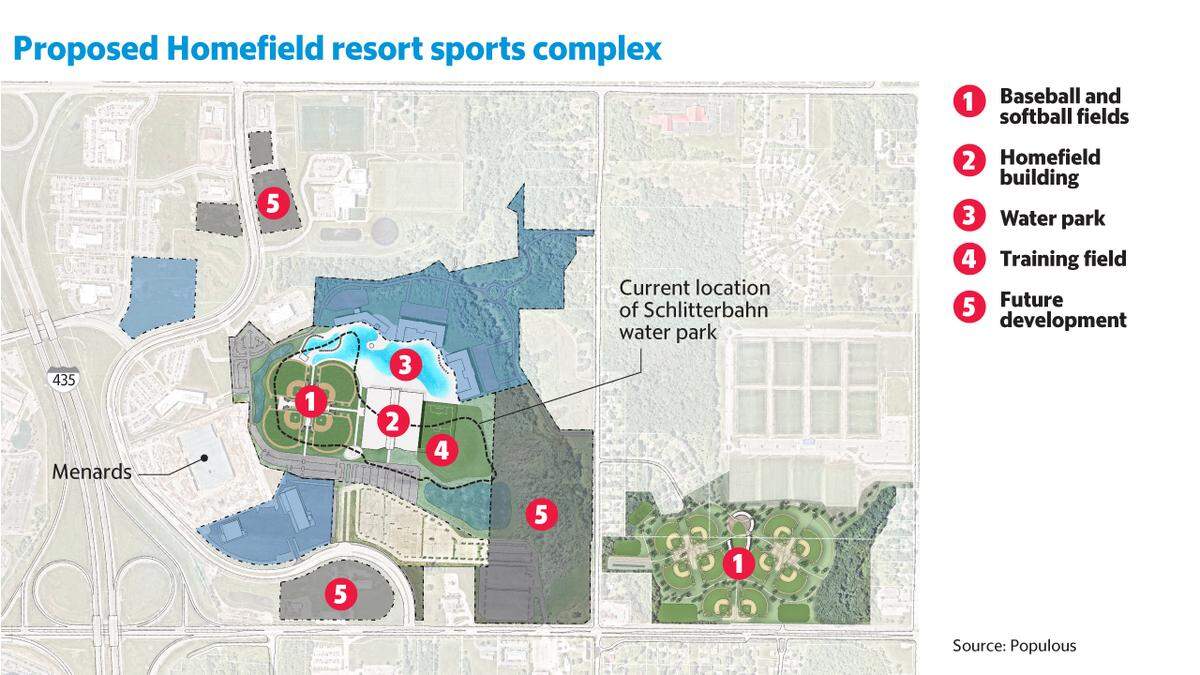
Homefield LLC proposes building a multi-sport complex that would include indoor and outdoor amenities and add retail, office and entertainment space. The complex would also house soccer, football, baseball and lacrosse fields, along with water sports like paddleboarding, dragon boat racing and kayaking.
To help fund the $330 million redevelopment, they’re seeking $130 million in Kansas STAR bonds, a controversial incentive program that redirects sales taxes to help offset the cost of major projects.
Developers will present their plans Monday to the economic development committee of the Unified Government of Wyandotte County-Kansas City, Kansas.
Homefield is run by Robb Heineman, a former CEO and current part-owner in Sporting KC, and Greg Cotton, a former chief operating officer and chief counsel for Sporting. The pair launched their Homefield youth sports company last year, acquiring two Elite Sports locations in Kansas City and Olathe.
In planning documents, UG officials say the Homefield development would “remove blight and the political stigma from the tragic events at the former and now defunct Schlitterbahn water park.” The park has been plagued by litigation and financial problems since a 10-year-old boy died on the Verruckt waterslide in 2016.
The redevelopment proposes asking for yet more sales tax dollars in a part of Wyandotte County that is ground zero for the state’s STAR bond program. The Kansas Speedway was the first recipient of the powerful inducement, and since then projects like Village West, Children’s Mercy Park, the relocation of Dairy Farmers of America and others have received millions in sales tax dollars.
But the Wyandotte County proposal comes as another community across the state line still awaits its own major sports development, promoted by part of the same team behind the KCK plan.
Cotton has twice before been involved in separate proposals for major sports developments that stalled or outright failed.
It wasn’t that long ago that PG LLC, which includes Cotton and former Kansas City Chiefs Player Deron Cherry, proposed building a $234 million soccer complex in Grandview called Gateway Sports Village. It was supposed to include a hotel, retail space, a fieldhouse and more than a dozen soccer fields.
Construction began in 2017, but officials say little progress has been made. In 2018, Cotton told the city that developers had exhausted credit options. After already being awarded $43 million in tax increment financing, he asked the city for an additional $8 million in funding, saying the team was financially at “the end of our rope. ”
Tim Gordon, a Grandview resident whose property is next to the Gateway site, has seen little in the way of meaningful construction since.
“Oh, Jesus Christ,” Gordon said after learning that a principal involved in Gateway was also pitching a wide-ranging sports complex idea to the Unified Government.
“There’s no work being done at all,” Gordon said. “Which is very upsetting now that they’re trying to sell it to somebody else.”
Big expectations in Grandview
Gordon prefers the undisturbed scenery around his property and didn’t like the idea of a sprawling soccer park there. But now he worries about what may happen with the land if the Gateway partnership ultimately abandons its plans to build on the 250-acre site at Missouri 150 and Byars Road.
“Are they going to sell it to somebody who will build a SkunkWorks around us?” Gordon said.
The site is occasionally home to bulldozers or other equipment. But no significant progress has occurred in months, though the development website describes the soccer fields as sold out “ahead of a late Fall 2019 opening.”
“As far as the city knows, the developers are still trying to finalize the funding to move forward,” said Grandview spokeswoman Valarie Poindexter.
Grandview alderman John Maloney, whose ward includes the Gateway development site, said the developers’ publicity tour when the project was announced created big expectations.
“Some of us who were on the board at the time, we tried to encourage them not to announce so much things,” Maloney said. “As soon as you do groundbreakings and things, people have expectations of what’s going to happen.”
Maloney said he prefers that the site remain the way it is for now.
“I’d much rather that stay an empty canvas until something happens,” Maloney said. “I would hate to start putting streets and sidewalks in for a soccer complex and it doesn’t happen and all that has to get taken out.”
In a separate attempt, Cotton and Cherry were involved in a push to build a destination soccer complex near the Lake of the Ozarks. To help fund the project, they sought an increase in lodging taxes in Camden, Miller, and Morgan counties, but voters rejected that idea last year.
The pair’s company, XO Strategic, compiled a feasibility study as part of that campaign. Cotton recommended the Lake Convention and Visitors Bureau and Tri-County Lodging Association pursue a contract with a soccer association to manage the complex. Specifically, he suggested Overland Park-based Heartland Soccer Association, which is run by Shane Hackett — another partner in the Grandview soccer development.
Neither Cherry nor Hackett responded to requests for comment.
A new ‘youth sports mecca’
For now, UG officials aren’t too concerned about the history of those previous projects.
Katherine Carttar, the local economic development director, said developers won’t receive a penny in incentives until they build the first phase of the project in Wyandotte County. The county has no plans to offer property tax abatements, she said.
“The way that we’ve structured it, we have as little risk as possible,” she said. “We feel pretty good.”
Tom Burroughs, a Unified Government commissioner and chair of the Economic Development and Finance Standing Committee that will hear the proposal Monday, signaled that he thought the project fit in with other development around it.
“Having that sports mecca there, it just plays right in with the development we have in western Wyandotte County,” Burroughs said. “I like to call it leisure-tainment.”
For the Homefield project, UG proposes issuing $130 million in STAR bonds. It plans to use state and city sales tax revenues from the Menards store off of Interstate 435 to help fund the project. Beginning July 2021, a quarter of the state sales tax and all of the local sales tax collected at the store would be diverted to developers.
In the first phase of the project, the developer will have to invest $75 million in private funds to receive an equal amount in tax revenues. In a second round of funding, the UG proposes giving developers $55 million in STAR bond revenue after they’ve invested an additional $118.25 million in private capital.
Carttar said the development is envisioned as a “youth sports mecca.” The developers will remove much of Schlitterbahn’s slides and rides, but will utilize the park’s existing infrastructure to retain some features like the wave pool and lazy river.
“Just by itself it’s a great project and something that’s really interesting by doubling down on the youth sports ecosystem we’ve built in the region,” she said. “That being said, it really seems like an even bigger win-win that we can get rid of Schlitterbahn and still get something really exciting there.”
Through a spokesperson, Heineman and Cotton declined interview requests ahead of Monday’s meeting.
“We are pleased to present a project that will generate significant economic activity and job creation, as well as result in substantial visitation and tax revenue generation for the area,” Heineman, founder and CEO of Homefield, said in a statement. “And our conversations to date with Unified Government of Wyandotte County/Kansas City, Kansas and potential project partners indicate a shared enthusiasm.”
The pair previously outlined their company’s vision in an interview with The Star last October.
“We feel there’s a real opportunity to kind of change the amateur sports industry and how it’s presented,” Heineman said.
Generally, youth sports venues provide few amenities for parents and spectators, he said. And Homefield wanted to provide a place for parents to grab a drink or get in a workout in addition to providing top notch athletic training and associated health services.
He pointed to the $40 million redevelopment of Kemper Arena into Hy-Vee Arena. The iconic structure was transformed to include multiple courts for tournaments and leagues, restaurants and retail space, though the developer acknowledged financial challenges in its first year.
“That’s exactly the sort of thing that we’re doing,” he said. “And we just think there’s a big hole in the market where there are very few facilities like Hy-Vee arena and like what we’re doing that are done really well.”
Schlitterbahn’s STAR bonds
In Kansas, STAR bonds are among the most powerful incentives available to developers. They were originally designed to induce exceptional attractions that bring in tourists from far away: the STAR bond-funded Kansas Speedway is often held up as the prime example of their potential.
But in recent years, developers have used the program for more routine projects, like adding new turf to soccer fields in Wichita or building a new aquatic center in Goddard.
A 2019 analysis by The Star found that projects frequently over promise potential benefits, subvert the original intent of the program and lack state oversight. STAR bonds were set to sunset in June, but lawmakers reauthorized the program for an additional year.
Cities sell STAR bonds to provide upfront capital that a developer can pour into a project. The bonds are paid back over 20 years with the sales tax generated by the development.
Schlitterbahn opened in 2009, adding to the growing mix of retail and entertainment destinations in western Wyandotte County. Five years later, it debuted Verruckt, a 17-story water slide — the tallest in the world at the time.
In 2016, 10-year-old Caleb Schwab died after the raft he was riding down the slide on went airborne and collided with a netting system meant to keep riders from flying off. Schlitterbahn and others involved in the design and construction of the ride paid the Schwab family a nearly $20 million settlement.
After closing Verruckt, the water park remained open for a couple more years but struggled financially. It did not open for the 2019 season. Cedar Fair Entertainment Company, owner of Worlds of Fun in Kansas City, contemplated purchasing the park as part of a larger acquisition deal, but ultimately did not.
In 2013, the park won millions of dollars in Kansas STAR bonds. Last year, the Kansas Department of Commerce, which oversees the program, reported an outstanding balance of more than $65 million on those bonds.
Sales taxes from existing retail outlets near the park help pay down that obligation, said Robert North, chief counsel for the commerce department. If the Homefield project is successful, sales taxes collected within the existing taxing zone would help pay off that existing debt.
But the state would also create a new STAR bond zone to provide the $130 million to Homefield’s developers, North said.
“One of the things that we potentially really like about it is that it’s going to put the Schlitterbahn site back to good use and create some positive economic impact that we’re not getting now with the waterpark sitting closed,” he said.
So far, the UG hasn’t made any formal application for STAR bonds, though North said the state has been in touch with local officials about the project.
“We like what we hear so far,” he said, “but there’s a whole bunch of details and deal points that haven’t been fully developed yet.”