Most Johnson County students opt for in-person school. But they all might stay home
Update: It’s not safe to reopen schools, Johnson County health officials advise districts. Story here.
Along with thousands of other Johnson County parents this month, Leawood mom Sarah Mackay enrolled her children in school with seemingly endless questions and few answers.
Can online learning offer enough structure for her fourth-grade son? For her freshman daughter, would the mental health benefits of going to class outweigh the risks of getting COVID-19 and bringing it home?
And will it all be moot anyway if her district, like some others in the Kansas City area, decides that bringing students back into classrooms next month is too dangerous?
With the high level of coronavirus transmission in Johnson County, there’s a growing chance that all students will be learning remotely when school begins next month.
On Tuesday, the Johnson County health department will meet with six local superintendents to offer its recommendation, based on the infection rate in the community.
Last week, the county reported that, on average, more than 10% of tests were coming back positive. That puts the county in the “red” zone for opening schools, meaning officials could warn against bringing students back to class.
But the decision is up to individual districts.
The Blue Valley school board has scheduled a special meeting for 5:30 p.m. Tuesday to discuss how to begin the school year. Other districts will likely do the same after the county makes its recommendation.
Without knowing how districts will begin the semester, parents still had to make a choice.
“We decided to keep my son at home. If I can make that work, then we can help get as many kids out of the classroom as possible, so the kids who have to be there have a better shot at social distancing,” said Mackay, whose children attend Shawnee Mission schools. “But we gave the choice to my freshman, and she chose to go back. I wouldn’t have chosen it, but it’s been hard on these kids mentally. And she really needs that connection.”
These are only some of the considerations parents had to work through when enrolling their students in either online or in-person classes earlier this month — the two options that most districts offered. Even when schools do bring students back, those families who agreed to in-person classes may end up in a hybrid model, learning from home for half of the week.
In Johnson County’s three largest districts, roughly 70% of families chose to send students back to classrooms. Between 25% and 30% of students in Shawnee Mission, Olathe and Blue Valley will learn online.
While Johnson County families wait for their districts to make a decision, other districts across the metro have already decided it is unsafe to bring students back. The Kansas City, Kansas district in July decided on fully online learning for the first nine weeks of the year.
On the Missouri side of the metro, the Kansas City school board decided to begin school with online classes only after Labor Day until case levels drop significantly. Lee’s Summit will also start online only, with an undetermined date for when class is in person.
Many parents said they assume that no matter what option they chose for their students at enrollment, their children will end up learning from home at least part of the time. Trying to balance work schedules and find tutors, many have come up with creative ways to make that happen, such as joining with other families to form small pods of students to learn together.
And with less than a month before school starts, some parents said they’re growing increasingly frustrated, waiting on their districts to make a decision so they can better prepare. Some parents have said they are considering leaving their districts entirely.
“The biggest frustration with all of this is it feels like the parents are being forced to make the decisions for the district. But how can we make informed decisions when we’re not getting information?” Shawnee Mission parent Alycia Jiskra said. “We’re talking about so much more than our kids getting sick. We’re talking about our teachers, our family members getting sick. It’s so much larger than any of us.”
Will students return?
Lisa Feingold of Merriam said she had a lot to consider when deciding whether her son should return to Shawnee Mission North High School for in-person classes during his sophomore year.
If he chose to learn online, could he take all of his advanced placement courses? And could he participate in orchestra and other school activities?
“I joked that I might as well decide with a magic eight ball, because things like curriculum, classes, teachers — there were so many things that no one could answer,” she said. “There’s the health and safety side that we’re all trying to figure out. And then there’s the education piece. Where are our kids actually going to get the best possible education?”
Districts also are still deciding who will teach online or in person, how to social distance in each room and whether extracurricular activities will be allowed. Many decisions will depend on the rate of COVID-19 transmission in the county in the coming days.
Late last month, the Johnson County Department of Health and Environment released guidance to school districts on how to determine when it is safe to bring students back to class. It includes several reopening phases based on key metrics, including the positivity rate — which is the average percentage of positive COVID-19 tests among those processed over a 14-day period.
▪ In the “green” zone, the rate of positive tests is below 5%, and all students can learn in person, with social distancing and other precautions.
▪ Johnson County was in the “yellow” zone earlier this month. That means the positivity rate was less than 10%, and the number of new cases was steady or decreasing. In that phase, students could learn in a hybrid model, such as going to class for half of the week and learning online during the other half. That would help schools reduce interactions and implement social distancing.
▪ But last week, Johnson County was in the “red” zone; its positivity rate exceeded 10%. After holding steady and averaging around 90 new COVID-19 cases each day for a couple of weeks, the number of new daily cases started to rise again. That means officials would likely recommend that schools begin the year with online only learning.
A New York Times analysis also found that Johnson County is not ready to safely reopen schools, per guidelines from the Harvard Global Health Institute, which looked at counties’ rate of new infections and testing capabilities.
Is in-person possible?
When students do return to class, most will be required to wear face masks, per Kansas Gov. Laura Kelly’s executive order issued last month, which Johnson, Wyandotte and Douglas counties are following. Some districts, like Blue Valley, will check students’ temperatures before they come into school each day. Others, like Shawnee Mission, will ask parents to do so from home. Hand sanitizer will be used religiously, and buildings will be continually sanitized.
“Nothing is going to be normal,” Olathe Superintendent John Allison said at the August school board meeting. “For students, how they come to school, how they enter the building, where they go in hallways — which may be one-way (traffic) — where they store their backpack and not being able to use lockers, all of these things are going to be different. Because that’s the way it has to be.”
Districts are attempting to mandate social distancing in classrooms, cafeterias and other common areas. But with some teachers being designated to teach students in the online program, officials expect logistical challenges. Michael Schumacher, with the Shawnee Mission district’s human resources department, said “even though we have less kids, we have less staff.”
And even with dozens of safety precautions, county health officials warn that coronavirus cases will occur. Over the summer, cases have popped up among students taking classes, doing sports conditioning or going to camps. At Shawnee Mission East High School, for example, 14 student athletes tested positive for COVID-19.
On the Missouri side, officials in the Park Hill school district said that during summer school and other activities, 20 COVID-19 cases were reported — 16 among high school students and 4 among staff.
Across the country, some districts have closed schools days after opening them due to COVID-19 cases and the need to quarantine students.
Throughout districts, if students are exposed to a positive case in the classroom, they will be told to quarantine for 14 days. Officials will do contact tracing and instruct affected students to quarantine as well. Whether a school will shut down will depend on the severity of the outbreak.
“If a kid gets sick with COVID-19, how do you ask a 5-year-old questions about contact tracing? How do you ask a 5-year-old how long they’ve spent with friends, and for how long and how close they were together?” Jiskra said. “How do you keep a bunch of 5-year-olds, or even high schoolers, separated? There just are no good answers. And that’s the frustrating part of it.”
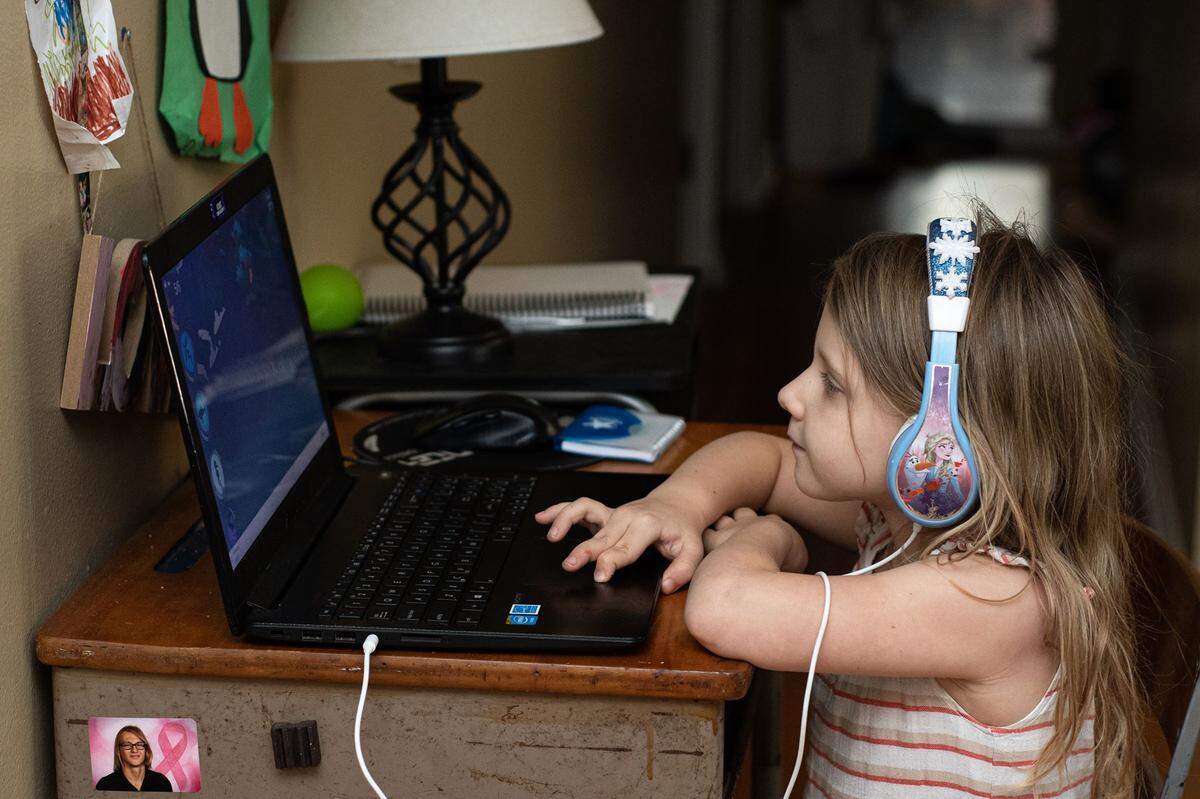
Online poses challenges
When Etienne Clatanoff’s two children were stuck at home and taking classes online this spring, she said she felt like “the teacher, the principal, the janitor and the lunch lady.”
She’s doing everything she can to avoid that this fall.
Clatanoff has two children in the Shawnee Mission district. Her kindergartner will learn online, which she hopes will offer more consistency. But her sixth-grader will go to class in person. She knows that will probably mean online classes for part of the week.
“There are all of these what-if scenarios. And planning in all of these different directions is very stressful. So you end up collaborating with a lot of other parents,” the Prairie Village mom said.
A therapist with her own private practice in Prairie Village, Clatanoff said she came up with a plan with four other families. Her office building is empty because the therapists are working from home, so she decided to convert the offices into classrooms.
“That way kids can transition out of their homes and have that mental transition of going somewhere different than your house. And they won’t have to bounce back and forth between four families’ homes,” she said. “We’re going to hire a tutor, and then some parents will volunteer when they don’t have to work.”
Students will learn in pairs with tutors, which she hopes will help them not feel as isolated. Mackay, the Leawood mother, said her child also will join a “pod” of other students for online classes.
“Virtual learning, for us, had a couple of advantages over the unknowns of the classroom this year. One of them is having control over breaks and the stresses. We know that every hour, I can send the kids outside to play for 15 minutes or to take a break,” she said. “I don’t know what’s going to happen in the classroom. So having some sort of control was a big push for us.”
Students who learn remotely will be required to log in for a certain number of hours each day to meet attendance requirements. Some parents, like Jiskra, are preparing their children for that commitment — sitting her soon-to-be kindergartner in front of the computer for several hours each day as practice.
“Even with all the complications, it was still easy for us to say she’s going to be a remote learner. We’ve known people who have been sick. And seeing them experience death and watching how quickly COVID-19 spreads among families, it’s really scary,” Jiskra said. “We didn’t want her to go to school and see her classmates disappear from class or possibly her teacher get sick. How do you explain to a kindergartner that her teacher got sick and died?”
Jiskra also didn’t want to take that risk for her own family, knowing her daughter regularly visits with her grandparents.
“We’re trying to create as safe of a way as possible for them to do that. And her going to school would eliminate that option. In my opinion, we’d have to act like we’re quarantined at all times because of the risk of exposure,” she said.
With coronavirus cases rapidly rising in Johnson County, it’s become increasingly possible that all students will be logging into classes online next month.
And many parents don’t have the luxury of hiring a tutor or staying home with their children for homeschooling. Many do not have access to reliable internet — an inequity that was brought to the forefront when schools closed this spring and that district officials have been working to address. And parents are trying to figure out how to make online learning work without yet knowing what their students’ schedules will look like.
“Tons of families are dying to know what’s going to happen so they can plan their child care and their work schedules. Some of them have to hire a tutor to each their kids, but they don’t know whether they’ll need it full time or part time. But that’s a small group of people with enough money to do that,” Mackay said. “We have neighbors who lost their jobs. People are making these decisions while having the stress of job security, without having access to internet and without being able to plan.”
This story was originally published August 17, 2020 at 3:21 PM.