‘I’m scared to death’: KC area teachers worry if schools can be safe during COVID-19
Olathe teacher Amy Hillman said she was “given a gift” when Gov. Laura Kelly announced she would order Kansas schools to stay closed until after Labor Day due to skyrocketing coronavirus cases.
“These three weeks are giving us a leg up. It doesn’t sound like much, but it’s a lifetime for teachers,” said Hillman, a science teacher at Santa Fe Trail Middle School. Like other teachers, she has spent the summer taking online courses, learning how to use new technology and researching the virus — preparing to drastically transform her classroom for students returning during the worsening pandemic.
Kelly is expected to sign an executive order on Monday — which will then need approval by the state board of education — to delay the start of school until Sept. 9. The decision, announced Wednesday afternoon, came as districts were scrambling to craft reopening plans before letting students back into classrooms in August.
With an additional three weeks, Hillman hopes districts and teachers would have more time to stockpile protective equipment, train to use online learning platforms, and practice new schedules and routines. She also hopes that if Kansans continue social distancing and wearing masks, the rise in new COVID-19 cases could slow.
“Just wear the mask, follow procedures for social distancing and wash your hands. If you follow those three things, we can get back to business,” she said. “The virus doesn’t know Democrat versus Republican. ... To me, it’s so important that we all do our part.”
Missouri educators have an eye on how Kansas’ delay will play out, but state officials there say they will leave it up to individual districts to choose when they reopen and how. Like in Kansas, districts in Missouri are scrambling to release plans for reopening while considering guidance from local health departments and concerns from teachers and administrators.
Those plans, they say, come with a caveat — they are in flux — because decisions about when school might reopen, how they open or whether students and teachers go back into the classroom at all have been changing almost as quickly as the number of COVID-19 cases are rising.
“It’s not likely that there would be any statewide mandate about school reopening,” said Mallory McGowin, spokeswoman for the Missouri Department of Elementary and Secondary Education. “There are not any laws or rules that would prevent local school leaders and boards of education from being able to delay the start/opening of the school year.”
Hundreds of teachers and their supporters protested outside St. Louis Public Schools headquarters earlier this week calling for the district to hold off on sending students back into classrooms while coronavirus cases are still rising. Districts are set to send plans for reopening to the state next week.
But even if there is a delay in the start of school in Kansas, teachers cope with mounting anxiety. Many districts are giving parents the option of having their children stay home and learn virtually, or sending them back to the classroom. But teachers worry that social distancing won’t be feasible in classes if most students return — and that groups congregating in schools could lead to further outbreaks of the disease. They worry for students and staff members who are at-risk and have underlying health conditions.
And some worry they will be forced to act as a medical professional in their classrooms, responsible for keeping dozens of students healthy, without being thoroughly trained to do so.
“Nobody wants to be in school more than I do. But at the same time, there’s a lot of stress and anxiety for teachers who feel like they are now in the position of not only teaching your kid a subject, but now I’m going to be potentially in charge of someone’s health,” said Tony Budetti, a teacher at Shawnee Mission South High School.
“I’m not a doctor; I teach economics.”
Teachers anxious
Last year, Budetti said he had 33 high schoolers in a class with 32 desks. One student, he said, “ended up sitting on the couch.”
So it’s difficult for him to imagine a classroom where social distancing is feasible. And limiting class sizes is only one hurdle.
“Yeah, how do you social distance because our classrooms just are not big enough,” said Andrea Flinders, president of Kansas City Federation of Teachers, a union representing teachers in greater Kansas City. “Teachers are extremely concerned. I am scared to death too. I don’t want one child gone because of this virus and not one adult either. A lot of teachers are advocating for the virtual model.”
She wondered, is it possible to keep high school students from congregating? “In a high school where there are a thousand kids getting off buses and dropped off in the mornings, they are in a logjam trying to get through security. How long is that going to take? Students might not get to their first class before the second period starts.”
To quell the fear, state officials suggest districts “make a lot of plans so you can pivot on a moment’s notice should the situation change,” McGowin said.
“I can tell you with certainty our main concern is bringing kids back to school and keeping them safe and keeping our staff safe,” said Kenny Southwick, executive director of the Cooperating Schools Districts of Greater Kansas City, which represents about 30 area school districts.
Teachers want the same thing, Flinders said. “But I would rather we just go slow and do it right.”
District plans across the Kansas City metro call for social distancing in classes and common areas, mandatory masks, continual cleaning and sanitizing, modified schedules, as well as requiring both online and in-person instruction.
Many teachers worry that it is placing unreasonable expectations on school staff, according to a survey by the Missouri State Teachers Association.
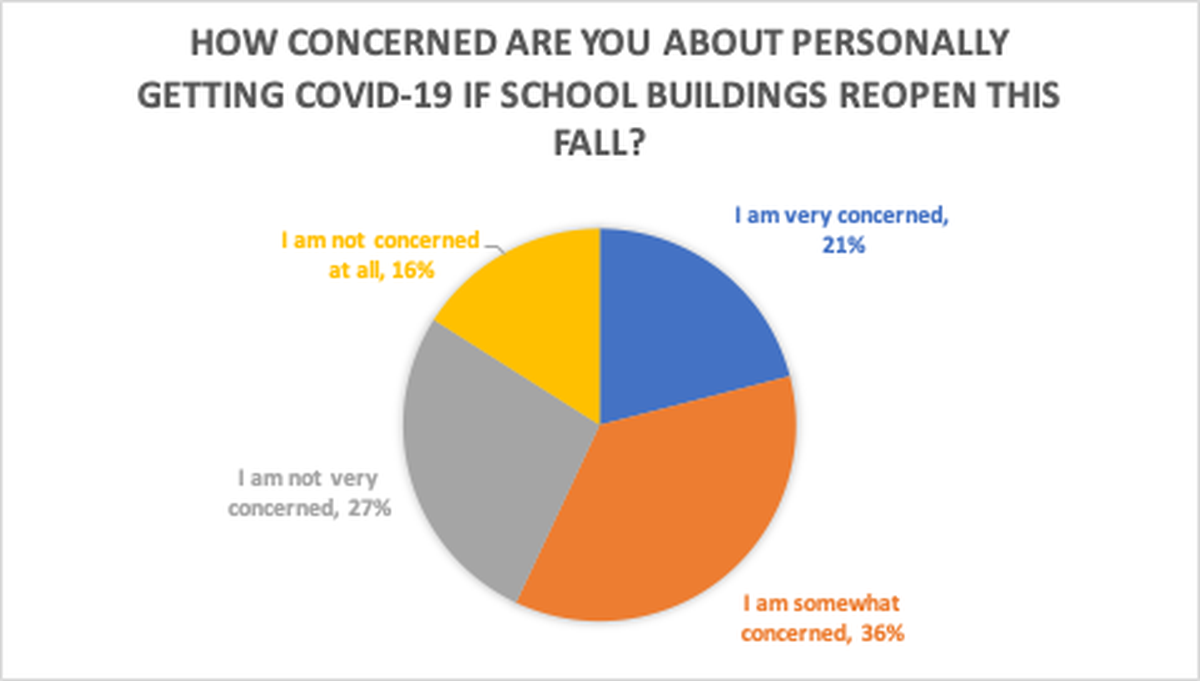
The group surveyed more than 2,500 teachers last month, asking how concerned they were about getting COVID-19 if school reopened for the fall; 57% said they are worried. “Many are concerned about contracting the illness and passing it on to immune-compromised relatives or students,” the survey said.
Some worry that parents will keep their children from attending in-person school out of caution, while others are concerned parents will keep sending sick children to school due to lack of child care.
Their biggest concern? The uncertainty of what the school year will look like, especially as many decisions have yet to be made.
“It’s the unknown that is making teachers nervous,” said Todd Fuller, spokesman for the group.
And that anxiety continues to grow as the school year approaches.
“The strain on educators right now is not knowing that we can go to school, come home to our families and keep everyone healthy. That is what’s keeping teachers up at night right now,” Hillman said.
What’s next?
In Kansas, some are grateful to potentially have a few extra weeks before they head back to class.
“First and foremost, we are unwavering in our belief that students, educators, and the patrons in our schools should be ensured a safe teaching and learning environment free from significant risk of serious illness and threat to life. This means schools should reopen only when it is safe to do so,” said Kansas National Education Association President Mark Farr in a statement.
Before Kelly’s announcement on Wednesday, the state board of education approved reopening guidance from the Kansas State Department of Education. It is up to districts to decide whether to use the state’s suggestions. But the executive order will likely require districts to adopt many of the safety recommendations — such as masks, social distancing and temperature checks.
Similar suggestions, with no mandate, are coming from Missouri state education leaders.
Guidelines give districts the final say in how to operate schools depending on the severity of COVID-19. Districts could choose to bring all students back to class, move to online-only instruction, or implement a hybrid of the two.
Southwick said an unofficial survey of Kansas City area parents found that 15% to 25% said they will keep their children home, opting for virtual learning.
In Kansas, students who return to in-person instruction could still face school closures or modified schedules, said Frank Harwood, superintendent of the De Soto district, who worked on the state guidance.
“The major decision for health-related closures is made at the county level. But each individual district could make decisions that are more restrictive,” Harwood said. “We need to realize that as tired as we all are of COVID-19, it’s still a new disease. And as we get new guidance, we need to incorporate that into our plans. This will change as we move along, which I know is frustrating for everyone.”
While several questions remain unanswered, local districts are moving ahead with approving their reopening plans. Some of those decisions could be postponed depending on delays to the start of school and how many new coronavirus cases are reported in the coming weeks.
“Children thrive in schools. But safety is everything,” Hillman said. “Educators have to be in unison right now. It doesn’t have to be perfect. But our voices need to be heard. Unity has to be at the forefront. But that all goes away when people feel unsafe.”
This story was originally published July 16, 2020 at 5:52 PM.