KC police think they have safe alternative to chokeholds. Critics say it can kill
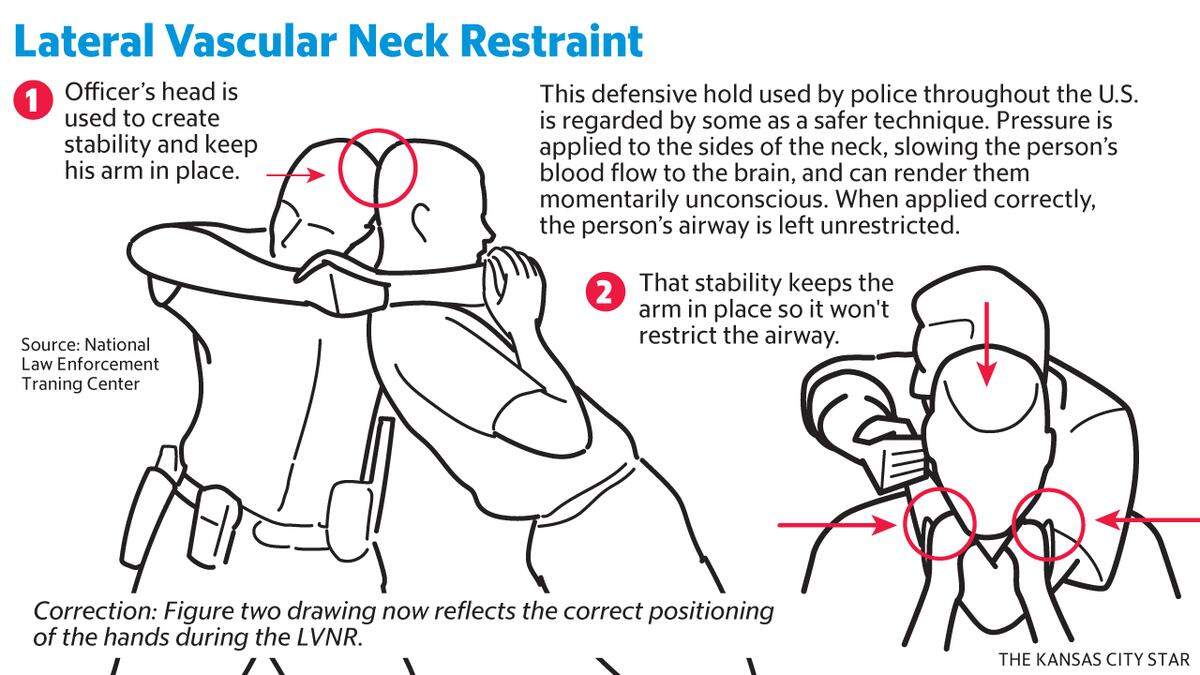
Editor’s note: This article has been updated to correct a drawing in a graphic that appears lower in the story.
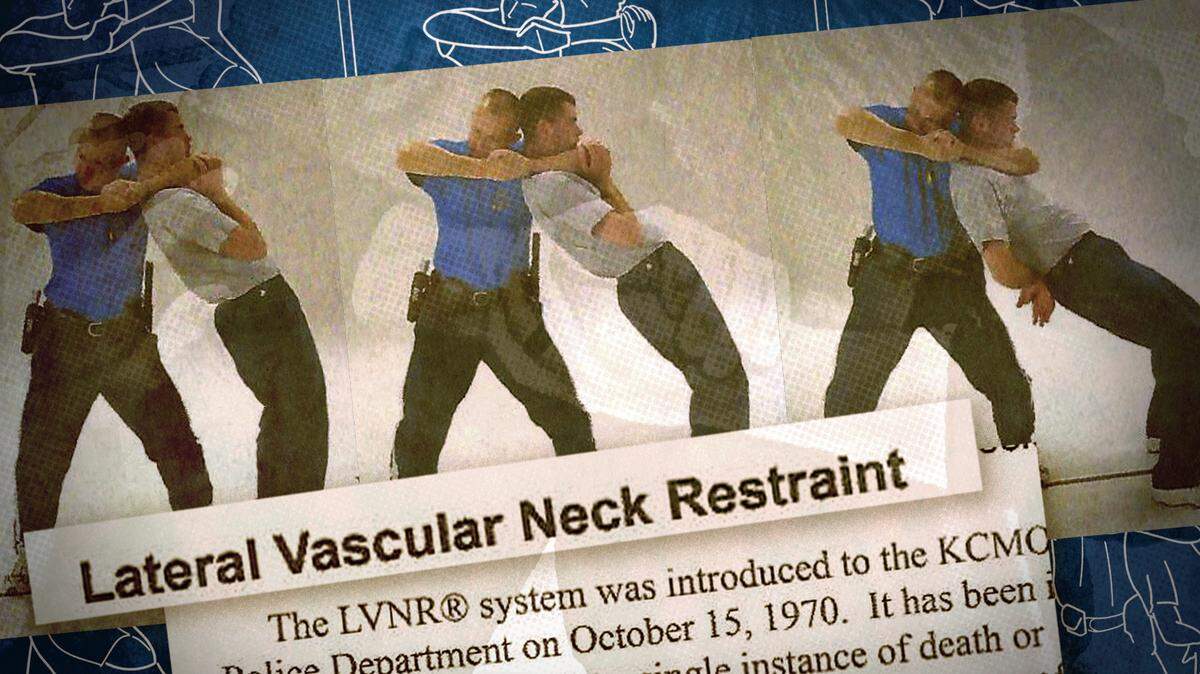
For 50 years, the Kansas City Police Department has enthusiastically promoted a maneuver that looks a lot like a choke- or stranglehold for restraining an unruly suspect.
The department says the move — the Lateral Vascular Neck Restraint, invented in Kansas City — is safer than a chokehold and reduces the chance an officer might have to pull a gun.
But the LVNR, as it’s commonly known, is not without controversy. And recent calls to ban all neck restraints in the wake of the killing of George Floyd have the future of Kansas City’s method and similar holds in doubt.
“Law enforcement officers shall not use chokeholds, strangleholds, Lateral Vascular Neck Restraints, Carotid Restraints, chest compressions, or other tactics that restrict oxygen or blood flow to the head or neck,” the advocacy group Campaign Zero stresses in the policy it is encouraging all police departments to enact.
The LVNR restricts blood supply to the brain when an officer compresses the carotid arteries on either side of a suspect’s neck with his bicep and forearm. In a few seconds, it can render an unruly suspect unconscious long enough to put on the handcuffs. Often, suspects become compliant before they ever come close to passing out.
If done properly, the airway stays open at all times.
But if done incorrectly by someone who lacks the training or modifies the technique in some way, the LVNR can become as deadly as an ordinary chokehold, which Kansas City and many other departments banned dcecades ago.
That concern has some calling for the LVNR to be outlawed, as well.
Used by hundreds of police departments worldwide, the lateral vascular neck restraint was developed by a black-belt Judo champion who the Kansas City department hired in 1970 to teach officers martial arts principles.
Like Tasers, which didn’t come along until the 1990s, a key aim of the LVNR was to reduce police shootings. By giving officers a less-lethal tool to use when trying to control someone who was resisting arrest, police would be less likely to pull a gun, the thinking went.
“In my career, there have been three times when, had I not had the LVNR as a I tool, I would have had to resort to lethal force,” said Hugh Mills, a former Kansas City cop who is now head of security at the Kansas City Area Transportation Authority. “Kansas City is the home of the LVNR.”
A former Marine, the LVNR’s inventor, Jim Lindell, is a fit 89-year-old who worked as a trainer for the Kansas City Police Department for 23 years.
Lindell was disgusted when he watched Minneapolis police officer Derek Chauvin dig his knee into Floyd’s neck for nearly nine minutes, resulting in his death.
“Putting your knee on a guy’s neck, that was such an insensitive use of force,” he said.
But Lindell swears by the safety of the technique he trademarked and popularized within the wider law enforcement community through the non-profit National Law Enforcement Training Center, which he formed and still has its headquarters at the Kansas City police academy.
“Fifty years and we have seen no death or serious injuries (from its use),” Lindell said. “I’d call that fairly successful.”
Others contend that’s a misleading testimonial, as injuries and deaths have occurred when either the LVNR was performed incorrectly or was a contributing factor in fatal and serious medical conditions.
Banning all neck restraints is the first plank of the 8 Can’t Wait policies that Campaign Zero wants police departments to adopt to reduce police-on-civilian violence. A number have complied in recent weeks and more are expected to as political pressure grows.
Congressional Democrats this month introduced legislation, the Justice in Policing Act of 2020, that would ban federal law enforcement officers from using neck restraints and deny federal funding to state and local authorities who fail to do the same. A similar Republican bill would discourage chokeholds, but made no mention of carotid neck restraints like the LVNR and other so-called sleeper holds.
At the state level, Colorado passed a statewide ban last week and California’s legislature is considering it.
“These methods and techniques are supposed to save lives, but they don’t — they take lives,” Democratic Assemblyman Mike Gipson told reporters there.
This past Tuesday, a group representing police forces of the largest cities in the United States and Canada issued a policy statement in line with the 8 Can’t Wait campaign’s demands. The Major Cities Chiefs Association, of which Kansas City Police Chief Rick Smith is a member, said it “recommends a ban on chokeholds and carotid holds, unless an officer is in a fight for his or her life.”
Many cities have done just that.
Some departments wary
The same day the association made that announcement, Kansas City police Major Greg Dull told the board of police commissioners that the department’s cops used the LVNR method 84 times between 2017 and 2020 without anyone being injured.
He knew the exact number because officers file a use-of-force report every time they lock an arm around someone’s neck and squeeze, while being careful not to come in contact with the windpipe in front. Officers do that by pressing the side of their head against the back of the suspect’s head to provide stability and keep the airway open.
“We agree chokeholds and strangleholds have a poor track record of causing injury and death in a law enforcement environment,” Dull said.
But the department is reluctant to give up what he said is a safe and effective tool that allows police of even small stature the ability to control much larger suspects during a scuffle.
About 85 percent of the time, according to the National Law Enforcement Training Center, suspects quit struggling before becoming unconscious. The average LVNR encounter is over in 10 seconds. Anytime someone is passed out for more 30 seconds, emergency medical aid should be summoned.
“The LVNR has a remarkable track record,” he said. “In hundreds of thousands of applications over a 50-year service life, the NLETC reports that there have been no deaths, serious injuries or adverse litigation attributable to its use.”
That assertion is subject to interpretation, however. Several states and scores of cities have over the years at first allowed then forbidden their police to use the LVNR, also known as a blood hold, after deaths and injuries when the maneuver was done incorrectly.
Portland, Oregon, banned carotid holds 35 years ago. Phoenix did the same this month
Because of the danger, the Iowa Law Enforcement Academy hjas long refused to teach any neck restraints. The Los Angeles Police Department dropped the LVNR from its tactics many years ago after suspects were hurt or killed when an officer’s arm shifted from the side of the neck to the front and cut off a suspect’s air supply.
The city of Miami agreed in 1993 to pay up to $34 million in damages and a lifetime of medical support for 24-year-old Antonio Edwards, who was left comatose and on life support after just such an accident the previous year. Edwards was injured while fighting with police who had approached him for parking the wrong way on a one-way street. He died in 2006 without ever waking up.
The Dallas Police Department quit teaching its police the LVNR in 2004 after a number of in-custody deaths where the hold might have been a factor. That department switched to using Tasers in subduing people who were resisting arrest.
At the insistence of the American Civil Liberties Union, Las Vegas police reclassified the LVNR as “deadly force” in 2017 after years of using it routinely on suspects who did not comply with an officer’s demands. The change came after a cop allegedly used an unapproved neck hold that he maintained was the LVNR on 31-year-old Tashi Farmer.
Farmer lost consciousness and died.
Sonny Lynch is president of the Kansas City training center that Lindell founded and is one of those who travels nationwide to train law enforcement officers how to properly use the lateral vascular neck restraint.
A former Clinton, Missouri, deputy chief of police who is now the use-of-force instructor at the Central Missouri Police Academy in Warrensburg, Lynch worries that the stampede to ban all neck restraints will deny police use of an effective tool.
He agrees that people get hurt when neck holds are employed improperly, citing the Farmer case as an example. But he says the LVNR can and does save lives.
Had those two police officers in Atlanta used the hold as they struggled in the Wendy’s parking lot a couiple of weeks ago, 27-year-old Rayshard Brooks might be alive today, he said. Instead, Brooks was able to momentarily escape from the officers, one of whom shot him twice in the back.
“At any time, an LVNR could have been applied to that young lad and he could have been in custody,” Lynch said. “We believe the LVNR is absolutely something than can curtail those those things and head them off at the pass.”
Use suspended
The Kansas City police force’s use of the LVNR first came to public attention several years after Lynch began training all of the department’s officers. The late Sid Willens, an attorney who helped establish the police department’s Office of Citizen Complaints, questioned the safety of the technique in 1977 after two of his clients were rendered unconscious from the LVNR while they were in the old city jail atop police headquarters.
The department temporarily suspended use of the hold that year, after a neurosurgeon at Menorah Medical Center sent a letter to Chief Marvin Van Kirk expressing concern that applying pressure to carotid arteries could break off bits of plaque and cause a stroke.
The department resumed using the hold after about two years, Lynch said.
Studies of the LVNR’s medical risks have found that the hold is mostly safe when done properly, although it poses risks for some people.
A 2012 study in the Journal of Applied Physiology found that in testing it on 24 police volunteers, the LVNR “is a safe and effective force intervention; however outcomes could vary in different populations (ie., unhealthy or older subjects).”
In a 2007 report, the Canadian Police Research Centre raised those and other concerns, concluding that medical research provided no definitive answer on the safety of the technique. But it went on to recommend that police place the LVNR in their “use of force continuum.”
The Kansas City department suspended its use of the LVNR once again, for three months in 1991, after Jackson County Medical Examiner John Overman ruled the tactic contributed to the death of 38-year-old Daniel W. Clement.
But another pathologist said it wasn’t the direct cause. Clement was a big man, 6 foot, 5 inches tall and 289 pounds. Shirtless and sweaty, he fought with three officers outside a house in the 1600 block of Cambridge Avenue on a July day when temperature passed 100 degrees.
Finally one officer brought Clement down with the LVNR, and he later died. The other pathologist who had studied the hold extensively, Seattle medical examiner Donald T. Reay, testified that Clement likely died because he was face-down during part of the struggle, which led to respiratory problems and death.
But even if the LVNR was not the primary cause of death, Reay said it likely lowered Clement’s oxygen level, which can be deadly for some people, especially those who are schizophrenic, have heart disease or are on cocaine or PCP.
Clement had no drugs in his system, but was diagnosed with schizophrenia.
“It’s totally unpredictable,” Reay said at the time. “That’s what makes it so deadly.”
The police board decided to allow Chief Steven Bishop to reinstate the LVNY that October, reasoning that it would reduce confrontations in which officers would wield batons or fire their service weapons.
“There is no such thing as a non-lethal police technique,” Bishop said then.
Tasers came on the market two years later. Both stun guns and the the LVNR are now in the department’s toolbox.
The decision to keep using the LVNR worried then-Mayor Emanuel Cleaver, who was a non-voting member of the commission in 1991.
“I’m in favor of reinstating it, although I’m very nervous about it,” he said then.
At least week’s board of police commissioner’s meeting, current Mayor Quinton Lucas was also less than enthusiastic about continuing use of the technique.
“I’d like to see that narrowly used, as well,” he said.
But for the time being, the department has no plans to change policy.
Lynch thinks it would be a big mistake if that happened, but he also looks around at the current political climate and is bracing for a decline in the number of police training officers enrolling in the National Law Enforcement Training Center’s 16-hour course on how to use the lateral vascular neck restraint.
Those students then go back and teach their officers and cadets, who are recertified every year on a technique that Lynch believes is often unfairly lumped in with more dangerous holds.
“Every tissue is a Kleenex,” he said. “We’ve fought that for years.”
He said injuries to officers and suspects rose during those two years the Kansas City Police Department went without the LVNR.
Mills, the former cop now at the KCATA, once trained officers how to defuse dangerous situations with the hold. He said it would be a shame if law enforcement agencies dropped the LVNR over fears that some officers might not do it right.
“That’s a sad commentary on your training,” he said. “Training is key.”
This story was originally published June 21, 2020 at 5:00 AM.