‘The U.S. saved my life’: Kansas City area refugee can now give back amid COVID-19
Ceu Lian walked for hours through a Myanmar forest, moving only at night, staying undetected by government soldiers who might jail him or worse, torture him.
He believed his life depended on his escape from this war-torn country, formerly known as Burma. But it would be more than a decade later before Lian would feel completely safe as a refugee living in Kansas City, Kansas.
“I wanted to get a better life,” said Lian, who arrived here in December. He is grateful to the United States, he says, and happy to help out his new home amid the coronavirus pandemic.
Taught to sew as as child, Lian is now making protective masks for health care workers with Rightfully Sewn, a local group that trains and employs immigrants as they settle in the Kansas City area.
Lian, 33, is Chin — one of the largest ethnic minority groups in Myanmar. He grew up poor in a small mountain village. His childhood dream, he said, was “to get an education and to become a teacher for my village.” It would never happen.
“When we were young we didn’t get good education,” Lian told The Star during a remote interview with the help of a translator provided by Catholic Charities, which worked with the United Nations to sponsor Lian’s trip to the U.S.
The majority of refugees served by the group’s Northeast Kansas branch are from Myanmar, said Jenni Kornfeld, refugee employment services coordinator.
“They have established communities here in Kansas City, and pretty large ones,” Kornfeld said. “I strongly believe that refugees and immigrants strengthen our overall community. They bring in a lot of valuable skills and contribute in so many ways. They have strong will and are resilient to survive such traumatic experiences. When a refugee arrives, they immediately want to contribute to their new home.”
Myanmar, a former British colony in Southeast Asia, is ruled by a military government and has been plagued by a long-running civil war. In recent decades, tens of thousands of ethnic minorities, repressed and persecuted by the government, have fled their home to live as refugees in neighboring countries, including Thailand, Malaysia, Bangladesh and India.
The United States resettled more than 100,000 refugees from Myanmar, in the decade from 2009 to 2019 according to the Migration Policy Institute. It’s the largest group resettled in the U.S. Under the Trump administration, refugee admissions to the U.S. are at an all-time low, the International Rescue Committee reported in February. The president paused most routine visa processing and refugee cases during the coronavirus pandemic.
‘A bigger, better country’
When Lian was 16, he wasn’t allowed to go to school. Instead, “I was made to be a young soldier,” he said. It’s what happened to most boys in his village.
“Soldiers moved from one village to another, and I had to carry the weapons and big heavy bags of rice. We didn’t have the right to say no. The soldiers were very forceful. They treated the people very bad.”
Lian’s escape was not an easy one. He left alone.
“There were other people there too, but I did not know any of them,” he said.
They traveled through the woods and hid in small temporary camps. If they were lucky they could get a ride in a car or bus some of the distance.
“Of course I was afraid I would be caught,” Lian recalled. “But I had no choice. If I turned back to my village I would definitely be caught. I had to keep moving forward.”
After a nearly two week journey, the final leg aboard a boat, he arrived in Malaysia. He first lived with friends and eventually moved to a refugee camp, where he had to pay to share a small apartment with six friends.
“You had to make your own living in the refugee camp,” Lian said. “I worked a few jobs,” including at an auto repair shop and later with a tailor, learning skills that would come in handy in the U.S.
After Lian escaped to Malaysia in 2008, he made arrangements for his childhood friend to follow in 2012. “I felt that it was not safe for her to stay in Burma. The soldiers, they would treat people so bad,” Lian said. The two are now married.
It took 10 years from the time Lian received refugee status in Malaysia, in 2009, before he got permission to come to the U.S. He arrived just before Christmas.
“I wanted to come to a bigger, better country,” he said. “I was very happy when I found out I was coming to the U.S. I was really scared too. Excited and nervous because I really didn’t know where I was going and I did not speak the language. I didn’t have any money. I didn’t have a job. But Catholic Charities helped with everything.”
A need for COVID-19 masks
These days, Lian, his wife and their 6-year-old daughter live in KCK and he is working with Rightfully Sewn. With the pandemic, the group converted its operation to making fabric masks for health care workers to wear over their N95 masks, extending the life of the protective gear. Some also are sold to the public as demand grows, on rightfullysewn.org.
Seven of the workers making the masks are immigrants, said Jennifer Lapka, president of the organization. Mask making serves a dual purpose: Helping the community and helping immigrants who have been furloughed or laid off from other jobs due to the economic impact of COVID-19.
Lian, who recently got his driver’s license, sews well, Lapka said. “He can look at a garment and create a pattern and sew it up.”
Training immigrants to sew so that they can become employed and support their families has an economic impact that spreads well beyond the Rightfully Sewn work space, at 1800 Wyandotte St.
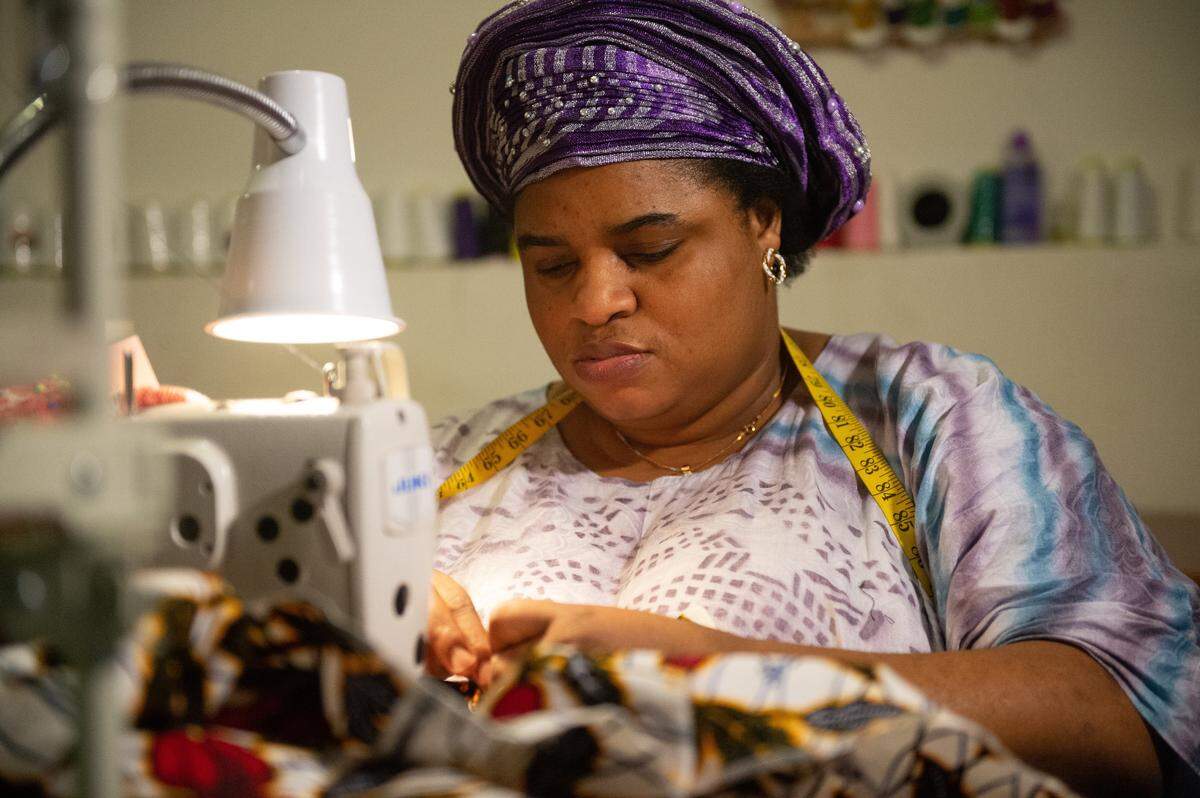
In December, The Star wrote about a former trainee, Liliane Lemani, who went on to start her sewing business in the garage of her KCK home. She now has her own dress shop.
These days Lemani, who more than a decade ago fled rebels in Democratic Republic of Congo, has joined in making masks from brightly colored African fabric. She says it’s her contribution to fighting the spread of COVID-19. “I want to help,” Lemani said.
Lian shares her sentiment.
“I finally feel like I am home,” Lian said. “My journey has been long, but to be honest, the U.S. saved my life.
“Now all the scary feelings are gone and I’m very thankful to all the people who helped me. I am so grateful to be able to make masks so I can pay it back.”