When will the coronavirus curve flatten in the KC area? So far, numbers keep growing
Since the beginning of the coronavirus pandemic, public health officials have stressed the need to flatten the curve, slowing the rate at which the disease spreads.
It’s the reason for the stay-at-home orders and social distancing efforts. And it’s crucial to keep hospitals from being overrun.
But so far it doesn’t seem that the Kansas City metropolitan area has achieved that goal.
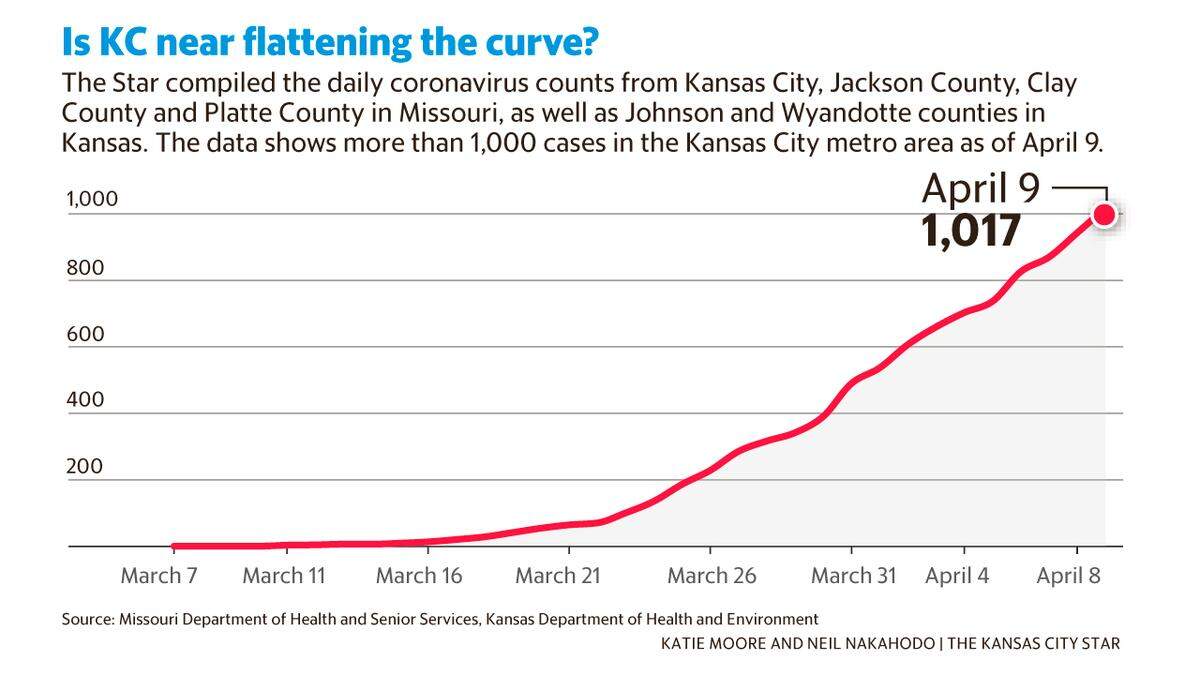
The trajectory of the cases does not appear to be leveling off, according to an analysis by The Star, based on data from local and state public health agencies in Kansas and Missouri. The largest one-day jump occurred March 31 when an additional 99 cases were identified.
The pace has not slowed consistently. In recent weeks, the metro has added dozens of cases some days and fewer on others. On Thursday, 74 new cases were reported. Stay-at-home orders remain in effect at least until later this month.
The area surpassed 1,000 COVID-19 cases, according to information released Thursday by health officials. One month ago, there was only one case.
Kansas City reported four new cases Thursday, raising the total to 257. Jackson County saw an increase of 10, to total 177 cases. Clay County reported 38 cases and Platte County had 21. On the Kansas side, Wyandotte overtook Johnson County with 272 cases to Johnson County’s 252.
Experts have warned that numbers are not accurate because not everyone with symptoms has been tested and results can take several days.
More deaths were also reported, raising the figure to 39 for the metro area. Three of the new deaths were in Wyandotte County, including a resident of Riverbend Post Acute Rehabilitation. Seven deaths have now been linked to the facility.
However, there have been positive developments locally.
There have been no new cases of COVID-19 at the University of Kansas Health System in a few days, the hospital said Thursday.
Steve Stites, chief medical officer for the hospital, said he is cautiously more optimistic than he was two weeks ago, but that several variables made forecasting challenging.
“How many pandemics have we lived through? That would be zero,” he said. “So we don’t really have models for how pandemics act, not in the modern health care world and especially not with a respirable, which means that a virus or a bacteria that you can breathe in and out.”
Kansas identified 1,106 COVID-19 cases on Thursday including 263 hospitalizations and 42 deaths.
In Missouri, there have been 3,539 cases and 568 hospitalizations. Seventy-seven people have died.
“The data we’re seeing today could still go either way,” Stites said.
Health officials and other leaders have cautioned that one large social gathering could easily thwart efforts to prevent further spread.
“The way this stays at a low level is because we’ve done such a good job of sheltering in place, keeping our distance, washing our hands, not touching your face and coughing into your elbow,” Stites said.
“Those things appear to really be working, not just in Kansas City, but across Kansas and Missouri, across the United States and in a way, across the world. So the curves are bent when we do the right thing.”
This story was originally published April 9, 2020 at 5:46 PM.