KCK schools had 1,400 homeless kids in 2015. Here’s how they cut that number by half.
When Marie’s daughter was stabbed — more than a dozen times — to death in Kansas City, Mo. in 2015, life for the school bus driver and mother of five started a downhill slide.
“My daughter’s death broke me,” said the self-described “strong woman” with a “deep faith in God.” Depression pulled her into a financial hole that ended in homelessness.
Had it not been for help from a Kansas City, Kansas Public School District program, she said she would not have regained her footing when she did. At her lowest point, Marie and three of her remaining five children — 9, 12, and 17 — moved from friend to friend for shelter. Marie, 44, asked that her last name not be used to protect her children.
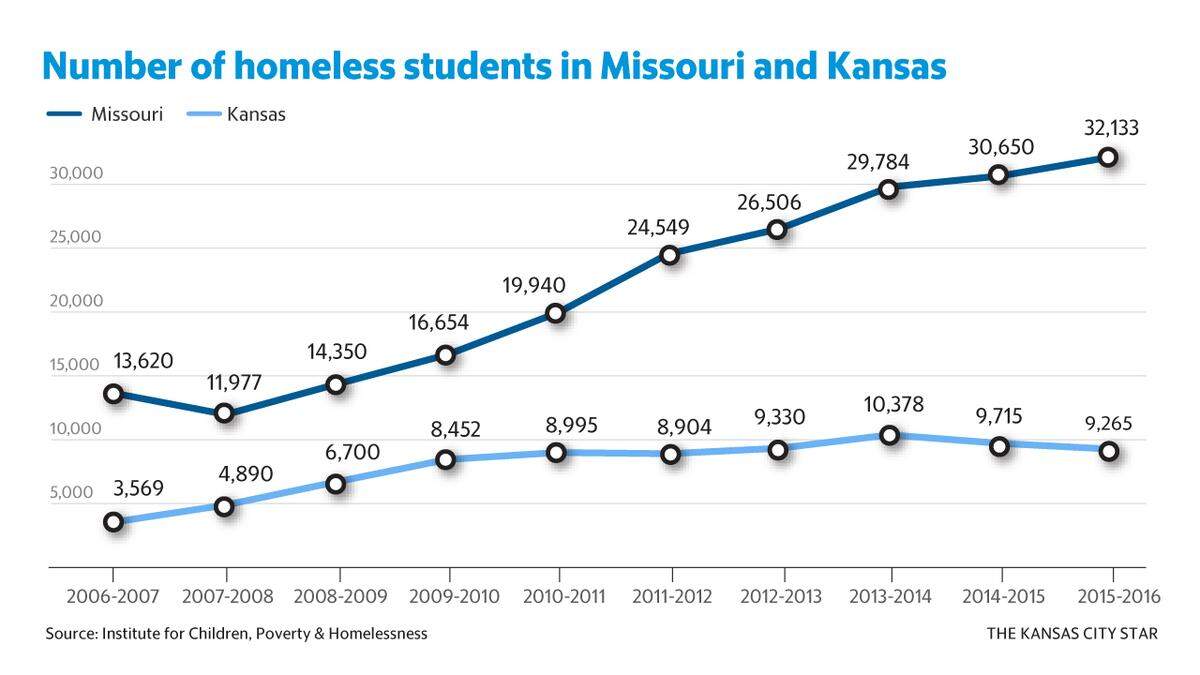
It’s a situation impacting thousands of our nation’s school children. Student homelessness in the United States more than doubled between 2007 and 2014. By the 2016-2017 school year 1.4 million students, ages 6 to 18, were homeless at some point, according to a 2018 report by The Institute for Children, Poverty, and Homelessness.
“Children experiencing homelessness lack the stability and support necessary to succeed academically,” says Noelle Withers, associate vice president of Housing and Homeless Services in New York City, where more than 20,000 school children, roughly the total enrollment of the North Kansas City School District, were homeless this year. In addition, Withers says, disruptions to a child’s education threatens their social and emotional development, while chronic absenteeism, “plays a significant role in homeless children quickly falling behind one grade or more.”
Wondering when or if they will eat, and where they will sleep, makes it hard for a child to focus on school work.
Districts around the country, including in Kansas and Missouri, are trying to tackle the problem. Marie and her children, who are enrolled in Kansas City, Kansas district schools, are an example of how KCK is succeeding and why the Hickman Mills and Center schools are replicating the effort in South Kansas City.
The Program
It was Marie’s conversation with another KCKPS mom about her struggle that led her to the McKinney-Vento program..
The 1987 landmark McKinney-Vento Act mandates that the nation’s public schools help remove barriers that impede homeless children in their classrooms from getting a fair shot at an education. Those eligible for McKinney-Vento help include children staying temporarily with friends or relatives, living in a park, motel or campground, in a shelter, vehicle or on the street.
The law, sponsored by two late Congressmen — Republican Stewart B. McKinney of Connecticut and Democrat Bruce Vento of Minnesota — gives students the right to remain in the same school district if they become homeless. In KCK, that has meant helping the whole family find stability.
But it’s an expectation that comes with little money, school officials said. This year KCKPS got $100,000 through a competitive federal grant.
“That pays for nothing,” said Jessica Smith, who coordinates McKinney-Vento for the KCK district. The money covers two salaries, including Smith’s, and buys school uniforms for students who can’t afford them. It also pays to transport transient students from wherever their family is staying to their district school. Supplies, toiletries, some food and money are donated by members of the community.

With so little to work with, the district needed help to offer families the level of social, housing and budgeting services they needed.
“We live in the most poverty stricken county in Kansas,” Smith said of Wyandotte. “We see generational poverty and homelessness and some have gotten comfortable there,” she said. They are families who have gotten fairly good at existing on life’s edge and have no idea how to walk it back.
“You send people somewhere to get money for the light bill when the lights are about to get caught off, but give them nothing more after that and in a month or two they are back in the same situation,” Smith said. “These families need guidance,” and someone to teach them how to get and stay stable.
In 2015, with more than 1,400 homeless students attending its schools, KCKPS partnered with the non-profit Avenue of Life, a community service organization looking for a population to help. In four years, the collaboration cut the district homeless population roughly in half. This year KCKPS counted 788 homeless students.
The expanded McKinney-Vento effort has aligned with other district efforts, such as instructional improvement officers in every school to work closely with principals, administrators and teachers, to improve student achievement. State data released earlier this month showed that more than 90% of the district’s 43 schools have made gains in English. The district report card, prepared by the state Department of Education, indicates that overall more students in the district are showing an excellent ability to understand grade-level math concepts.
Avenue of Life is what the district calls the “backbone” of McKinney-Vento in KCKPS, pulling community groups and agencies together under one roof. Through teacher and counselor observations of school children, homeless and low-income KCKPS families are identified and connected with the program.
Smith and her McKinney-Vento team bring families together with Avenue Of Life, where they are plugged into a network of support agencies that assist with everything from paying utilities to finding work, a home, food assistance, counseling and much more. Before any money is distributed, families complete a series of classes on employment, housing, finance and health care. Each family gets a navigator, or caseworker, who helps them journey toward independence.
The backbone agency carries most of the $1.5 to $2 million dollar-a-year cost. But every agency involved comes with in-kind professional resources as well as some financial contribution, said Desiree Monize, the chief operating officer for Avenue of Life.
It’s a lot of money. “But it’s worth it. It is solvable. We just have to learn to work together,” Monize said. “No one agency can do this alone. But when you leverage your assets together they go so much further,” Monize said.
“We can prove that it works.,” she said. “We have had a 95% success rate. Our families that get housing stay housed. Why do we do it? It’s what is right. Not just for our district, but for every district.”
The replicas
In Hickman Mills, which last year had more than 300 homeless students, the backbone is Blue Hills Church. The Center district, where 90 of the 2,700 students enrolled are homeless or very poor, partners with Serve the World Charities.
“Poverty and homelessness is a trauma,” said Stacey King, director of family and student services at Center. “The need was obvious.” She said that while the district, mandated by McKinney-Vento, had been “doing as much as we could,” it wasn’t enough. Following the KCK model, she realized, gave the district access to more resources and brought the community into the fold. “We could not do this work if we did not have that backbone agency,” King said.
“It’s our responsibility to support our kids,” she said. “What we are doing now is changing the tide for kids and their future. It will have much longer effects.”
Chris Buford, outreach pastor at Evangel Church and Mark Potter, an associate pastor at Colonial Presbyterian, two churches that have a long-standing relationship with the school district, were eager to get on board.
Potter said he was happy to help families “become eligible for dignified, affordable, sustainable housing in the school district.” He quickly learned that it truly takes a village to make the program work. Even if the district is identifying a student in need, “the parent has to be ready...so that it really becomes a partnership.”
It’s important too, Buford said, that when families sit down with a social service agency that has resources available, the agency is ready to say yes.
“If they are not ready to say yes then they are not really at the table,” King said.
They want families, when they show up for help, “to walk away with their needs met,” Buford said. His motivation is to ease the burden districts have carried to reach students who are so troubled by forces they can’t control that success in school seemed insurmountable.
“The schools’ job is to educate,” Buford said. “Leave the social work to the community and hopefully relieve the schools so they can succeed.”
Hickman Mills school officials said they were overwhelmed by the numbers and couldn’t get ahead of the problem.
“We had so many families that were so transient that just getting the children to school was not enough,” said Leslie Washington, a student services specialist for the district.
When she saw the Avenue Of Life success in KCK, “I said we have to make this happen in Hickman Mills.” the District launched their Hickman Mills Impact program on Thursday. Families left that day with connection to a case worker, boxes of food and sign up for holiday food baskets.
Washington has big aspirations. “My goal is to eliminate homelessness in Hickman Mills schools in three years.”
Making it go away completely, some experts say isn’t realistic. But a big reduction is doable.
If families feel supported and students are learning, Potter said, everyone is winning, including the community. “We don’t just want families to be here, we want them to stay here and contribute to the community.”
Finding trust and support through McKinney-Vento sometimes surprises families unaccustomed to that kind of help. “I never had no family and I never had no support,” said Marie, whose husband was murdered years ago. “What I’ve been through, God carried me.”
How homelessness happened
Marie’s 19-year-old daughter was murdered during a fight with a woman she was staying with in a midtown Kansas City apartment. “I wasn’t able to stave off the bills,” she said. As her depression deepened, she thought maybe changing her surroundings would help, so she moved from the south Kansas City home she was renting to Kansas City, Kan.
On the surface, the new house looked great, she said. But underneath the surface a black fuzzy fungus grew. “Mushrooms sprouted,” up through the floor. Mold clung to furniture, rugs, clothing, and Marie said her landlord wouldn’t clean it. “I told him I wasn’t going to give him another penny on that house in that condition,” Marie said.
She tossed most of what she owned in the trash and packed up the rest. But she and her children were left with no place to live.
“I had shelter but I didn’t have my own place,” said Marie, who continued working as a bus driver, a job she’s had for 13 years. She spent much of her salary buying groceries where ever she was allowed to stay and “I had to give people money to stay with them and buy gas.”
It wasn’t the first time Marie had been homeless. She grew up in Missouri’s foster care system. By the time she was a teen, she was living alone on the streets, she said. This time was a lot different. Marie had children counting on her and she could see the instability taking a toll them.
Then one day after leaving work, “a semi ran into the back of me so then I had no vehicle. It was very stressful. I just needed a little help.”
Smith says Marie’s story is not so unusual. Many of the parents she helps are working families that end up homeless due to circumstance. “People are not homeless because they wake up one day and say ‘Gee I think I’ll go be homeless today’.” And she says a lot of times they could have avoided it had they asked for help sooner.
As soon as Marie learned about KCK’s program she reached out. McKinney-Vento case workers helped her look for new home and inspected it before paying the $1,860 for first and last months’ rent so Marie and the children could move in.
“When McKinney-Vento helped me that was big,“ Marie said. She’s still driving the school bus, working extra hours and saving money when she can. Her children are doing a lot better in school now, she said. Avenue of Life has helped her find mentors and counselors for the kids and her oldest says she is proud of what her mom has accomplished.
“I have people tell me all the time, ‘Marie, you are very strong. You are unbreakable.’ I’m still broken but I just choose to manage. I really never had any other choice.”
This story was originally published October 27, 2019 at 5:00 AM.