Hickman Mills will definitely close schools — but how many?
Forced by financial turbulence and declining enrollment, the Hickman Mills school district announced it will shutter three to five elementary schools. Now, for the next two weeks, school leaders and the community will haggle over exactly how many and which ones.
Members of the south Kansas City district’s school board on Thursday got a first look at three options for closing some of the district’s eight elementary schools as it looks to cut $5.5 million from its budget. The board is set to make a final decision on March 7.
One option would close three schools: Johnson, Symington and Truman. A second would close those three as well as Dobbs. The third option would close those four as well as Ingels.
The plan would also reconfigure some grade levels: Ninth-graders, who have their own Freshman Center, would move into Ruskin High School. Sixth-graders, who are in elementary schools now, would move to Smith-Hale Middle School, and elementary schools will house kindergarten through fifth grade.
“There is no other way to say this except, you’ve got more capacity than you need,” said Edward Humble of MGT Consulting Group, the Florida-based firm the district paid $33,000 last month to study how well each school building meets district needs.
Humble said the firm considered demographic and enrollment data and location, and it held several community forums to come up with a plan to help the district operate more efficiently.
Parents and community leaders who packed Thursday night’s meeting said closing so many schools would hurt the district and send a message that Hickman Mills is going downhill. They asked board members to reject the MGT recommendations.
“I was stunned by the magnitude of the proposed closures,” said former Kansas City councilman John Sharp, who has lived in the Hickman Mills district for 51 years.
While the MGT recommendations did not address teacher layoffs, several people who spoke at the meeting said some teachers have started sending out resumes.
Closing schools, Sharp said, “sabotages our efforts to maintain a high quality staff. How likely will it be that the district will be successful in recruiting top teaching talent to fill vacancies when possible applicants hear about such massive school closures?” In addition, he said, the plan “could cripple efforts to bring more housing and retail services to the area.”
The proposed school closings come on the heels of the release of Missouri school Annual Performance Reports, in which Hickman Mills scored a 77.3 percent, its highest score in five years. Districts need to score at least 70 percent to be considered in full accreditation range. Hickman Mills and Kansas City Public Schools are the two districts in the area that are only provisionally accredited and working to regain the higher accreditation status.
Some at Thursday’s meeting said they thought news of the district’s high APR score might mark a turn-around that could boost future enrollment.
Board members said they will consider the community concerns as they study the proposals over the next two weeks.
“It is a very sensitive matter and we are not taking it lightly,” said board member Carol Graves. “I don’t want people to think that board members don’t care. We live in this community. We don’t want to make any decision that is going to disrupt this community.”
Part of the problem is that for years Hickman Mills has been spending more than it was bringing in and dipping into its reserve funds. The state recommends districts keep 24 percent fund balance, enough to cover expenses for at least three months. But this school year, the reserves dropped to 8 percent. Board members have recommended the district increase reserves to 15 percent.
Another contributing factor, school leaders said, was an error with tax revenue estimates from Jackson County.
“We have to find a way to stabilize our budget,” said board President Wakisha Briggs. ”We understand it is going to be very difficult.”
A big factor adding to the woes is the district’s history of declining enrollment. The district lost an average of 72 students a year for the last 30 years. In some years the drop was as many as 300 students, according to a demographic study commissioned by the district. Under the state’s per-pupil allotment, a loss of 72 students equates to about $347,250.
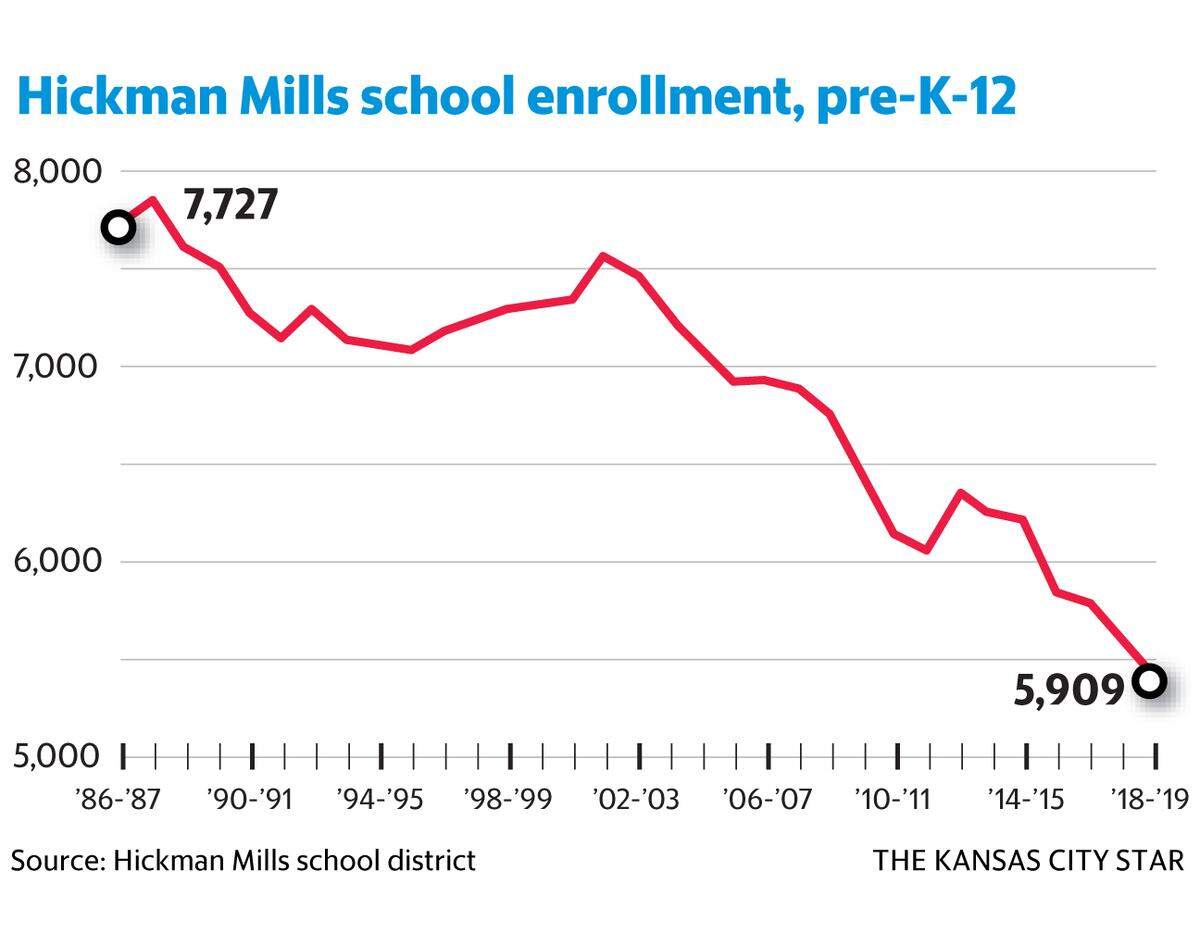
Carl Skinner, deputy superintendent of student services, said on Thursday that enrollment continued to decline in the last three years, from 6,309 in 2017 to 5,883 today, not including pre-K. That drop of 426 students is “in line for what the district has done for the past decade.”
District leaders said they see no evidence that enrollment numbers will stabilize or turn upward. Rather projections are that enrollment will decrease more than 20 percent down to 4,472 by 2027.
The board will meet at 6 p.m. March 7 at Smith-Hale Middle School’s multipurpose room, 9010A Old Santa Fe Road.