
Amid bullet holes, scars and fear, Jackson County prosecutor’s office helps victims
Akacia Moore was ready to enjoy a late evening meal in mid-September when she realized the restaurant failed to put napkins into her bag of takeout.
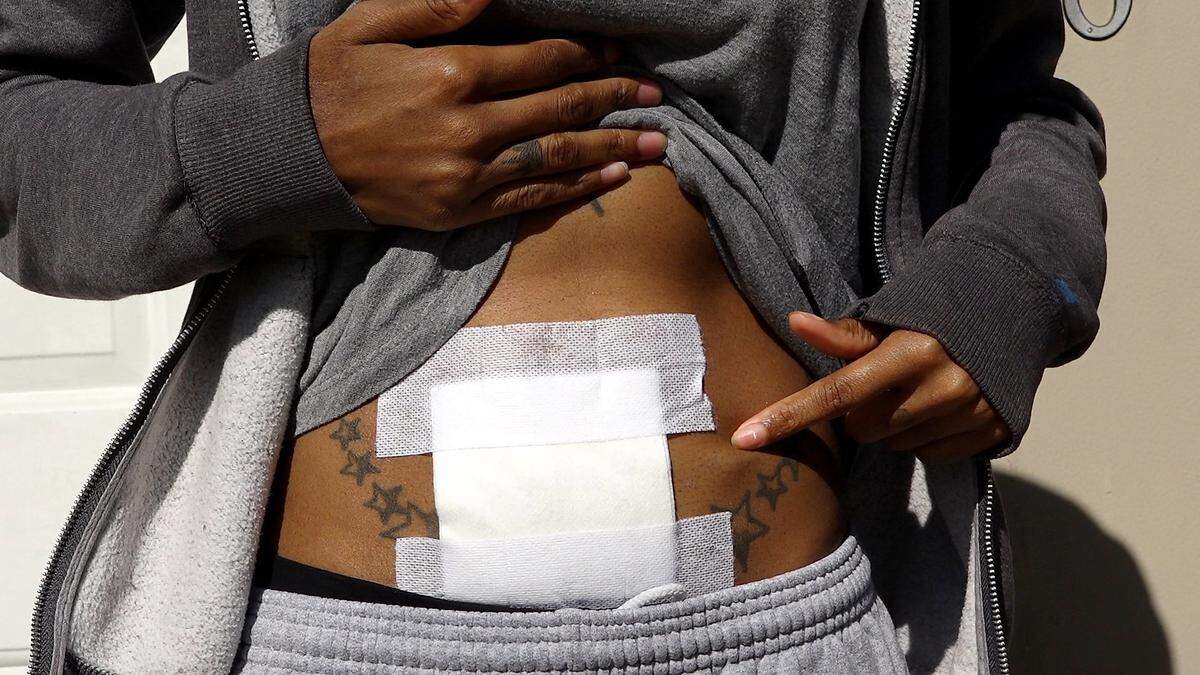
Just as Moore, 25, dragged herself off of the couch to retrieve some napkins from the kitchen, four bullets ripped through her living room wall. One 9mm round hit Moore in the lower abdomen.
Weeks later, while she was recovering at her south Kansas City home, two workers from “Caring for Crime Survivors,” a new program aimed at helping victims of gun violence, knocked on her door to offer help.
“It sucks that this happened to me but with this program it will definitely help me get better mentally and in every way actually,” Moore said.
The Jackson County Prosecutor’s Office launched the program earlier this year, offering help repairing bullet holes, in-home trauma and grief counseling, help paying utilities, sometimes just a bag of groceries.
Since it began in February, the program has sent workers to meet with 100 crime victims. One visit was to the 4500 block of Lister Avenue, where a gun battle between neighbors left homes with more than 60 bullet holes.
“If you want to live in a healthy community, you have to demonstrate what good health looks like,” said Jackson County Prosecutor Jean Peters Baker. “That means when homicide befalls a family, even non-fatal shootings, we should not just let them fend for themselves and say ‘good luck.’ We need to wrap our arms and try to lift them up.”
Baker said part of the idea is to encourage victims and witnesses to cooperate with police in bringing criminals to justice.
Kansas City police and other area law enforcement agencies provide referrals to the Jackson County program. Workers also receive non-fatal shooting reports from police departments to help identify those who may need their services.
From there, trained workers with the Ad Hoc Group Against Crime and a victim advocate from the prosecutor’s office travel throughout the county to meet with crime victims. Three days a week, the workers visit homes hit by gunfire.
On a recent Friday afternoon, Marilyn K. Layton, a victim advocate, and Branden Mims, a community resource advocate with Ad Hoc, visited the home of Myrna Towson, 76, who almost fell victim to a stray bullet.
The bullet blasted through a window in her gray bungalow in the 4500 block of Monroe Avenue, left a quarter-sized hole in a living room wall, flew into her bedroom and lodged itself in her cable television box, destroying it.
Had Towson not moved in time, the bullet would have struck her. It also could have hit her son, who also was in the room.
“I thought it was a firecracker,” she said. “Thank you Jesus, that it missed me.”
Her visitors, Layton and Mims, shook their heads in disgust.
They went outside to survey the damage, noticing the spray of bullets also impacted the siding and a car parked next door. The workers offered to help that homeowner, too.
“I think it’s nice that at least somebody cares enough to see what is going on in your community,” Towson said.
The program operates this year with $100,000 in funding through the county’s anti-drug and anti-violence agency, COMBAT.
Peters Baker said her office also sought grants to pay for the program but nothing came through.
The Jackson County effort also can provide victims with a change of clothes and help cleaning up crime scenes. Shelter and relocation assistance also are available. The Kansas City Police Department has had a similar program since 2012.
Layton has been working with family members of homicide victims for 24 years.
“It is more than a job to me; it is the help that we deliver to people,” Layton said. “These are innocent people and they shouldn’t have to go without support.”
Akacia Moore, the south Kansas City resident hit by gunfire in September, said she has suffered from night terrors and has had difficulty sleeping since the shooting. A four-inch bandage covers the scar where the bullet struck her.
The bullet remains lodged in her body. Surgeons told her it will work its way out on its own.
“I say a prayer every night,” Moore told her two visitors from the county. “When I get up in the morning, I say, it is going to be a good day. If not, then I am going to make it a good day.”
Hearing that, Mims, who also is the senior pastor at the Greater Metropolitan Church of Christ on the east side of Kansas City, said he felt compelled to do something else to uplift Moore.
He and Layton took Moore by the hand and prayed.