
She agreed to testify against her smuggler. He went free; she’s still in ICE custody
For nearly three years, an undocumented married mother who first came to Kansas City when she was 8 has been in a Kingston, Mo., jail, under custody of U.S. Immigration and Customs Enforcement.
She was caught trying to cross the Mexican border for a second time, with a paid smuggler whose associates she now fears.
The smuggler she agreed to testify against was slapped on the wrist and freed — sentenced to 30 days in 2015, most of it already served after his arrest on felony smuggling charges.
Maria Garcia-Mata’s case sheds light on a little-reported tactic in border enforcement called the “flip-flop.”
Immigration lawyers say it’s putting some persons at risk of being targeted by criminal rings when sent back to their native countries. And it’s occurring at a time when the U.S. government has vowed to scale back asylum options for those immigrants.
A practice dating back years, the “flip-flop” allows an overworked Justice Department to negotiate felony smuggling counts down to misdemeanors after lining up witnesses against the accused. This way, the arrested smugglers — mostly U.S. citizens — are quickly moved through the system instead of creating a logjam of trials.
Ironically, the deal that sprung Garcia-Mata’s smuggler was struck near the Arizona border town where U.S. Attorney Jeff Sessions pledged in April 2017 to get tougher on traffickers-for-hire.
“As you know too well, this is a booming business down here,” he told a gathering of border agents. “No more.”
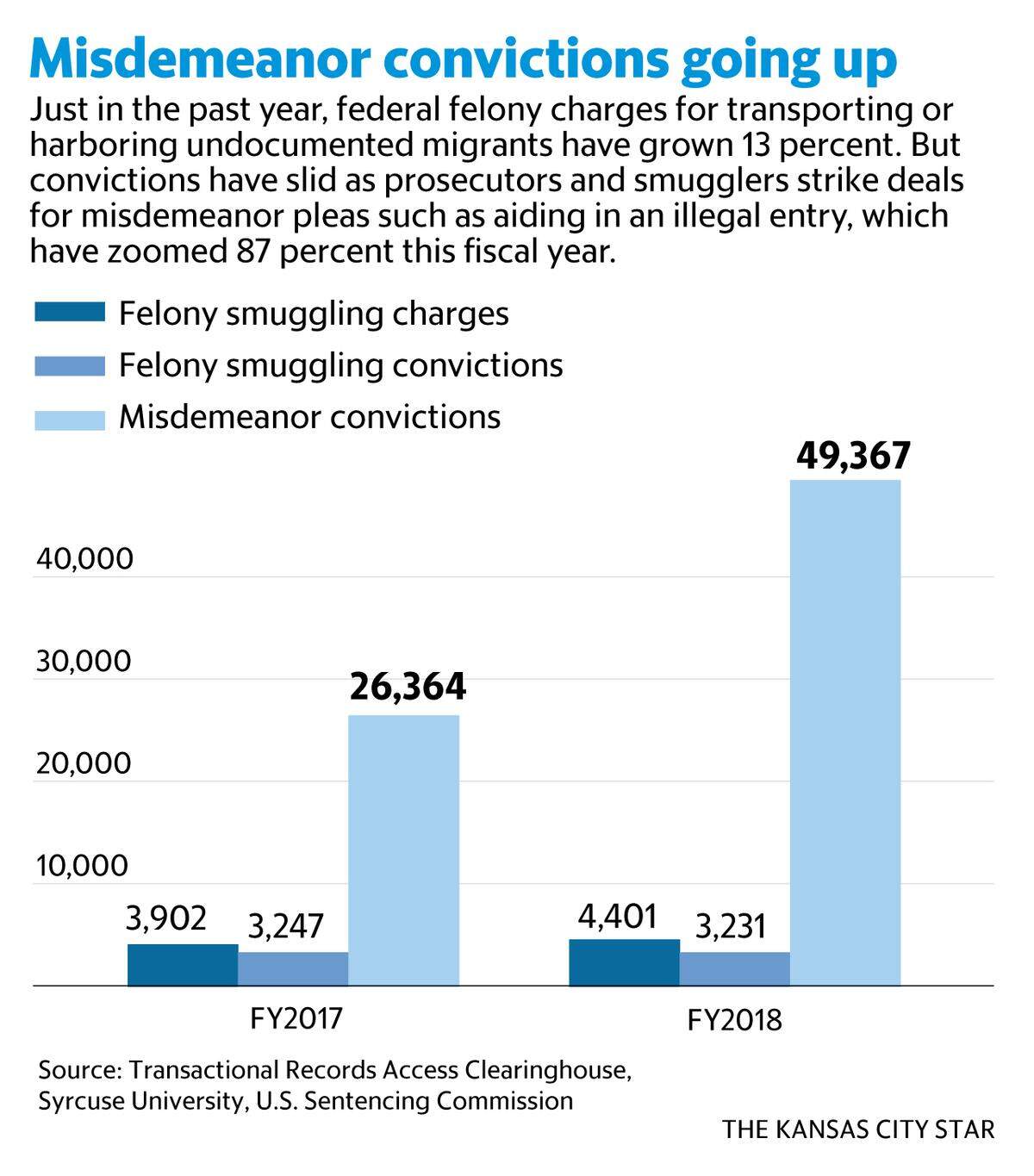
Statistics compiled by Syracuse University show that while the number of felony charges filed against smugglers are projected to be up 13 percent for fiscal year 2018, convictions and prison sentences have dipped from the year earlier.
More dramatically, the numbers show that misdemeanor convictions for assisting in an illegal border entry are expected to jump 87 percent in the same period, from 26,364 to 49,367, according The Star’s analysis.
This suggests more professional smugglers are being captured and released on minor charges.
Garcia-Mata, 32, is seeking asylum from a third removal to Mexico in five years. Her argument is based on alleged threats from a member or members of a group her relatives hired to smuggle her, according to court records.
Now she is caught in the buffeting effects of policy changes from one president to the next, said Washington D.C.-area immigration lawyer Dree Collopy, who has no connection to the case.
“I don’t know the data on smugglers,” acknowledged Collopy, “but anecdotally? Individuals being apprehended seem much more targeted than the smugglers.”
Breaking down stats
Since the late 1990s, Syracuse’s online Transactional Records Access Clearinghouse (TRAC) has compiled data on federal prosecutions, convictions and prison sentences of persons suspected of “bringing in and harboring certain aliens.”
TRAC statistics reveal broad patterns of crackdowns on smugglers between 2004 and 2008, followed by a drop in criminal cases under President Barack Obama’s administration, then a slight uptick in the first 16 months of President Donald Trump’s term.
While the disposition of individual cases isn’t accessible, an analysis of the data by The Star shows that throughout those years, felony charges against alleged smugglers routinely vanished.
They either were dropped, failed to result in convictions and prison sentences, or were whittled down to lesser crimes such as “aiding and abetting” in an illegal entry.
(Tens of thousands of misdemeanor cases are brought annually against persons not linked to professional smuggling rings. They include the relatives and friends of migrants who cross the border, and about 95 percent plead guilty.)
Regarding the accused felons, consider: In fiscal year 2013, early in Obama’s second term, U.S. attorneys filed 3,585 cases of transporting and harboring unlawful migrants — a charge typically brought against alleged smugglers working for profit. But TRAC recorded only 2,650 convictions in 2013 and fewer than 1,500 prison sentences of one year or more.
Similar patterns are emerging in fiscal year 2018, not quite halfway into Trump’s first term.
TRAC shows prosecutions to be far higher, as Sessions promised, than five years ago — about 4,400 cases projected to be filed against suspected smugglers by October, when a new fiscal year begins. Should activity continue at the present pace, felony convictions will number around 3,200 and prison sentences below 1,800.
However, felony convictions so far are flat. And in 2018, the number of prison sentences is 5.5 percent lower.
Meanwhile, lesser convictions — charges related to aiding and abetting migrants, with little or no jail time — have skyrocketed in the past year.
Bottom line, the smuggling rap plunges from a felony and imprisonment to a misdemeanor — often because the accused knows a witness is cooperating with authorities, said Arizona defense lawyer Paul J. Gattone.
“Flip-flop,” said Gattone. “You’d be a fool not to take it” when facing human smuggling charges.
He added, “It’s all very weird and sort of a game, actually.”
KC mother’s case
Gattone in 2015 was appointed to represent Salvador Suchilt, an 18-year-old American facing up to 10 years imprisonment in the case involving Garcia-Mata.
According to public records that Gattone kept on the case, Suchilt had no criminal history. The same applies to most persons arrested for helping migrants cross, according to the U.S. Sentencing Commission.
“And that’s the most likely reason for the flip-flop,” Gattone said.
Though he said he understood why Garcia-Mata’s family and attorney would be indignant about the plea deal, Suchilt was a two-bit player for the group that arranged the smuggle: “If I recall correctly, he was one of these recruits from the United States who gets a call saying, ‘We’ll give you $300 if you meet this person at mile marker whatever and drive her in.’”
But the pair drew suspicion at the point of entry. Garcia-Mata’s papers were fake and she told agents that Suchilt provided them, according to documents that Border and Customs Protection filed to hold her as a material witness.
Despite her helping prosecutors, it took only a few days for the U.S. Attorney’s office in Tucson to drop felony smuggling charges against Suchilt and let him plead to a misdemeanor of assisting in Garcia-Mata’s re-entry.
“Pretty egregious,” said Matthew Hoppock, Garcia-Mata’s attorney in Kansas City. “He pleads because he knows that a woman (he smuggled) in a cell down the hall is able to finger him. ... Then the government just lets him go.”
So Garcia-Mata never did testify. Still, she had reason to fear that anyone with Internet access could learn through public records that she was going to talk.
Experts say authorities often will entice witnesses to cooperate by pledging not to pursue felony charges and prison time, which is the government’s prerogative with repeat violators. But in Garcia-Mata’s case, officials offered no such promises, Hoppock said: “She’s a simple person wanting to do the right thing.”
After the plea deal, a federal court sentenced Suchilt to 30 days, with credit for time already served after he was arrested. He was freed without probation.
Garcia-Mata, meantime, was placed in ICE custody, where she remains.
“Is that a common situation? The answer is no,” said Cosme Lopez, a spokesman for the U.S. Attorney’s office in Arizona.
Still, he acknowledged what federal prosecutors everywhere are saying: Stepped-up arrests and an overwhelming backlog of immigration cases require them to be selective in whom they take to trial.
In response, Attorney General Sessions announced in May that 35 assistant U.S. attorney positions will be added along the southwest border to handle prosecutions, including those addressing “alien smuggling.”
Asylum changes
Garcia-Mata’s case recently rose out of the shadowy proceedings of federal immigration court into the public domain of the U.S. Court of Appeals, the Eighth Circuit.
Hoppock, her Kansas City attorney, convinced a panel of judges, over ICE objections, to remand the case back to the Board of Immigration Appeals for reconsideration.
Following that ruling, Garcia-Mata’s local family, who include three U.S.-born children, did not respond to requests to discuss their situation with The Star. They declined to even provide a photograph of her.
“They believe the less publicity, the better for her” if she must return to Mexico, Hoppock said.
Appellate court records and oral arguments detail her 2015 attempt to return to the U.S. — after her second deportation in two years. The first time she re-entered, she was charged with making false claims and sentenced to 150 days in jail before being returned to Mexico, ICE said.
Then her relatives hired a group to smuggle her across the border once more. According to Garcia-Mata’s account in immigration court, “the group told her in Mexico that they were ‘not allowed to make any mistakes,’ and that ‘they will never leave a loose string,’” records state.
She said that she spent almost two weeks in a house frequented by armed men. She said that she heard other persons shouting and being beaten in the house. And that the group seized her cellphone before the border officers thwarted her re-entry.
Not familiar with the case, border patrol agent David Hernandez told The Star in a phone interview that apprehending paid “foot guides” is a high priority for his agency. But once a case is passed on to U.S. attorneys, “prosecution of the foot guides is very difficult” and deals get made.
“Some are mom-and-pop operations” asking $2,000 or less to transport one person across the border. Others guides are linked to crime syndicates. “Human smugglers are among the most unsavory people we come into contact with,” Hernandez said.
After the arrests of Garcia-Mata and Suchilt, someone in the smuggling group used Garcia-Mata’s phone to message her husband. Then family members on her contact list began receiving cryptic notices, some taken as threats.
One text said that when Garcia-Mata “got out...they had something to ask (her),” according to a court filing.
It all sets up an arguable case for asylum.
As immigration Judge Glen R. Baker ruled in 2016, Garcia-Mata belonged to a group of “witnesses in criminal proceedings who will be targeted in Mexico.” And knowing the Mexican address of her grandparents, the “the smuggling criminal organization would have the capability and the knowledge ... to carry out any threats” should she return, the judge reasoned.
That ruling came five days before Americans elected Trump president. Several weeks after his inauguration, a panel of the 21-member Board of Immigration Appeals took the uncommon action of overturning Baker’s decision on ICE’s appeal.
And under the Trump administration, odds are growing longer that asylum seekers claiming what courts call a “credible fear” of persecution can avoid deportation, said Collopy. She chairs an asylum committee for the American Immigration Lawyers Association.
Session’s recent directive on tightening asylum guidelines may compel some judges to turn down claims of fear not tied to the actions of government officials of a native country, she said. (Sessions also said that fear of violence from domestic partners be disregarded.)
“If it’s private actors you fear, you have to prove that the government is unable or unwilling to control them,” Collopy said. “And that would apply a lot of times to Mexico, given the government corruption.”
She said Garcia-Mata’s case for asylum “certainly makes sense and, to me, is a reasonable claim.”
As for Suchilt, the accused smuggler, his freedom after the plea deal was short-lived.
Arizona authorities busted him in February 2016 for possessing methamphetamine and allegedly conspiring to import and distribute the drug. He pleaded guilty to importation and was sentenced to 46 months in prison.
His release is scheduled for next June.
Garcia-Mata could remain jailed beyond that, given the months-long backlog of immigration cases awaiting final disposition.
“As a twice-deported convicted felon,” said ICE spokesman Shawn Neudauer, “she remains in ICE custody pending a ruling by the Board of Immigration Appeals.”
The re-hearing has not yet been scheduled.
This story was originally published August 20, 2018 at 5:30 AM.