
Benchmarking offers new strategy for teaching reading
Don’t worry, teachers, say the big thinkers brewing a new strategy for reading.
Your unique classroom styles are safe. Your best practices can still prevail.
Benchmarking — a teaching strategy that has worked for math in many Kansas City area classrooms — might just be the thing that reading instructors need to win what has long been a nationwide struggle to get all children reading at grade level in the third grade.
“There was some fear,” Grandview first-grade teacher Cyndi Lyons said. “Are we going to dissect the reading process?”
What’s on the way, first in the Grandview and Center school districts in south Kansas City, will certainly challenge early elementary teachers and principals, say the district leaders and educators at Prep-KC developing the idea.
But this is not the next round of the Reading Wars.
In the past, academic forces have fought over ideology, like phonics versus whole-language instruction. Programs like Success for All swept into schools, holding that heavily scripted reading content and instruction protocols were the key.
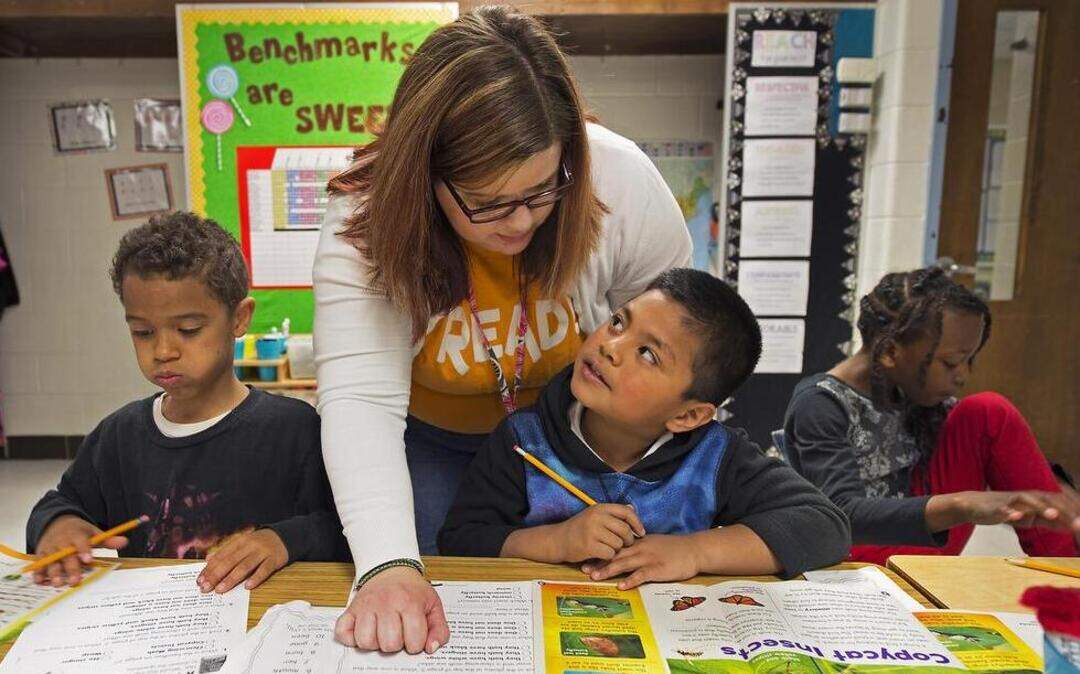
This time, with benchmarking, no one means to get in the way of Lyons and her sing-song lyricism as her children at Meadowmere Elementary join her in voice and hand claps, unpacking compound words.
The mealworms in the tiny plastic cups at each desk — inspiration for reading about the worms and then writing about them — fit right in.
Stacie Moore, who will try benchmarking in her first-grade class at Belvidere Elementary, gets to keep on with her author studies.
She has children participating with such enthusiasm that their raised hands wiggle like dolphin flippers in hopes of being called.
All of their strategies will remain in play as nearly 90 kindergarten through second-grade teachers work together in the coming summer months on benchmarking strategies. They’ll put benchmarking to work in their classrooms this fall, hoping this will be an idea that grows.
In math, the Grandview and Center districts saw benchmarking work, and it made sense: Teachers create a precise series of kid-friendly “I can...” statements that describe math skills their children need to learn.
The skills build on each other, and the children follow their progress and motivate one another as they check off each mastered skill on charts hung on classroom walls.
Teachers began to ask, said Prep-KC Vice President Kathleen Boyle Dalen: “When can we do benchmarking for literacy?”
That question is not easily answered because of the different nature of learning reading versus learning math.
But no one questions the urgency.
Ability to read at grade level by the third grade has become a major indicator of a child’s chances of future success.
A child who falls short in reading is four times more likely not to graduate from high school on time, according to research by the Annie E. Casey Foundation.
If that child is poor, the number increases to 13 times more likely.
And despite generations of educators’ sincere efforts, 66 percent of the fourth-graders nationwide taking the National Assessment of Educational Progress scored less than proficient in reading.
In Missouri, 65 percent of fourth-graders were less than proficient, and in Kansas, 62 percent.
Local districts also struggle in state test performance. Area Missouri districts on average saw less than 40 percent of their third-grade students score proficient or advanced in reading.
The scores show that the strain grows for districts as their percentage of poor students grows.
Both Lyons and Moore know what’s at stake. It’s why they teach first grade, they say.
“To be able to do anything else … science, math, social studies,” Lyons said, “you can’t do it if you’re not reading first.”
Like riding a bike
“Look at her eyes,” reading specialist Krista Calvert told a roomful of Grandview elementary teachers.
A young girl pictured on the screen is trying to ride her first bike.
The concentration is intense. So many things have to work in that moment, Calvert says. Balance. Grip. Steering. Pedaling. The critical skills must be learned and practiced simultaneously, or you’re not riding a bike.
This is why learning to read and benchmarking are a complicated fit, Calvert said.
Math is more like constructing the bike. You need to know the overall picture from time to time. But the pieces of math build on each other, focusing on single skills at a time.
Think of all the things a reader does in that bike-rider-like moment, Calvert explained later.
You’re recognizing words. You feel the structure of language. You read and re-read when losing track. You’re self-correcting. Seeing different perspectives. Sensing expression. Building impressions of characters and themes.
And it’s happening all at once.
Teachers can create “I can…” statements to motivate children and help them understand the skills of good reading — but the skills are never fully mastered.
They challenge every reader over and over, only moving to deeper and more difficult texts.
I can retell a story with details. I can identify character traits.
Teams of teachers and coaches will work this summer to develop their own “I can…” statements aligned to the state’s learning standards.
The skills will be arranged to guide teachers and children and chart their growth as the teacher reads aloud and as children read independently.
Prep-KC is also researching and accumulating books to supplement the teachers’ existing school libraries.
The libraries will provide more choices of “authentic texts,” Calvert said, that are “well-written, of high-quality, by real authors and real illustrators” — and that also can go home with children.
And the teams of teachers and their coaches will meet regularly to learn from each other.
Every child can learn to read, said Prep-KC’s Susan Engelmann. But every child can also “get stuck” at critical moments along the way.
Benchmarking and the collegial support around it, she said, mean to help teachers “know when and how to intervene.”
More work, more fun
Lyons stepped out of a career in insurance and went back to school to become a first-grade teacher at Meadowmere Elementary because she wanted to help change the world.
Moore, now with 18 years in classrooms, knew all along she wanted to teach first-graders like her class at Belvidere and help set off “the connections” in children’s heads “that get them so excited.”
The teachers like that the plans around benchmarking, if anything, will give them more freedom in creating ways to inspire their students.
The “off-the-shelf” prescriptive reading programs had their run and haven’t made enough difference, Calvert said.
“We can’t do it for them,” she said.
The teachers want the responsibility, Lyons said.
“It’s more work, but more fun,” she said. “I don’t know any teacher not willing to do the work.”
The program will rely on the collective and growing expertise of teachers who made elementary teaching their life’s work, Boyle Dalen said.
“What we know is how truly complex it is to be a great reading teacher,” she said. “And every kindergarten through second-grade teacher needs to be great.”
Reading consequences
4: number of times more likely that a child will not graduate high school on time if the child is not reading at grade level by the third grade
13: number of times more likely the child will not graduate on time if the child is not reading at grade level and is also living in poverty
Source: Annie E. Casey Foundation
This story was originally published May 6, 2015 at 9:38 PM with the headline "Benchmarking offers new strategy for teaching reading."