
Arrests made in Kansas City fast-food worker protests
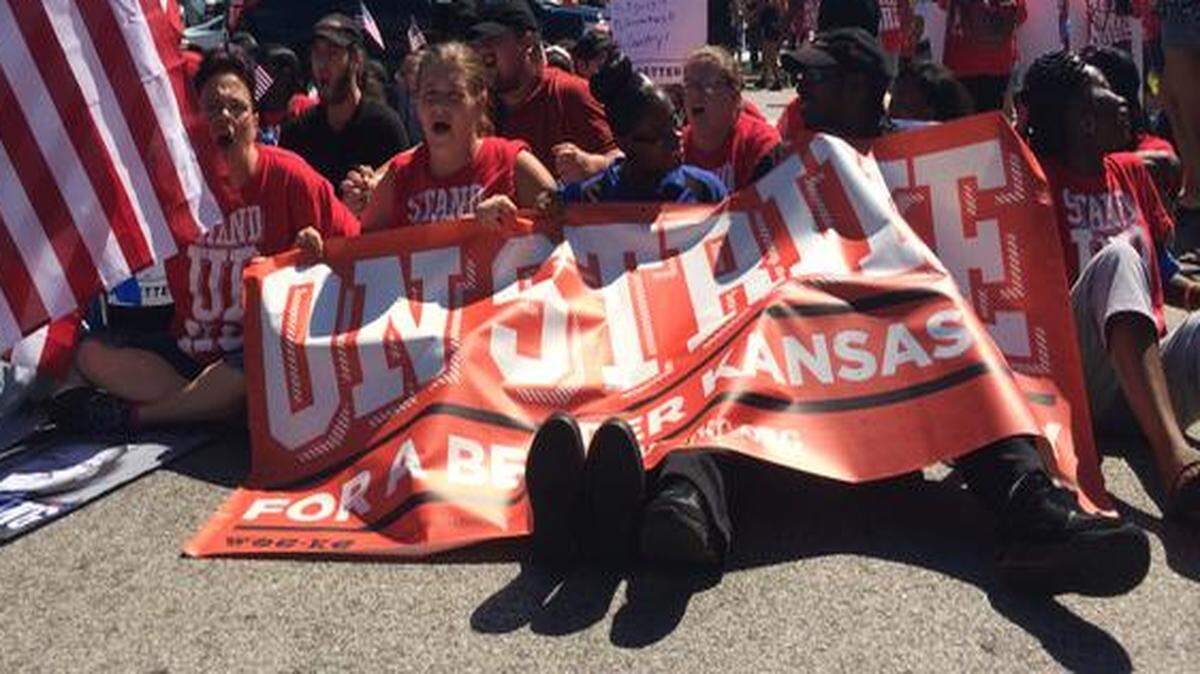
Hundreds of workers, union members, clergy and social justice advocates sang and chanted as 52 fast-food workers were arrested by Kansas City police Thursday during a wage protest.
The workers participated in a noon sit-down at 14th Street and Prospect Avenue, in front of a McDonald’s restaurant.
The day marked the first arrests locally in what has become a series of six large, fast-food wage protests staged in Kansas City in the last year and a half.
Dozens of arrests were reported in Detroit, New York, Chicago, Las Vegas and Little Rock, Ark., among about 150 events nationally. In all, about 500 arrests were made, protest organizers said.
The protests, loosely tied to efforts to increase the federal minimum wage, have broad labor union support. Nationally, the wage campaign is organized under the slogan of “$15 and a union.”
“The movement is challenging fast-food companies’ outdated notion that their workers are teenagers looking for pocket change,” a union-sponsored statement said. “Today’s workers are mothers and fathers struggling to raise children on wages that are too low, and they’re showing the industry that if it doesn’t raise pay, it will continue to be at the center of the national debate on what’s wrong with our economy.”
The Service Employees International Union and other labor organizations are spending millions of dollars to underwrite the fast-food workers’ movement.
In Kansas City, the labor-supported StandUpKC coalition was prepared to put up bail money for the arrested workers if needed.
The National Restaurant Association said in a statement that the protests are an attempt by unions to “boost their dwindling membership.”
McDonald’s issued a corporate statement saying it respected “everyone’s rights to peacefully protest,” but it criticized staged strikes in which protesters were bused to locations or, according to its information, being paid to be arrested.
The company also said it supported “paying our valued employees fair wages.” It said the minimum wage demands affect everyone, not just one company, and should be debated along with related issues, including the impact of the Affordable Care Act.
“We believe that any minimum wage increase should be implemented over time so that the impact on owners of small and medium-sized businesses — like the ones who own and operate the majority of our restaurants — is manageable,” the company said.
McDonald’s is challenging a determination by the National Labor Relations Board counsel that the company is a joint employer with its franchise operators.
Restaurant trade groups have said higher wages would lead to increased food prices and would cause job losses, especially among entry-level workers. The International Franchise Association said higher wages would pare profit margins among franchise operators.
The Kansas City protests on Thursday included a breakfast-time demonstration at 103rd Street and Wornall Road. The activity heightened around noon at 14th and Prospect, where protesters temporarily blocked an access road across the street from a McDonald’s.
“I’m doing this to bring my family together, to pay for our life,” said Kat Lickteig, one of the sit-down participants, who said she has worked for Wendy’s for 10 years and earns $7.85 an hour.
She said she was willing to be arrested in an effort to improve her pay.
Bob Bertini, a corporate spokesman for Wendy’s, responded that the company was “proud to give thousands of people, who come to us for an entry-level job, the opportunity to learn and develop important skills so that they can grow with us or move on to something else.”
Most of the crowd stayed on the public sidewalk. Kansas City police officers used plastic handcuffs on those who chose to be arrested for sitting in the street.
Officers confirmed with protest organizers that being arrested was the goal of the participants.
The 52 arrested workers were charged with a city infraction of failure to use the sidewalk and were released on their own recognizance without having to post bail. Court dates were set for October in Kansas City Municipal Court.
Rob Green, executive director of the National Council of Chain Restaurants, said in a statement that such protests were “irresponsible” and put workers and customers in danger.
“Unions are calling it ‘civil disobedience’ when in reality, this choreographed activity is trespassing and it’s illegal,” Green said.
The Rev. Susan McCann, an Episcopal priest, was among Kansas City protesters on the sidewalk. She said she believed it was “a gospel imperative to stand with the marginalized in our community.”
Another supporter, Leonard Zeskind, president of the Institute for Research and Education on Human Rights, said the public should remember that low wages make workers eligible for food stamps and other public help — “which means that taxpayers are subsidizing them because these companies won’t pay them a living wage.”
To reach Diane Stafford, call 816-234-4359 or send email to stafford@kcstar.com.
This story was originally published September 4, 2014 at 1:13 PM.