
In the aftermath of fatal police shooting, registering voters is a priority in Ferguson
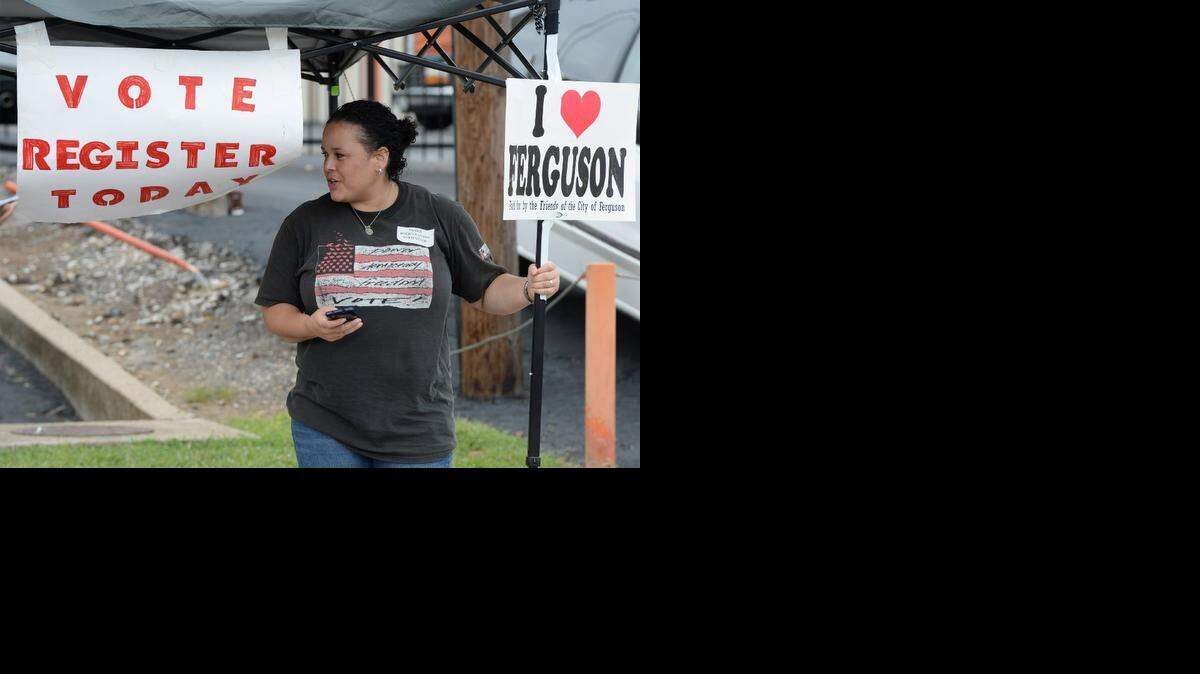
Down the street from where the body of Michael Brown lay for hours after he was shot three weeks ago, volunteers have appeared beside folding tables under fierce sunshine to sign up new voters.
On West Florissant Avenue, the site of sometimes violent nighttime protests for two weeks, voter registration tents popped up during the day and figures like the Rev. Jesse Jackson lectured about the power of the vote.
In this small city, which is two-thirds African-American but has mostly white elected leaders, only 12 percent of registered voters took part in the last municipal election, and political experts say black turnout was very likely lower.
But now, in the wake of the killing of Brown, an unarmed black 18-year-old, by a white Ferguson police officer, there is a new focus on promoting the power of the vote, an attempt to revive one of the keystones of the civil rights movement.
“A lot of people just didn’t realize that the people who impact their lives every day are directly elected,” said Shiron Hagens, 41, of St. Louis, who is not part of any formal group but has spent several days registering voters in Ferguson with her mother and has pledged to come back each Saturday.
“The prosecutor, he’s elected. People didn’t know that. The City Council, they’re elected. These are the sorts of people who make decisions about hiring police chiefs. People didn’t know.”
NAACP leaders are creating a door-to-door voter registration effort with a jarring reminder as its theme: “Mike Brown Can’t Vote, But I Can.”
U.S. Sen. Claire McCaskill is working with others to hold a “candidate school” for people, including young black residents, who say they want to serve on a city council or school board but need guidance on what a political campaign requires.
Over the last 25 years, the population of Ferguson, now about 21,000, has shifted from nearly three-quarters white to mostly black. Even so, five of the six City Council members are white, as is Mayor James W. Knowles III. Knowles, who once led the St. Louis Young Republicans, won a second term in April with just 1,314 votes from among the city’s more than 12,000 registered voters. No one ran against him.
Ask people along the streets here why they choose not to vote and they answer, mostly, with shrugs. Voter turnout has been far higher in presidential elections, and some had not even realized there was a mayoral race last spring.
“You don’t really see the candidates or even anything about them until a week or two before the election, and even then it’s not much,” said Alyce Herndon, 49, who has voted but, like many here, said she had not had cause to attend council meetings.
David C. Kimball, a political scientist at the University of Missouri-St. Louis who has studied voting patterns in the county that includes Ferguson, said some other suburbs that became black majority communities earlier than Ferguson, such as nearby Dellwood, have since begun electing black leaders.
“There is often a lag time,” he said, noting that Ferguson’s black population was only slightly higher than half the total as recently as 2000.
There are small indications, Kimball suggested, that black voters in Ferguson had begun to exert at least some political muscle even before Brown’s death. In a school board election for a district that includes Ferguson residents, three black candidates ran this year after the removal of a popular black school superintendent.
Only one of the three won a seat, but Kimball said he viewed the campaign as a modest sign of shifting.
Among some Republicans, the mounting political efforts have provoked tension. Told of the voter registration booth that had appeared near a memorial for Brown, Matt Wills, executive director of the state Republican Party, voiced outrage in an interview with Breitbart News.
“If that’s not fanning the political flames, I don’t know what is,” Wills was quoted as saying. “I think it’s not only disgusting but completely inappropriate.”
Other state Republican leaders have distanced themselves from those remarks, and Wills did not return requests for an interview.
“I think he spoke inartfully about one effort,” Ed Martin, chairman of the Missouri Republican Party, said in an interview. “Anything we can do to get more participation is good for all of us.”
Trayvon Martin’s father urged people to register as he appeared onstage at an Aug. 24 peace rally in St. Louis. Over a period of several hours, though, few people came forward to register.
Demarkus Madyun, 26, of St. Louis, said he was registered but had come to the registration table to update his address.
“If we’re going to try to say that the system has to be corrected for us to receive justice, we have to do everything that we can to be a part of the system,” he said. “Until we have people in office, it will never be better. Not just presidents — mayors, county executives, the governor.”
Without that, he added, “then everything that we’ve done for the last few weeks is for nothing.”
This story was originally published August 30, 2014 at 7:22 PM.