
Coronavirus weekly need-to-know: Fake COVID testing sites, boosters, ‘flurona’ & more
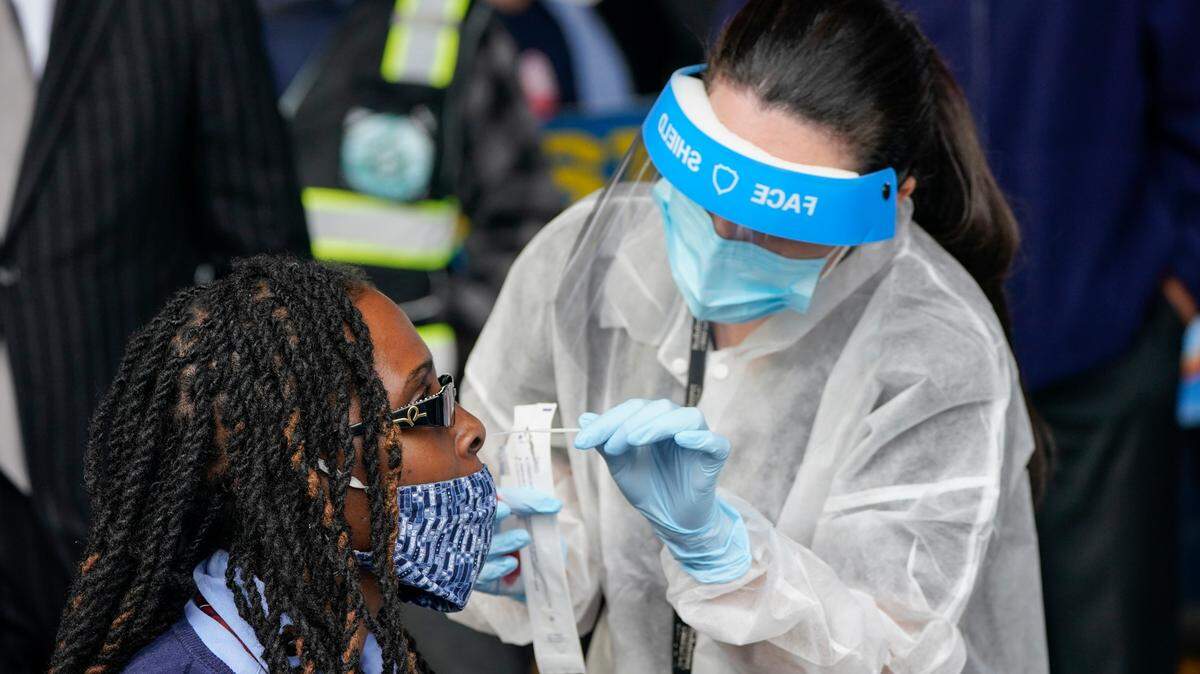
In the United States, more than 59.4 million people have tested positive for coronavirus as of Saturday, Jan. 8, amid the omicron variant’s spread, according to Johns Hopkins University. Out of those numbers, 836,901 Americans have died.
Throughout the world, there have been more than 303 million confirmed cases of COVID-19. Additionally, 5.4 million worldwide have died from the virus.
There are more than 207 million U.S. citizens who are fully vaccinated to date – 62.4% of the population – and 72.9 million of those people have gotten a booster shot as of Jan. 6, according to Centers for Disease Control and Prevention data.
Here’s what happened between Jan. 2 and Jan. 7:
Fully vaccinated and just got COVID? Here’s how long you should wait to get a booster
If you are fully vaccinated, just tested positive for COVID-19 and are trying to get a booster shot, you’ll need to wait a bit for your extra jab, according to experts.
Dr. Jorge Luis Salinas of Stanford University in California told McClatchy News that you should wait until you recover and your COVID-19 symptoms subside before getting in line for a booster. Salinas focuses on infectious diseases at the university.
If you get a breakthrough infection while vaccinated, you might not need a booster “for three to six months after (you) have recovered, though it would be safe to obtain a booster dose as early as two weeks after full resolution of symptoms,” Dr. Angela Branche, an associate professor of infectious diseases and co-director of the Vaccine and Treatment Evaluation Unit at University of Rochester Medical Center in New York, said.
Here’s what other experts said:
Can you get a coronavirus vaccine while COVID positive? Here’s what to know
Do not get any coronavirus vaccine while COVID-19 positive to protect others, such as health care workers, against potentially getting the virus, according to the CDC
The agency says you should wait until your symptoms go away and you know you’ve fully recovered – meeting the criteria to end personal quarantine that was recently updated by the CDC.
Continue reading to learn more about what the CDC says:
When should you get a COVID vaccine if you’re pregnant? Here’s what a study found
A recent study in which 1,300 pregnant patients participated showed that receiving a COVID-19 vaccine while pregnant can bolster antibodies. .
Based on the findings, researchers discovered that those who are pregnant should not delay getting vaccinated against the virus.
“The message here is that you can get vaccinated at any point during pregnancy and it is likely going to be beneficial to you and your baby at the time of birth — and of course by getting vaccinated early you will be protecting yourself and your baby throughout the pregnancy,” study author Dr. Yawei Jenny Yang, assistant professor of pathology and laboratory medicine at Weill Cornell Medicine, said in a news release.
Read more to learn about the research findings in-depth:
Consider swabbing your nose — and throat — for rapid COVID tests, some experts say
While taking an at-home rapid test for COVID-19, anecdotal evidence suggests that alongside swabbing your nose, you should also swab your throat as the omicron variant spreads.
“Symptoms are starting [very] early [with] Omicron. This means that there is a chance the virus isn’t yet growing in the nose when you first test,” said Dr. Michael Mina, a former associate professor of epidemiology at the Harvard T. H. Chan School of Public Health, on Twitter. “[The] virus may start further down. Throat swab [and] nasal may improve chances a swab picks up virus.”
Here’s what other experts are saying about throat swabbing:
CDC recommends getting COVID booster sooner if you got Pfizer, 3rd dose for some kids
If you are fully vaccinated with the Pfizer COVID-19 vaccine, you can get a booster shot a bit sooner than previously suggested, the CDC recommends.
The wait period for an mRNA booster of one’s choosing is shortened from six months to five months after getting a second Pfizer dose, the CDC announced Jan. 4.
Additionally, the CDC is recommending “moderately or severely immunocompromised” children ages five to 11 to get an additional vaccine dose 28 days after their second shot.
Here’s why the new recommendations were issued:
CDC considers updating COVID isolation rules following pushback on testing, Fauci says
On Dec. 27, the CDC shortened the isolation time for those who are asymptomatic or have “resolving symptoms” while infected with coronavirus to five days instead of 10. Additionally, the five days should be followed by another five days of mask-wearing.
However, this has prompted criticism, including from some experts, due to there being no testing requirement in the updated isolation guidelines.
Because of this, Dr. Anthony Fauci, the nation’s top infectious disease expert, said on Jan. 2 that these new guidelines could be re-considered.
“There has been some concern about why we don’t ask people at that five day period to get tested,” Fauci said Jan. 2 while appearing on ABC’s “This Week.
“That is something that is now under consideration.”
Read more to see what Fauci said and why the CDC updated its guidelines:
COVID test positivity rates are breaking records. How your state ranks as of Jan. 4
As of Jan. 4, states in the Northeast have the highest percentage of positive COVID-19 cases, according to Johns Hopkins data compiled by Becker’s Hospital Review.
However, states in the South are in the top 20 with the Midwest closely behind in terms of positive virus cases.
Read more to see how your state ranked as of Jan. 4:
CDC says it won’t change definition of fully vaccinated to include boosters. Here’s why
On Jan. 4, CDC Director Dr. Rochelle Walensky said you’re still considered fully vaccinated after receiving two doses of either the Pfizer or Moderna vaccines and one dose of the J&J vaccine, despite the availability of booster shots.
This follows a push to change the definition because of how booster shots can increase protection in the face of the omicron variant.
“That definition is not changing,” Walensky said during a White House briefing.
Here’s what else she said:
What is ‘flurona’, and should you worry about it during flu season? What experts say
After Israel, California, Texas and others reported their first known cases of a patient having both the flu and COVID-19, ideas and panic about “flurona” began to spread.
As coronavirus infections are running high with the highly transmissible omicron variant, the odds of being infected with both the flu and COVID-19 are higher, and the U.S. will see more cases of this “flurona” in the near future, experts warn.
But don’t freak out just yet — If you are vaccinated against both influenza and COVID-19, you are unlikely to be majorly affected by this flu and COVID-19 combination, experts say.
Here’s what else you should know about flurona:
Why are vaccinated people catching COVID? It doesn’t mean vaccines aren’t working
Those who are unvaccinated are at the highest risk for catching COVID-19 and having more severe outcomes, experts say, but even the fully vaccinated are susceptible.
Here’s what you should know:
Cloth masks no longer good enough as University of Arizona updates rules for omicron
Cloth masks will no longer meet the University of Arizona’s COVID-19 face mask requirements as the omicron coronavirus variant spreads across the U.S., the school said Wednesday, Jan. 5.
The school said it’s requiring the use of “surgical or higher-grade (KN95, KF94 and N99) face masks” in all indoor spaces where it’s not possible to social distance, in any university-operated facility “where patients or human research subjects participating in clinical research are seen in person,” in places where PPE has always been required and on public transportation provided by the school.
Cloth face masks can still be worn on top of a surgical mask to “improve fit and increase protection.”
Here’s what else you should know:
Does being infected with the omicron variant protect you against delta? What to know
Emerging research suggests that individuals with COVID-19 caused by omicron develop significant protection against the delta variant.
The laboratory study out of South Africa tested a group of 15 volunteers, both previously vaccinated and not, who were infected with omicron. Blood plasma samples were taken from each, and researchers observed how the antibodies performed in contact with omicron and delta.
Read on to learn more:
Fake COVID testing sites are popping up across the US, officials warn. How to spot one
Reports of unauthorized “pop-up” testing sites have officials sounding the alarm about scammers taking advantage of the pandemic to get to people’s money and personal information.
Illinois Gov. JB Pritzker recently called on his state’s Attorney General’s office to investigate what he called “fly by night” testing sites, according to WLS.
Read more on how to spot these fake sites:
Which face masks best protect children against the omicron variant? What experts say
While that cloth mask is better than nothing, experts agree that it’s time to upgrade masks in favor of ones of higher quality. Those cloth masks are “little more than facial decorations,” Dr. Leana Wen, a public health professor at the Milken Institute School of Public Health at the George Washington University, said on CNN.
Omicron spreads more quickly and is highly transmissible, so much that it can cut through fabric face masks, experts say.
Here’s what else you should know:
Reporters Katie Camero, Tanasia Kenney, Bailey Aldridge, Mike Stunson, Mitchell Willetts, Hayley Fowler and Mariah Rush contributed to this report.
This story was originally published January 7, 2022 at 7:32 AM with the headline "Coronavirus weekly need-to-know: Fake COVID testing sites, boosters, ‘flurona’ & more."
.jpg)