
Where to get a COVID test in Kansas City area? Some are in high demand, short supply
Anyone in Kansas City wanting an at-home COVID test kit right now — one that gives results in about 15 minutes — should be ready for these three words: Out of stock.
The kits are in short supply nationwide, to the point where some pharmacies reportedly are keeping them behind the counter to limit how many each customer can buy. Shoppers have found that even pharmacies that say online they have the tests in stock might actually be out.
Starlight Theatre prevailed upon friends in Kansas City’s medical community when it needed rapid tests for people working backstage at some of its productions.
“We couldn’t get them. We called every Walgreens, every Walmart, every CVS. The problem everybody’s running into now is there’s a test shortage,” said Rich Baker, Starlight’s president and CEO.
Several places in Kansas City offer rapid tests, many by appointment only, and they’re cautioning customers of high demand.
The quest for fast results is leading some folks to put out calls for help on social media, like this recent Facebook post from a Missouri woman: “Anyone know where I can get a rapid covid test? I’m not sick but need a negative test by tomorrow evening in Kansas City. CVS and Walgreens are all booked from Des Moines to KC.”
The Biden administration’s plans to require larger businesses to mandate vaccinations or weekly testing for their workers apparently set off stockpiling of tests. Over the summer, some parents reportedly began buying them up to have on hand when their kids went back to school.
And the public health message about the importance of testing with the highly contagious delta variant seems to be sinking in.
“We’ve seen a surge in rapid testing, especially among people who fear they’ve been exposed to the virus or who are showing COVID symptoms,” said Kirk Thompson, a partner with GS Labs, which operates a rapid testing site in the Northland.
Though rapid tests are getting hard to come by, local health departments, hospitals, community groups and other health care providers continue the free COVID-19 testing they’ve offered for months (see the list below). Those are usually PCR tests, which have a longer waiting period for results, 24 to 48 hours.
Hospital officials ask that you not go to emergency rooms for a COVID test unless you are sick and need emergency care since hospital beds are still in short supply.
Health officials still say that testing and vaccination are key to pulling the country out of the pandemic. Knowing whether they have the virus lets people make important decisions — to quarantine or not.
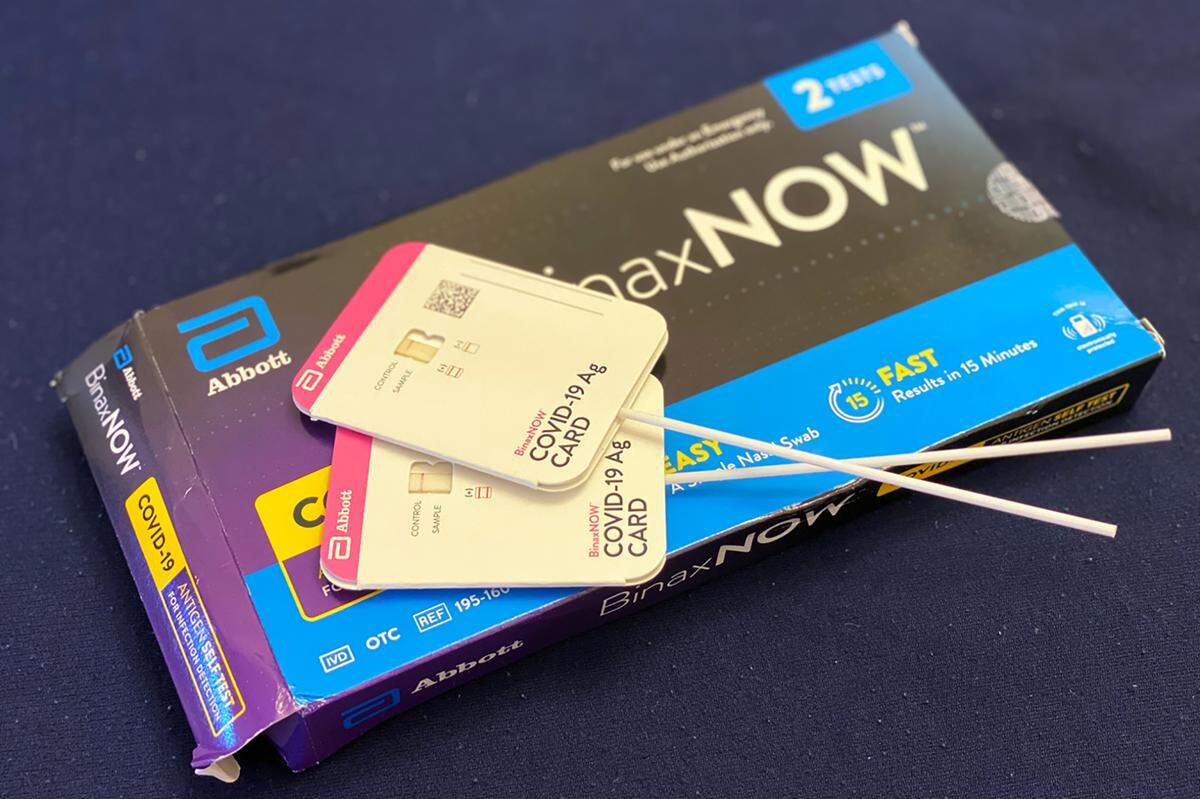
Manufacturers expect demand for the rapid tests to continue. Abbott Laboratories, whose BinaxNOW is considered the most widely used in the United States, says it is ramping up production and expects to make tens of millions more tests available over the coming weeks.
“We’re seeing unprecedented demand as case rates rise and have been scaling back up our manufacturing of BinaxNOW test kits since delta became the dominant strain and new CDC guidance called for a re-prioritization of testing,” Abbott spokeswoman Aly Morici said in a statement.
What’s the best test?
The home tests are fast and convenient, but the PCR test is more accurate, experts say. The Centers for Disease Control and Prevention considers them the gold standard because they offer more exact results analyzed in a lab.
“I think the home test, it’s not a bad thing to have on hand. It gives you a really quick result,” Dr. Rachael Liesman said during a recent health briefing sponsored by her employer, the University of Kansas Health System.
But if you have COVID symptoms and one of those tests says you don’t have the virus, Liesman recommends following up with a PCR test, also called a molecular test.
The PCR test, the kind typically used at community testing events, involves a long swab slid up your nose. It detects genetic material of the virus, and results are reviewed in a lab.
The at-home antigen tests that produce results in minutes — and are more comfortable because you don’t have to swab your nose deeply — detect certain proteins in the virus.
Liesman, director of clinical microbiology, said there haven’t been a lot of false positives reported with the rapid tests.
“If you’re symptomatic it will give you a really quick result and that can be helpful,” she said. “But I think given … the potential ramifications of missing a case, I would recommend that if you get a negative (and you have COVID symptoms), you go and get a PCR test because those have much better sensitivity.
“I think the availability of those PCR tests is quite good nowadays and the turnaround time on them is pretty well. One to two days, so not a long, extended wait. I think because we don’t have those long waits, (that) makes PCR-based tests a really good option still.”
At-home rapid tests vary in price.
“The first thing I was surprised about, these tests are expensive,” said Liesman, who paid $26 for two Abbott tests. “When they first started talking about these they were hoping they would come in at a price point of $5, or maybe even cheaper.
“I think it would probably be too expensive for most families to do something like weekly testing of their kid that was going to school.”

Where can you get a COVID test?
Most urgent cares now offer rapid testing, as do pharmacies and specialty rapid testing clinics. Most require an appointment, which can be hard to come by.
For example, GS Labs, which operates rapid testing sites across the country, runs one at 4341 N.E. Chouteau Trafficway and plans to open another location in Kansas City in the near future, a company spokesman said.
Each location can run up to 1,000 rapid tests daily, he said.
GS takes appointments online at gslabstesting.com and promises typical, same-day results in about 20 minutes.
For people with insurance, the cost is covered under the CARES Act. For people who don’t have insurance, the same-day testing costs $380. (GS Labs is currently involved in a court battle with Blue Cross Blue Shield of Kansas City over payments for tests the company performed for Blue KC members.)
Costs vary. One Overland Park rapid testing site charges $60 if you don’t have COVID symptoms — free if you have symptoms — but cautions that insurance companies won’t cover the cost of a test if you need it for travel.
If you don’t need a rapid test and have the time, public health departments, community health clinics, private clinics and pharmacies continue to offer COVID testing. Some are walk-in, others are drive-thru. The sites have various requirements.
Here’s how to find sites, and where some are located, in the Kansas City area:
▪ Kansas: knowbeforeyougoks.com. You can also book a test at gogettested.com/kansas.
▪ Missouri: health.mo.gov or 877-435-8411
▪ Kansas City area: comebackkc.com/kc-covid-testing-locations
▪ Platte County: Appointments in Parkville required. 816-587-5998.
▪ Johnson County: jocogov.org/schedule-covid-19-test
▪ Wyandotte County: Has added PCR saliva tests at its testing locations. wyandotte-county-covid-19-hub-unifiedgov.hub.arcgis.com.
▪ Truman Medical Centers/University Health: 816-404-2273 (CARE) for an appointment.
▪ Jackson County Health Department: 816-404-6416
How to use a home testing kit
Both Liesman and Jessica Lovell, who now hosts KU’s health briefings, demonstrated Abbott’s home COVID test on video.
First, read the directions, Liesman said. “They’re a little more complicated than you think,” Liesman said. “Follow everything to the T and then you’ll have a successful test.”
Check the expiration date, too. “Treat this like the food in your fridge. When it’s past the expiration date, throw it away,” she said. “If it’s been in your house for a while, give it a check and make sure it hasn’t expired.
Also, note the recommended storage temperature — the one she used says 35.6 degrees and 86 degrees. “Don’t leave this in your car overnight,” she said. Heat “will degrade everything that’s in this box.”
The test involved multiple steps and came with a few pieces, including a cardboard card, a dropper and a swab. As both women swabbed the inside of their noses, Liesman told Lovell she didn’t have to “go all the way back.”
“But you also don’t just want to collect snot,” Liesman said. “So if you’re really sick and mucusy, don’t just swirl it around and get snot.”
They poked the swabs into a slot on the card, swirled it around in an extraction liquid, closed the card and waited for a strip on the card to change colors, like a pregnancy test.
They both tested negative.
This story was originally published September 30, 2021 at 5:00 AM.
.jpg)