Missouri lags Kansas in rural vaccinations. Here’s why and what it means as delta spreads
Marshall County, Kan., and Shannon County, Mo., both have fewer than 10,000 residents. Historic red-brick courthouses anchor their local governments. Former President Donald Trump carried more than 70% of the vote in both counties in November.
But Marshall, along the Kansas-Nebraska border, is in a different vaccination universe.
Nearly 63% of adults are fully vaccinated, compared to 23% in Shannon County in southeast Missouri. It has the third-best vaccination rate among all Kansas counties, surpassing many with urban areas like Douglas and Sedgwick.
“We value good health care and we’re committed to supporting it,” Barbara Kickhaefer, a Marshall County commissioner, said. “It’s just always been in our community that health care matters.”
Much of rural Missouri is struggling with low vaccination rates. Virtually all rural counties have fully vaccinated less than 50% of adults, according to CDC data. In southeast Missouri, the rate is less than 40% for most counties.
Kansas, by contrast, has vaccinated more than 40% of adults in most rural counties and a handful have even broken 50%. In Iowa, more than 40% of adults in every county are fully vaccinated.
The Kansas numbers still fall well short of the 70% or greater rates that health experts say are needed to adequately control COVID-19. State officials are clear vaccination rates need to improve as delta spreads.
“Despite the fact that we have slightly higher vaccination rates in rural counties, because we have such pockets of unvaccinated individuals we will continue to see an uptick as Missouri has, as Arkansas has … This is spreading like wildfire,” said Marci Nielsen, Kansas Gov. Laura Kelly’s COVID-19 advisor.
But the Kansas and Iowa vaccination numbers also show that in sparsely-populated and deeply conservative areas, it’s possible to get more shots into arms than what Missouri has achieved.
The vaccination gap between rural Missouri and neighboring rural areas holds potentially deadly consequences as the highly-contagious delta variant advances unchecked across large swaths of the state. The variant thrives in low-vaccination areas, placing much of the state in a dangerous position as it becomes the virus’s dominant strain. An outbreak in southwest Missouri has already pushed Springfield hospitals to the breaking point and Missouri was one of four states last week that accounted for 40% of all cases in the United States.
Southeast Missouri, with some of the lowest vaccination rates in the state, has so far not experienced an explosion of cases, but the region is a tinderbox. Wastewater monitoring has detected the delta variant and cases are already beginning to creep up in some counties.
Raising vaccination rates by 5 or 10% in rural Missouri won’t vanquish delta. Still, even modest advances will help limit hospitalizations and deaths as health officials grapple with a growing crisis. Every completed vaccination represents one more one person who will almost certainly avoid a severe or fatal case of COVID-19.
“The vaccine is not going to fix things overnight,” U.S. Surgeon General Vivek Murphy told McClatchy in an interview Thursday. “But it will get people closer to that full immunity that they need. And that will protect them against the delta variant.”
Interviews with public health experts, doctors and elected officials in Kansas and Missouri point to no one factor that fully explains the rural vaccination gap. Instead, they offer a mosaic of answers that illuminate the problem: Parts of rural Missouri struggled with health outcomes before the pandemic. The state pursued an early vaccination strategy that leaned heavily on mass clinics. And Gov. Mike Parson and other leaders sent uneven messages.
“Problems in rural America are just being highlighted by the COVID pandemic across the board,” said Alan Morgan, CEO of the National Rural Health Association. “The difference between Missouri and Kansas is probably among the most stark.”
For many residents in these areas, vaccine attitudes are hardening. For those in the middle, between the adamant and the vaccinated, hearing from trusted community figures, such as a family doctor, will be key, those interviewed said.
Tale of two counties
In Marshall County, Kickhaefer, a Republican, said the local focus on health predates the pandemic. In 2019, voters approved a half-cent sales tax to fund a local hospital. The county has an extensive network of walking trails and restaurants get vegetables from a community garden.
Marshall’s health outcomes — measures that include premature death and low birthweight — place it in the top half of Kansas counties, according to annual rankings produced by the Robert Wood Johnson Foundation and University of Wisconsin Population Institute.
“Good health happens way before you get to the doctor or to the hospital,” Kickhaefer said.
The same rankings show southeast Missouri counties trailing the rest of the state in health outcomes. They’re often the same counties with the lowest vaccination rates.
Shannon County ranks 99th out of Missouri’s 114 counties. About 16% of residents are uninsured, above the Missouri rate of 11%. Adult obesity and smoking rates are higher than the state’s and 37% of children live in poverty — more than double the statewide measure.
Jon Roberts, a primary care physician in Shannon County, said a family’s income can vary paycheck to paycheck. Fewer residents have insurance. As a result, few obtain preventative health care.
“We’ve done everything we possibly can,” Roberts said in a May interview. “We talked to all the superintendents in the schools, said we’re all set to do the bus drivers, their spouses, teachers, custodians.”
Kandra Counts, who leads the Shannon County Health Center, echoed the sentiment this past week. “As far as the local health department, we’ve done everything that we can do,” she said.
Combating misinformation
Nationally, rural residents have become more resistant toward vaccination in recent months. Between February and April, the percentage who reported that they would “definitely not” get a shot fell from 24% to 17% before rising back to 24% in June, according to ongoing polling by the Kaiser Family Foundation.
In June, the Kansas Health Institute, analyzing data from the U.S. Census Bureau’s Pulse Survey, found that while Kansas and Missouri residents report similar levels of intent on getting vaccinated, some of the reasons for holding back differ.
About 8% of Kansans said they definitely won’t get a shot compared to 10% of Missourians. Residents of both states who are uncertain about the vaccines named potential side effects as their top concern.
But 34% of Missourians listed mistrust of the government as a reason compared to 23% of Kansans. Thirty-two percent of Missouri residents said they don’t trust the vaccines while just 18% of Kansas residents said that was a concern.
Baseless fears and conspiracy theories have flourished online. Claims that vaccination may affect pregnancy, that shots include microchips or that the billionaire Bill Gates is somehow using vaccines to collect biometric data have all prompted Missouri to dispel the discredited allegations on its official vaccine website.
Sometimes confusion surrounds the vaccination process, rather than the vaccine itself, however. Officials, including Parson, have mischaracterized federal efforts to raise vaccination numbers.
The Republican governor tweeted earlier this month that sending government employees or agents door-to-door to “compel vaccination would NOT be an effective OR welcome strategy in Missouri!” But neither Missouri nor any other state mandates COVID-19 vaccinations.
In some instances, groups are pushing messages that raise doubts about vaccines. Kansans for Health Freedom, an Overland Park-based group with about 550 members founded in 2019, got its start opposing mandatory vaccinations for schoolchildren. It has adapted to the pandemic by posting a list of COVID-19 vaccine concerns to its website. It also features a sample letter parents can send to schools warning against vaccinating their children.
“Any violation of this directive will be considered a battery on my child and will be addressed accordingly,” the letter says.
White House Press Secretary Jen Psaki said Wednesday officials need to be “clear and direct” about vaccine messaging.
“There is misinformation out there. Sometimes that’s traveling on platforms. Sometimes that’s traveling, unfortunately, out of the mouth of elected officials,” Psaki said. “So, it’s really case by case, but the most important thing we can do is not see this as a partisan issue because, certainly, the virus is killing people, whether they’re Democrats or Republicans.”
Some rural areas were very successful in moving quickly to vaccinate residents when doses first became available early this year, Morgan said. Even though restrictions limited who was eligible, shots went into the arms of as many people as could qualify — as fast as possible.
Several months later, opinions about vaccines have solidified, he said. The percentage of rural residents who were taking a “wait and see” approach fell from 38% in December to 12% in June, according to Kaiser. The drop suggests more and more people are making up their minds, one way or another.
“Some communities that were slow to be able to have vaccine availability, now that the availability is not an issue, perceptions have solidified. Now it’s very difficult to be able to move the needle on that,” Morgan said.
Did mass clinics work?
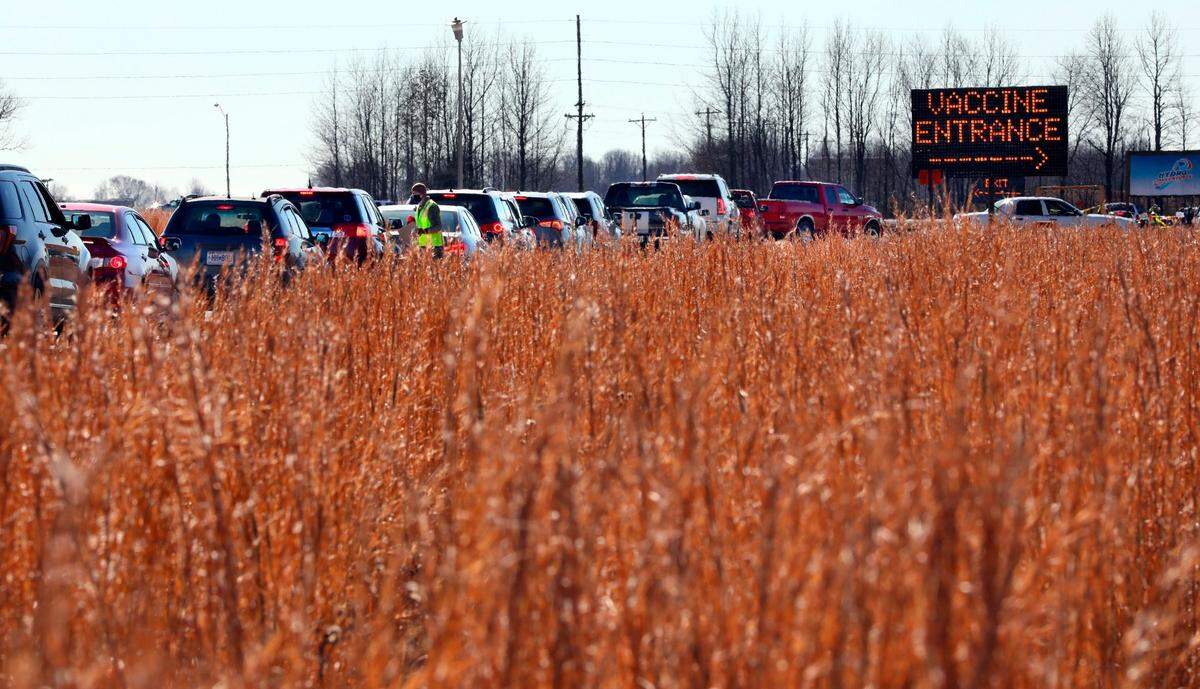
Parson early on adopted a mass clinic approach for Missouri and funneled thousands of doses to regional sites set up by the state National Guard. He reserved as many as half of the available doses for hospitals while allocating less than 10% for local health departments.
In many instances, the mass sites effectively rewarded those most eager to get a shot and those with readily available transportation and enough time to get there.
“I feel like we could have done a faster rollout if it just came to the health departments first,” Counts said. “In the beginning, lots and lots of people were wanting to get vaccinated.”
In Kansas, state officials distributed substantial doses to local health departments and relied less on mass sites. The approach at times led to complaints from urban areas that too few doses were going to population centers.
Nielsen, Kelly’s COVID advisor, said the administration’s strategy was “fairly rural-focused.”
“We made certain that every county got vaccine every week for many weeks,” Nielsen said in a June interview. “We know that some states, to include Missouri, chose to send vaccine to their high population centers.”
“Every state had its own reason for doing so, but we think that part of the reason we’re doing better in Kansas is that we got early on to rural residents who were interested in the vaccine,” Nielsen said.
The vaccination gap between rural Kansas and Missouri had developed by April. A CDC study found 41.3% of Kansas adults in rural counties had received at least one dose by April 10, compared with 31% of Missouri adults in rural counties.
Missouri health officials have touted their rural strategy. Acting DHSS Director Robert Knodell told reporters in a recent briefing that more than 5 million vaccinations have occurred in the state. Vaccinators are offering “convenient, accessible vaccination options throughout the state,” he said.
“We received a lot of criticism previously about our vaccination effort very early on in rural Missouri,” Knodell said. “We’re not hearing that today.”
Local leaders key
Health experts uniformly emphasize the influence of local leaders to persuade more rural residents to get vaccinated.
“Who are you more likely to listen to? The figures in Washington telling you to do something or the person in your local community that you trust? It’s going to be the person in your local community that you trust,” said Tim Callaghan, a professor in the College of Health at Texas A&M University.
Doug Gruenbacher, a physician in Quinter, Kan., said when vaccines first became available there was a “huge push” to vaccinate and that a large majority of people at the highest-risk for complications from COVID-19 have gotten a shot.
He’s now trying to encourage those in less-risky categories, such as younger people, as they come through his clinic. One argument in favor of vaccination that is resonating with students and their parents is the ability to avoid quarantine after a potential COVID exposure.
“Our kids are all really active and nobody wants to go back to virtual school,” Gruenbacher said.
Quinter, a of town of about 920 along I-70 in western Kansas, went three or four months without any apparent cases, Gruenbacher said, an accomplishment he believes is tied to the vaccination of higher-risk individuals.
Recently, there was one delta case but no more since then. “Mostly because everyone who was in quarantine also had at least one shot of the vaccine already,” he said.
Kansas, Nielsen said, is leaning on “local leaders and influencers” to encourage vaccinations. In Wilson county, the local health officer is doing several media interviews in an attempt to explain the urgency of the situation to residents.
Shannon County has begun to post short Facebook videos featuring Roberts, the local doctor, talking about vaccines. Health officials said it’s starting to make a difference.
“We have had a lot of phone calls even in the last few days of people wanting to be vaccinated,” said Summer Crider, the department’s nursing supervisor. “We are seeing an increase.”
The McClatchy Washington Bureau’s Bryan Lowry and Francesca Chambers contributed reporting
This story was originally published July 18, 2021 at 5:00 AM.