
ICU beds filling up in Missouri as COVID lingers. Map shows how your area is faring
As the coronavirus pandemic rages on, health officials across the nation have warned that hospital beds in some areas are becoming scarce.
What does hospital capacity look like in Missouri? It depends on where you are, according to new federal data.
The U.S. Department of Health and Human Services on Monday released COVID-19 capacity data at individual hospitals according to the number of available ICU beds. Previously, that data was only available on a statewide level.
“When data are aggregated at county or state level, the average across all facilities can mask what is happening at each local hospital,” the agency said in a news release. “Using this new data, the public will have access to hospital-specific COVID-19 numbers to understand hyper-localized community impacts.”
In Missouri, at least 95% of ICU hospital beds are occupied in at least eight cities and towns, according to an analysis of the DHS data by The New York Times.
Some of the state’s largest metros, including Kansas City, St. Louis, Columbia and Springfield, are at 80% ICU capacity or more.
The Times’ analysis shows the seven-day average patient count by hospital service area for the week ending Dec. 3. It does not include counts from hospitals operated by the U.S. Department of Veterans Affairs and the Indian Health Service, which were excluded from the DHS data.
A closer look
Hospitalizations for people with COVID-19 in Missouri peaked last month and have stayed high through December.
State data show 2,708 people were hospitalized with COVID-19 on Dec. 9 — compared to a record 2,851 on Nov. 18 — and 644 people were in the ICU.
Some suburbs and rural areas are faring worse than cities.
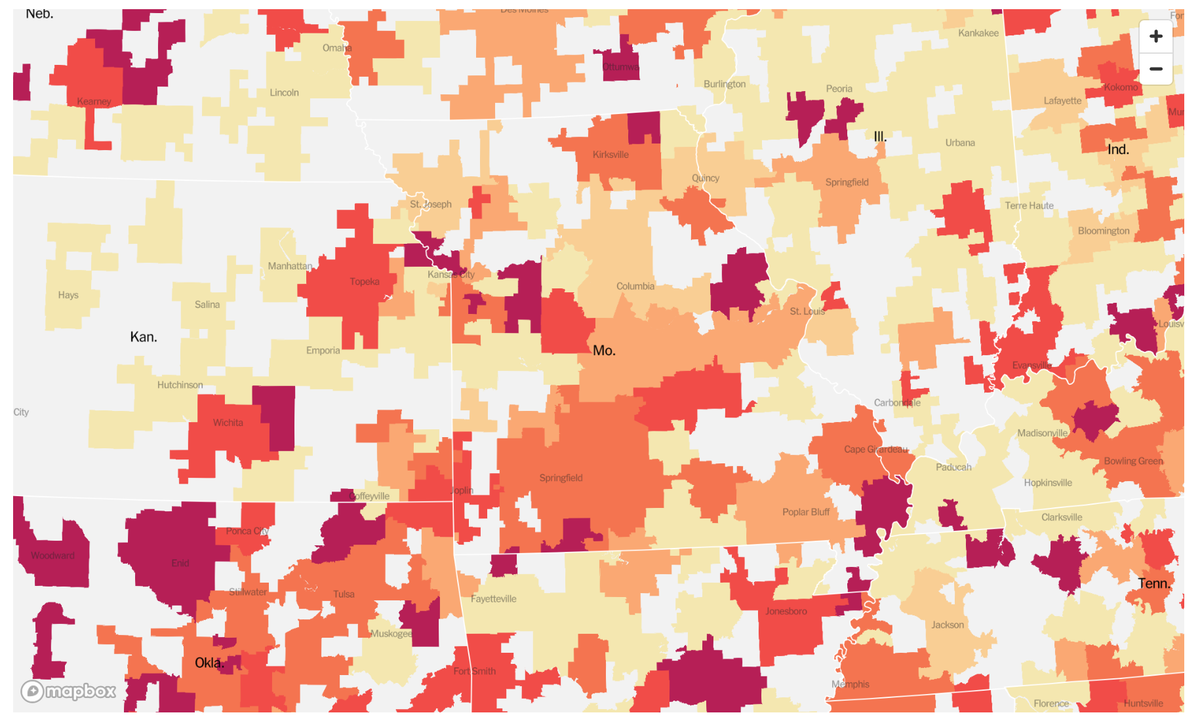
Areas with the highest capacity of occupied ICU beds include Branson, Lake Saint Louis, Lexington, Memphis, North Kansas City, Sikeston, Troy and Warrensburg.
Troy, which has three total beds, and Memphis, which has one, are both at 100% capacity, data show. All of Warrensburg’s five ICU beds are occupied as well as Lexington’s one.
Lake Saint Louis, which has 10 ICU beds, and North Kansas, which has 57, are both at 99% capacity, according to data. Sikeston has 12 beds and is at 98% capacity and 25 of Branson’s 26 ICU beds are occupied, putting it at 97% capacity.
Some of the state’s most populous areas are faring slightly better.
Of Kansas City’s 331 ICU beds, 34 are available, putting beds at 90% capacity, data show. St. Louis is at 82% capacity with 162 of its 915 ICU beds available.
The Joplin area, which includes parts of southeast Kansas and northeast Oklahoma, is at 96% with only four available beds out of 69. Springfield has 29 of its 222 ICU beds available, putting it at 87% capacity. Jefferson City is at 83% capacity with 20 of its 24 ICU beds occupied, data show. Columbia has 28 of its 136 ICU beds available and is at 80% capacity.
According to Beckers Hospital Review, the nationwide average hospital bed occupancy rate in 2012 was 61%. Health care analytic company Definitive Healthcare reported that figure at 49% in 2019 with some difference between urban and rural hospitals.
Compared to testing, “hospitalizations can help give officials a real-time visual of how many people are severely ill with COVID-19,” the Miami Herald reported.
Missouri has logged 334,704 cases of coronavirus since the onset of the pandemic and 4,450 deaths, according to state data from Dec. 10. In the last week, the state added 21,452 cases.
This story was originally published December 10, 2020 at 2:02 PM.