Face masks protect less with each cough, study finds. Should you keep wearing it?
The general consensus on whether a mask will protect you from coronavirus infection has wobbled back and forth since the pandemic began, confusing health authorities and the public alike.
Now, new research says your blue surgical mask will reduce the amount of respiratory droplets that escape your mouth — coronavirus-infected or not — and shield you from those coming from others, according to a study published Tuesday in the journal Physics of Fluids.
But the mask’s ability to do so diminishes as you and surrounding people cough repeatedly, the researchers from the University of Nicosia in Cyprus — an island country in the Eastern Mediterranean — said in their study.
In other words, social distancing plays a large role in determining your chances of contracting COVID-19.
“Although masks will reduce the droplet transmission, we should not ignore that several droplets will be transmitted away from the mask,” the researchers said. “[They] will not provide complete prevention from airborne droplet transmission. Therefore, social distancing remains essential when facing an evolving pandemic.”
When the pandemic first sprouted, the Centers for Disease Control and Prevention urged the public to avoid wearing masks because they had to be saved for healthcare workers; there also wasn’t enough research to determine if they did good rather than harm.
Then in April, the CDC reversed course and recommended the public wear cloth face coverings to minimize coronavirus spread.
And most recently, the World Health Organization said in June evidence had finally proved worthy enough for the group to officially advise governments to encourage the public to wear face masks “where there is widespread transmission and physical distancing is difficult,” BBC reported.
Using computer models, the researchers found that with a mask, a person who experiences mild coughing can still expel droplets up to 3 feet from their mouth.
This happens because pressure builds inside a mask every time a person coughs, shooting droplets further distances each time.
“Without a mask, droplets travel twice as far, however, so wearing a mask will help,” because it can slow the speed and minimize the distance at which the virus flies toward you, the researchers said.
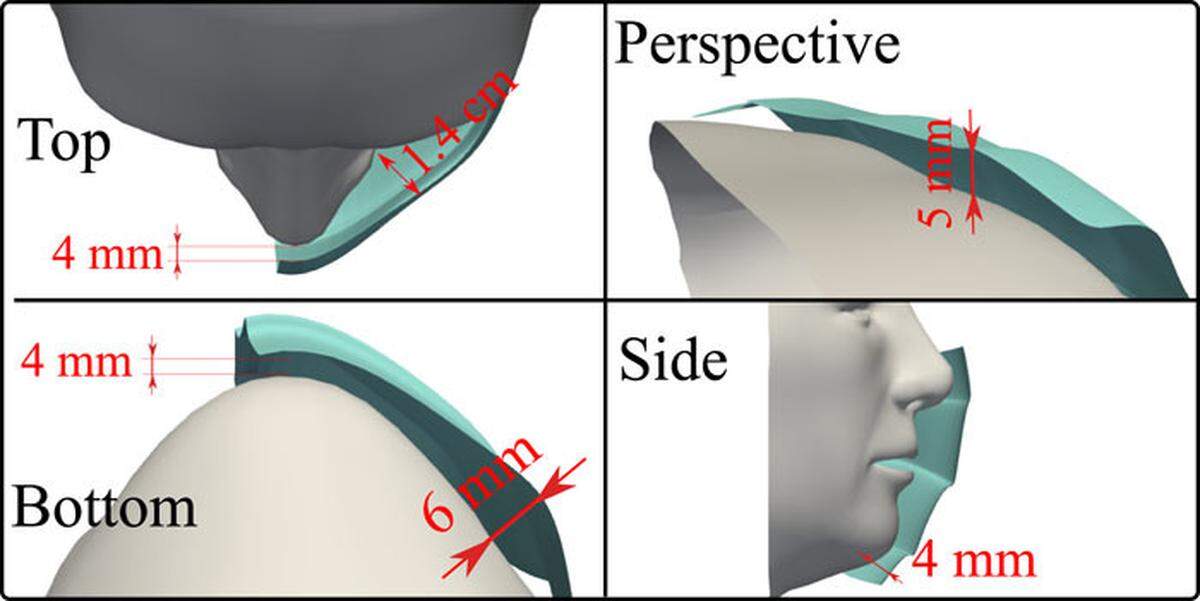
However, masks were not able to stop leakage around the top, bottom and sides, which “contributes to an additional reduction in mask efficiency.” Experts suggest wearing a tightly fitted mask.
After 10 coughing sessions, a mask’s ability to block incoming and outgoing germs dropped by about 8%, the study said, which is a “conservative” prediction because severe cough attacks, and the longer one wears a mask could make it less able to protect you and others.
The researchers also learned that droplets that escaped a mask were smaller in size compared to those coming out of an unmasked person; however, scientists aren’t sure if droplet size makes them more or less infectious.
The cloud of invisible particles that linger around your mouth area is also smaller when wearing a mask, according to the study.
Experts suggest using a new surgical mask each day, and the CDC recommends washing cloth face coverings after each use.
The big picture is that mask efficiency is dynamic, the researchers said, because it depends on the health, behaviors and environments of the person wearing them.
The study also offers advice for healthcare workers: wear more “complete” personal protective equipment such as face shields, disposable gowns and double sets of gloves, the researchers recommended.
“We should do everything we can to slow the spread of the virus,” Dr. Joseph Vinetz, an infectious disease specialist at Yale School of Medicine, said in April in a school article.
“A mask should not give anyone a false sense of security. It doesn’t give you a license to have social gatherings. It’s just a way to help reduce whatever small amount of transmission could be going on in public,” Vinetz said.
This story was originally published June 16, 2020 at 3:27 PM with the headline "Face masks protect less with each cough, study finds. Should you keep wearing it?."