Reopening the US without a national plan could bring economic pain, report says
Researchers in Massachusetts set out to learn just how devastating the uncoordinated decisions on reopening states during the coronavirus pandemic really is to the U.S. economy.
The models reveal a grim reality.
Using data from social media, mobile devices, the census and weather stations, the team concluded that a continued failure to work together could lead to about a 70% loss in economic gains.
The Social Analytics Lab at the Massachusetts Institute of Technology Initiative on the Digital Economy conducted the “working” report published Friday online.
“Viruses, and people’s adherence to the government policies designed to contain them, spill over from region to region,” the researchers said in the report. “We found that peoples’ behaviors are influenced not just by those in their local communities; social connectivity is often as important as geographic proximity. ... Put differently, a local government’s social distancing policy may significantly impact the health outcomes of other communities, near and far.”
The researchers analyzed data from 2,502 U.S. counties on COVID-19 — the disease the coronavirus causes — guidelines such as shelter-in-place and business closure policies between March 1 and April 18, when such measures were implemented, according to the report.
The team combined the daily county-level data with “movement data” from over 27 million mobile devices, more than 220 million Facebook users, temperature and precipitation measurements from 62,000 weather stations and the census.
Turns out, people are heavily influenced by their friends and family in nearby, and even distant, states that may or may not have different social distancing measures in place, the report said.
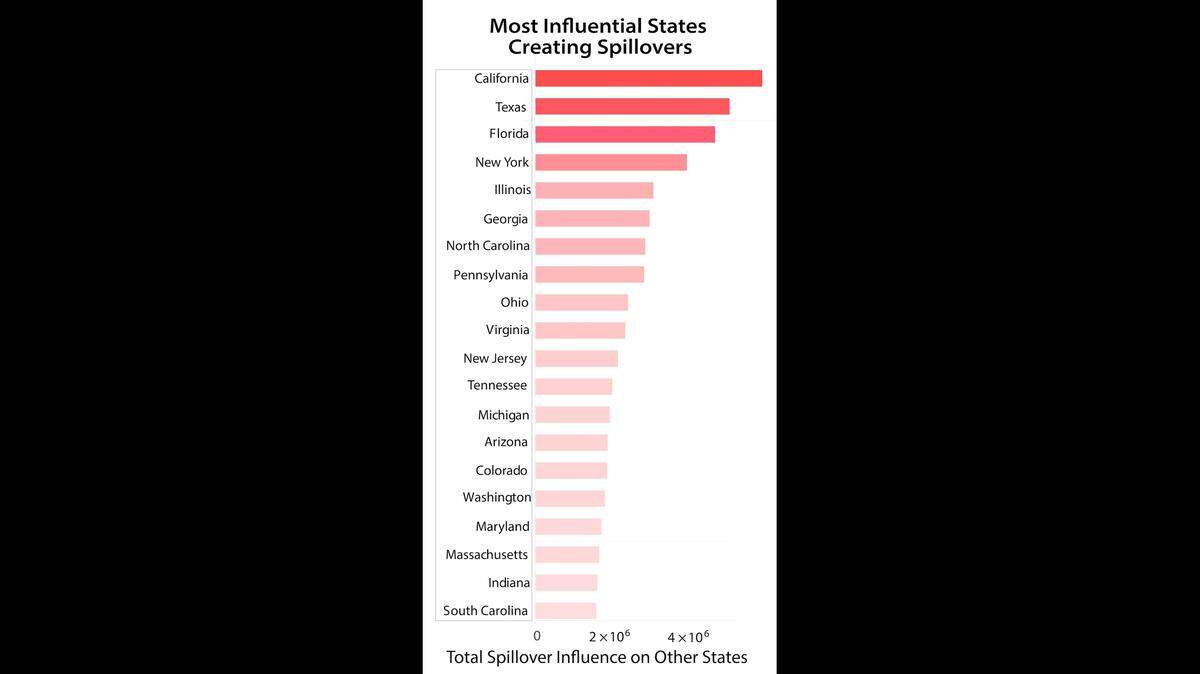
Florida’s social distancing was most influenced by New York’s shelter-in-place policy “due to social media influence and travel between states, despite their physical distance,” the report said.
California and New Hampshire, a small state in comparison, impacted Massachusetts the most.
Arizona was affected by Texas’ and Illinois’ policies. And Georgia was most influenced by social distancing measures in North and South Carolina, Alabama and California.
The researchers say the pandemic has shed a heavier dependence on the internet, “creating record breaking usage of social media and video conferencing to maintain our social ties across geographic distance.”
But “uncoordinated policy interventions neglect that many geographic borders are porous,” the team admits in the report, and this comes at a cost, both economic and health-wise.
When one state issues drastic changes in their social distancing policies, other states that do not do the same may have to “compensate for the neglect of another state’s loose restrictions” by enforcing stricter policies to keep up with their own goals.
Only Illinois, Delaware and New Jersey are still locked down, while 11 other states including Maine, California and Tennessee are “regionally reopening,” according to a New York Times interactive map tracking the state decisions.
Meanwhile, all other states are already in the process of reopening statewide.
These stricter policies could be expensive due to prolonged business closures and rising unemployment, experts say.
What’s more, such disorganization can further spread the coronavirus as people from one disease hot spot travel to another, not-so-devastated state with more lax social-distancing policies.
As of May 22, there were more than 1.5 million confirmed coronavirus cases in the U.S. and more than 95,000 deaths, according to a Johns Hopkins tracking map.
This story was originally published May 22, 2020 at 3:28 PM with the headline "Reopening the US without a national plan could bring economic pain, report says."