Calm before COVID-19 storm? Inside a Kansas City hospital preparing for ‘The Surge’
The Surge, as Charlie Shields calls it, is coming — a wave of breath-stealing COVID-19 cases that predictions say will hit the Kansas City area in late April to early May.
No one knows precisely when it will strike, or how large the surge will be, or the number of deaths that come with it.
The 60-year-old president of Truman Medical Centers — tall, graying, unrushed and with a neighborly air — stood outside the hospital’s intensive care unit on Tuesday, a place already on the front lines of the pandemic. He wore a dark gray suit and a protective, blue face mask. All the employees inside Truman wear masks now, even alone inside their offices.
Day by day, Shields checks predictions and models on the new coronavirus’s assault. He talks to disaster planners and checks other hospitals: How many open beds do they have? How many ventilators, portable ventilators, other positive airway pressure machines that can be turned into ventilators?
Aching to be positive, he is convinced that if people in the Kansas City area would just do what they’re supposed to do — stay home, socially distance, stop crowding the roads, parks and grocery stores — that the Kansas City area could be spared the worst of what’s stricken cities like New York, New Orleans or Seattle and states like New Jersey and Michigan, where medics and hospitals are overrun, or are soon to be, and hundreds of people, gasping for air, have already died of COVID-19.
“If we continue to do that,” he said with urgency, “and people stay vigilant, and they stay true to that, I think we’ll make it through this. I think it will be fine. I don’t think we’ll experience what we’ve seen in other communities.”
But Shields also senses that not enough people are staying home. He still sees too many people out and about.
Behind him, through the doors of one of the ICUs, nine people on Tuesday lay suffering. Five are confirmed to have COVID-19, some clinging to life on ventilators. The other four were strongly suspected of having the illness. One patient arrived that morning. On Saturday the hospital logged a death. At least a dozen PUIs — “persons under investigation” for the contagion — lay in isolation rooms elsewhere.
“If people veer away” from social distancing, “if people don’t take this seriously, we could easily then be in the same shape,” as hard-hit cities, Shields said.
His job is to make sure Truman is prepared. It is one of 27 hospitals that are part of the Kansas City area’s disaster planning. Visitors are being kept from the hospital, but The Star was allowed in to inform the public about how Truman and other area hospitals have been getting ready.
“The first thing I would say is that this is, by no means, business as usual,” Shields said before the visit. “It’s different than anything that any of us has ever experienced before.”
Protecting staff and patients
Inside Truman, the halls of the 350-bed hospital are all but vacant and eerily quiet.
Nearly half of its beds are now purposefully empty.
All elective surgeries, those not immediately necessary, have been canceled.
Daily clinic visits have been cut by 80 percent.
The emergency room and operating rooms are open for traumas like gunshot wounds, car accidents, broken bones, emergency cancer surgeries and the like. But outpatient surgeries have been reduced to nearly zero.
Wellness appointments, therapy sessions are conducted by video chat.
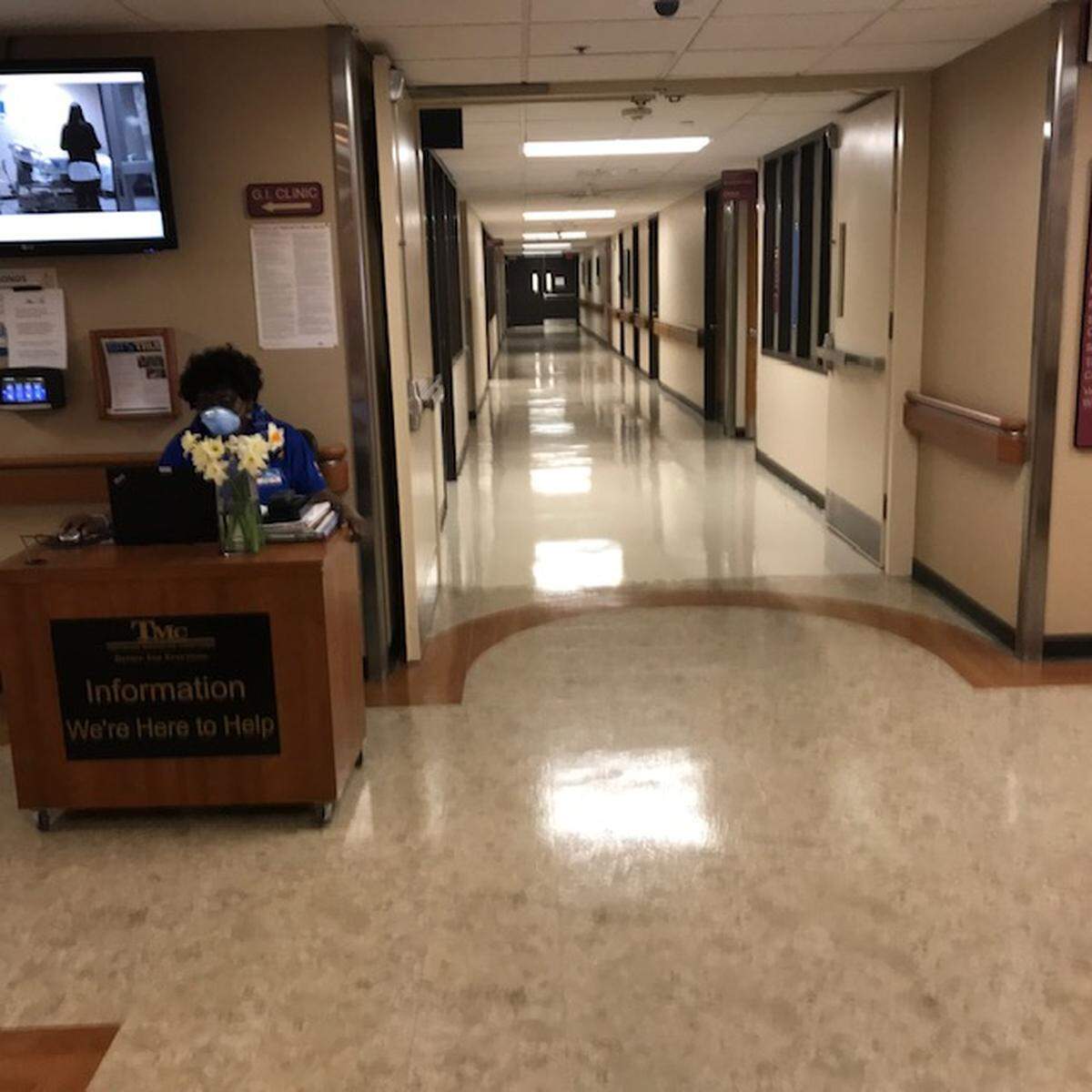
For safety, administrative staff are working from home. But doctors, nurses, X-ray techs, lab techs, respiratory techs and other medical personnel are at close to full staff, showing up, being paid.
Hospitals aren’t factories. They can’t furlough workers just because there are no patients now. They need to be at the ready.
“If you’re expecting this surge, you want to maintain all that capacity,” Shields said. “You might very quickly be working at 120% of capacity.”
The purpose of the changes is both to make room and to conserve the hospital’s cache of personal protective equipment: masks, gowns, gloves and other supplies known as PPE, which, nationwide, remain at critically low levels.
“Then also to decrease the number of people who don’t have to be here,” Shields said. “The more people you have could obviously increase the potential spread.”
All entrances to the hospital, except a few, have been locked to outsiders and the virus they could unwittingly carry into the hospital, possibly placing medical personnel in jeopardy.
“The worst case scenario,” Shields said, “would be to have this massive surge and then, at the same time, you have a significant amount of your staff incapacitated. I mean that is the absolute worst scenario that I think everybody is fearful about.”
The COVID-19 pandemic has strained supplies of PPE worldwide, forcing hospitals to scramble for it and putting nurses, doctors, paramedics and other health workers at risk. In Kansas City on Wednesday, nurses protested outside of Research Medical Center, part of HCA Midwest Health, over what they are calling dangerous shortages.
What few open entrances that exist at Truman are staffed by employees such as Ivon Hernandez, 32, a gastrointestinal technician from Liberty and the mom to three boys, ages 14, 9 and 22 months.
“It’s scary,” she said. “The whole thing.”
With their normal duties suspended, hospital staff are being conscripted into other COVID-19 related jobs. Hernandez now screens arriving employees and what few visitors may be allowed. If the hospital had enough thermal thermometers, they’d use them at the entrances. But they, too, are on back order. Screening is a brief Q&A:
Are you experiencing a cough? A fever? Shortness of breath? Have you come in contact with anyone with coronavirus? None of the above, employees are handed a mask and allowed to enter.
Hernandez and others here each said they follow similar routines. They arrive at work in one set of clothes, but bring an extra change and leave in another. Hernandez bags her work clothes in plastic, sprays her shoes with Lysol. At home, she washes everything in hot water. Then she showers.
Home to stay: “I put on pajamas.”
‘Hoping for the best’
Down more vacant hallways, emergency room physician Kevin O’Rourke sat away from the ER at his computer. On a normal Tuesday, he said, his department treats 200 patients or more.
“I think we saw 156 yesterday. It’s down over 20 percent,” he said. “The majority are coming in for this,” meaning people who fear they’ve contracted the coronavirus.
“We do have tests. We have been testing at will,” he said, meaning his will, doctor’s orders for cases that need it.
So far health officials have been trying hard to steer patients who think they have COVID-19 away from emergency rooms to prevent ERs from being inundated and to reduce the potential spread of the virus to other patients and health workers.
If one shows the hallmark symptoms — dry cough, fever of 100.4 or greater, difficulty breathing, contact with someone who’s tested positive — they’re being advised to call their doctor or hospital in advance, set up a time to perhaps go through drive-thru testing. Advice, otherwise, is for people to act as if they have the virus — stay home, stay away from others, practice good hygiene, stay quarantined.
It’s difficult to predict what will happen in Truman’s ER if, or when, the surge arrives.
“I don’t know what our expectations are,” O’Rourke said. “We’re just waiting to see what happens. We’re hoping it doesn’t hit hard. We’re hoping people stay away from each other. We’re prepared if it does (hit hard). But we’re kind of just hoping for the best.”
Steps down the silent hallway is a room that is less quiet: Truman’s “Incident Command Center,” established in the event of disasters like tornadoes, cyber-attacks or major power outages.
Ten staff members, outfitted with masks and safety vests, sit at a circle of tables in this office — seven in another office — with computers and cellphones, fielding operational questions from the nearly 6,000 employees on Truman’s two campuses, downtown and at Lakewood, in Lee’s Summit.
Like a city command center during a flood or tornado, it is the hospital’s information and communications hub for “the incident,” the threatening coronavirus.
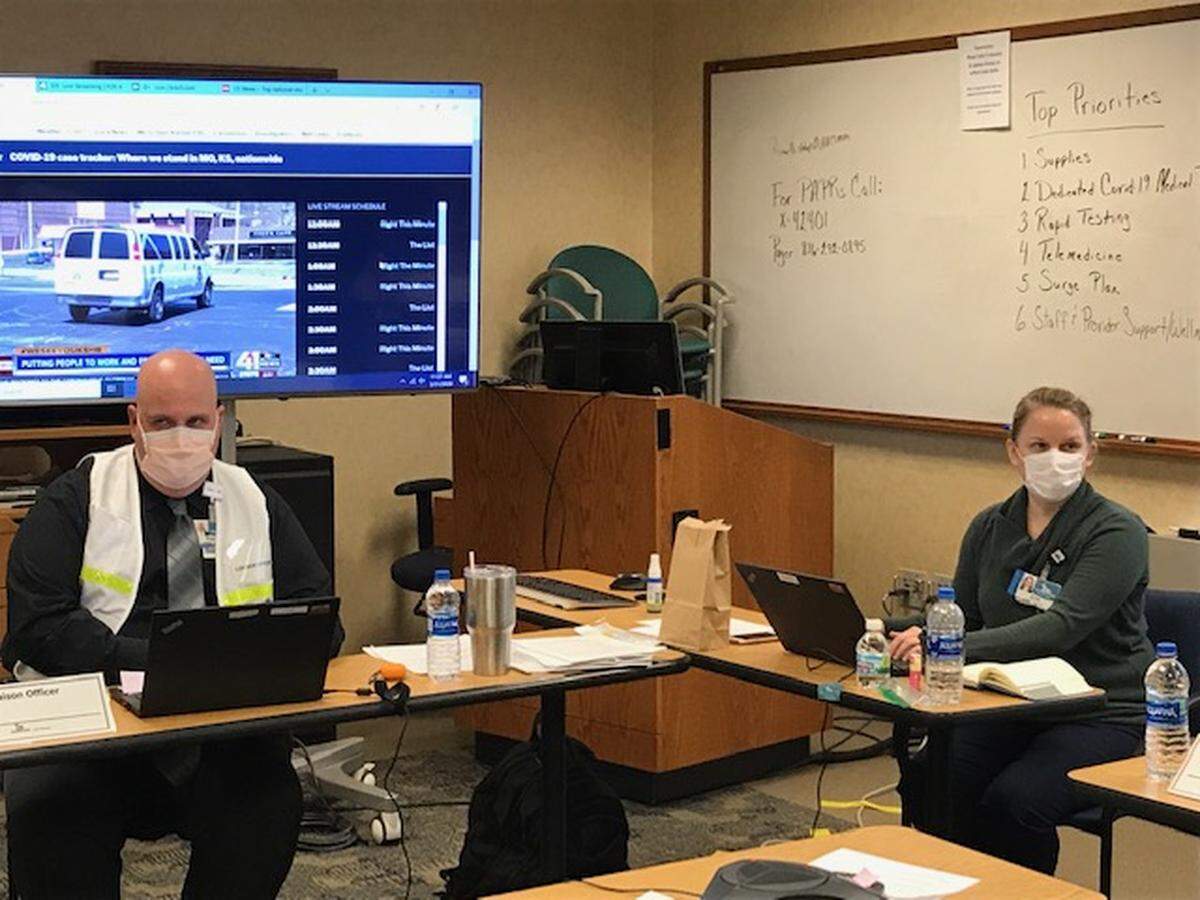
Most common question to date: “Which mask should I wear when? How do I get masks,” said Steven Hoeger, Truman’s 50-year-old director of safety and emergency management.
As the virus’s assault widens, new information is disseminated daily from the Centers for Disease Control and Prevention and from the World Health Organization on how to handle protective equipment, how to preserve it.
“We issue new guidance out to our employees on almost a daily basis,” Hoeger said. “We have people assigned to track that information so we can make informed decisions.”
Hoeger has other roles areawide, as the Missouri co-chair for the Regional Hospital Emergency Preparedness Committee and on Mid-America Regional Healthcare Coalition, that puts him in touch with issues of crisis management at hospitals across the Kansas City area.
There, too, they talk weekly about issues such as how to extend the life of their protective equipment.
“Normally you come out of a procedure, you throw your mask away and you get a new one. We can’t do that (because of the shortage),” Hoeger. “We’re not operating the same way we do every day. So we’re sharing best practices.”
Hoeger echoes Shields’ sentiment: The key to the surge is separation. Right now, he said, trend lines out of the CDC show that the stay at home order in the Kansas City area seems to be blunting or flattening the curve of the infection rate to a small degree.
That doesn’t mean that the surge won’t come. It means that if the trend line continues in that direction, the surge will not be as big and could be manageable when it strikes.
“Right now, the projections are that that trend line is going down,” Hoeger said. “I have hope that people will do what they’re supposed to, and we will keep that trend line going down. The current projections are that we will have enough hospital beds and ventilators if that happens.
“If people don’t do that? We could be New York.”
.JPG "IMG_6305 (1).JPG")
150 calls a day
Shields said that, if pressed, the hospital could turn 50 to 60 of its beds into critical care beds for the worst cases. Currently, the hospital has about 23 ventilators, although it also has about 90 portable ventilators, and can take ventilators out of its operating rooms and gastrointestinal labs. They also have the ability to take what are known as Bilevel Positive Airway Pressure machines , or BiPAP machines, and convert them into makeshift ventilators as well.
“We’re in pretty good shape with that,” he said.
COVID-19 testing is improving. More are coming in. Whereas it was originally taking up to a week to receive results, they are now getting them read locally, some within 24 hours.
In another room, down another empty hall, 11 registered nurses, in masks, screen calls from Truman patients, telling callers whether it is best simply to stay home, come in and be tested, or see a doctor.
At the start of March, two people were assigned to take COVID-19 calls in the hospital’s 404-CARE center. Now 11 nurses handle an average of 150 calls each day. The nurses use an algorithm based on callers’ symptoms — mild to severe — of whether they should self-quarantine, take a trip to “The Hut,” or to the nearby COVID Clinic.
“If you have a cough, a new fever , shortness of air and it’s just started and it’s just an annoyance, we’ll probably tell you to stay home and self quarantine,” said Cory Himes, senior director of primary care at the Hospital Hill site. “If they call in and they are coughing pretty good and have had a fever for several days, had some shortness of air, depending on what the nurse assesses, that would probably go to The Hut.”
It is exactly what it sounds like. It is a wood enclosure, in the parking lot on the east side of the hospital. There, nurses dressed in full protective gear — gowns, gloves, powered air-purifying respirators, or PAPRs, test patients who drive up in their cars. Those not seen at Truman previously can’t just show up, at least not now, until more tests are available.
Test results are returned to patients typically within three days. If symptoms are worse, patients are asked to go next door to the COVID Clinic, a larger outbuilding that was intended to be used as extra office space. There, a doctor examines and, if needed, admits them to the hospital.
“They’ll go straight from the clinic to an in-patient room,” Himes said.
Currently, The Hut is testing an average of 25 patients per day, with a recent high of 38. The clinic is seeing eight to 10 patients — numbers predicted to rise.
“The biggest part are coming out negative,” said nurse Marcia Waters, 57, who was testing patients Tuesday. A nurse for 34 years, Waters has been at Truman for a decade.
“Some of them you can tell are sick, but they’re not sick sick. You can tell they don’t feel good,” she said, “but, of course, we don’t know if it’s the COVID-19 or is it something else that’s going around.”
To be sure, infections and death are sure to rise. If people stay home, they ought not to rise too fast.
“I feel good at where we are with capacity,” Shields said. “I feel good about where we’re headed with testing. We are in a far better space than we were a week ago.
“The staffing piece of it: Our people are amazingly dedicated. You talk to our people, they have questions, but they don’t have fear.”
His conclusion:
“We’re ready,” he said. “Our hope is that we continue on this current path where we have a few positives coming in every day, but not overwhelming the system.
“If that happens, the health care system in Kansas City and the metro is ready to do that and is capable of dealing with this.”