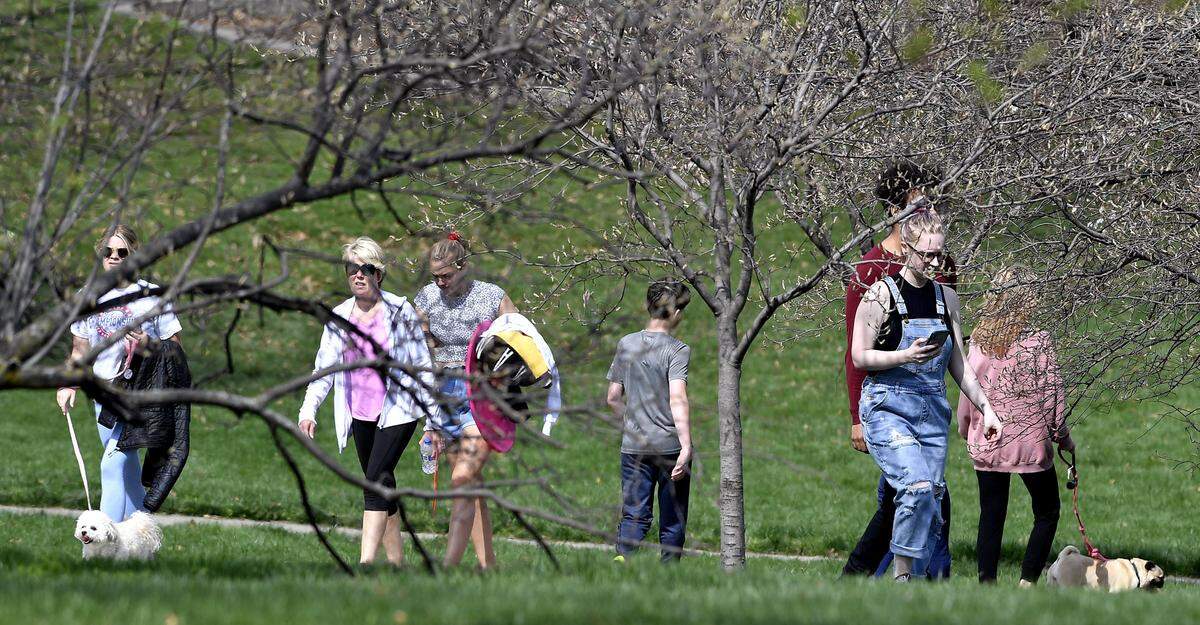
Safe? KC park is packed even as COVID-19 crisis pushes social distancing
Tennis courts were busy.
Walking paths were crammed with pedestrians and panting joggers.
At Kansas City’s Loose Park, south of the Country Club Plaza, children were sharing swings, slides and gamboling about together on the jungle gym as adults looked on. Inside the park’s shelter, people congregated at picnic tables, while a saxophonist played live music to draw fans and loose change.
That was Wednesday evening near 6 o’clock, barely 36 hours after Kansas City area officials put out a collective edict to stay home in order to squelch an ever-rising number of coronavirus infections and COVID-19 illnesses.
On Thursday, with the sun out and temperatures rising to the 70s, it was much the same. Shortly after noon two young women played tennis at the park, where, within 20 minutes, three of four courts would be full. Just that morning, park workers had placed a single sign in bold, green letters.
“PLAYING IT SAFE, followed by a message in red. “PLAYGROUNDS & COURTS ARE CLOSED,” although it said that parks and trails were open. The gate to the tennis courts had not been locked.
The area-wide stay-at-home edict allows parks to remain open while closing non-essential businesses and other gatherings, including all weddings and funerals.
The sign asks park goers to “maintain social distancing” of six feet and, when sharing paths, “to warn others of your presence as you pass.” Little of this was in evidence Wednesday or Thursday, as joggers, breathing heavily, shouldered past walkers.
As 5 p.m. approached Thursday, parking spots were full around the park and trees dripped with hammocks.
Are playgrounds safe?
Earlier at the jungle gym, Lisa Cunningham of Kansas City watched her two grandchildren, ages 4 and 10, play on the slides and swings that had already been used by a half dozen children before she arrived.
“I don’t know how to put this. I just think it’s overdone,” Cunningham said of the concern over the pandemic. “That’s my opinion. That’s about all I’ve got to say about it. It makes you kind of crazy if you sit and watch it on TV.”
She felt her grandchildren were safe.
“Yeah,” she said, “they’re not going to sit there and play on the equipment. I think they’ll play around it. I told them they could come on this slide. They’re on this slide, but the other kids are over there.”
The grandchildren were soon playing on the equipment alongside others. Prior to Cunningham arriving, foster mom Rachel Savage was at the playground with several young children.
“Since there aren’t any other kids out there, I’m OK with them playing on the equipment,” she said.
The World Health Organization notes that, depending on the surface, the coronavirus can survive and remain infectious for several hours to a few days.
“If there were other kids, we would definitely be in the grass, or riding the scooters that we brought, other stuff to do, so we wouldn’t have to be around other kids,” she said. “We want to do our part in this whole situation.”
During the 1918 flu epidemic, some 2,300 Kansas Citians died as a result of the city’s inconsistent public health policy, sporadically opening and closing schools and businesses, allowing the flu virus to die down then flare up again. During shutdowns, streetcars and elevators were ordered to be sterilized daily, public telephone booths were sterilized twice a day, streets were deluged with water by a small army of “quarantine officers” that spread throughout the city.
“There is nothing more important right now, living and being a native of this area, than staying home,” said Steven Stites, University of Kansas Health System Chief Medical Officer. “There is no question that shelter-at-home works. . .We are on the curve and how big that curve grows is entirely in the public’s hands.”
In some parts of the Kansas City area, such as Fairway’s Neale Peterson Park, playground equipment has been cordoned off with yellow security tape.
‘Nobody stopped us!’
Once tennis partners Meredith Shackelford, 24 and Elizabeth Wilcox, 25, finished playing in Loose Park, they were shocked to see the signs outside the court. Wilcox is a recovery nurse. Shackelford is an occupational therapist.
They take precautions seriously. Wilcox said that when she arrives home from work, she removes all her clothing, sprays her shoes with Lysol and immediately washes everything in hot water. Both have been told that overall infections in the Kansas City area are in their nascent stages. Infections and death are only likely to rise.
“I don’t think anybody thought it would get this bad,” Shackelford said, “and then it did.”
“It is all just kind of a waiting game right now,” said Wilcox, the nurse. “The doctors are saying we’re about a week behind New York right now. Whatever’s happening there is eventually coming to us. So we’re all just kind of rationing our supplies.”
Neither understood why, if the city wanted them not to use the courts, why the gates were not locked, or why the city workers who put up the sign while they were playing didn’t request for them to leave.
“I didn’t see that,” Wilcox said of the sign.
“Nobody stopped us!” Shackelford said.
“He could have stopped us while he was putting them up,” Wilcox added.
“Nobody said anything,” her friend said.
Both want the parks to remain open, if only to relieve the mental strain of staying cooped up per the area’s stay-at-home order. They’d both been to Loose Park on Wednesday evening.
“There were hundreds of people here,” Wilcox said. “They all, actually, they seemed to be happier than I’ve seen them in weeks. We had sun, and tons of dogs out. It was just fun to see everyone out.”
No touching
In Johnson County’s Shawnee Mission Park and Lenexa’s Sar-Ko-Par Trails park, both of which have lakes and walking trails, people on Thursday were fishing, jogging and walking, but generally keeping their distance other than when walking in pairs. Playgrounds, which also had signs indicating they were not to be used, were empty.
At Shawnee Mission Park, only one group of teenagers was seen sitting at a picnic table.
Up north, at Kansas City’s public Shoal Creek Golf Course, head pro Rhett Fregoe said that courses have remained open. Typically, daily attendance at it and nearby Hodge Park Golf Course runs about 180 golfers combined. The courses are still hosting about 90 each day.
They have instituted a no-touch policy: No cash. No food. No rented golf carts. Golfers now must walk at both courses. Golfers must book and pay in advance online or pay with a credit card at the club. Golfers hold up their cards. Fregoe does not touch them, instead he uses a walkie-talkie to read the numbers to a coworker.
Although the two golf courses do not allow golf carts, he said, that some public courses are still allowing them for one golfer at a time.
“To me, that’s a little bit dangerous,” he said, “having to sanitize the cart after each use. Who knows what that person has touched. You have to deep-clean the cart and you could miss a spot.”
Kevin Cronin of Parkville arrived alone for a 10:30 a.m. tee time. He would be golfing with other players he had never met.
“One of the great things about golf is that it’s social,” he said. “Meet people all the time that you might not normally meet somewhere else.”
He said he had few worries about possible viral contraction that common sense and social distancing would not address.
“Not really,” he said of any concerns. “If I saw them coughing and hacking and obvious symptoms, I’d worry. But the fact that you’re going to stay at least this far away from them the whole round? I’m not too worried about that.”
This story was originally published March 26, 2020 at 4:58 PM.