
Area medical workers see progress in the effort to eradicate Ebola in Africa
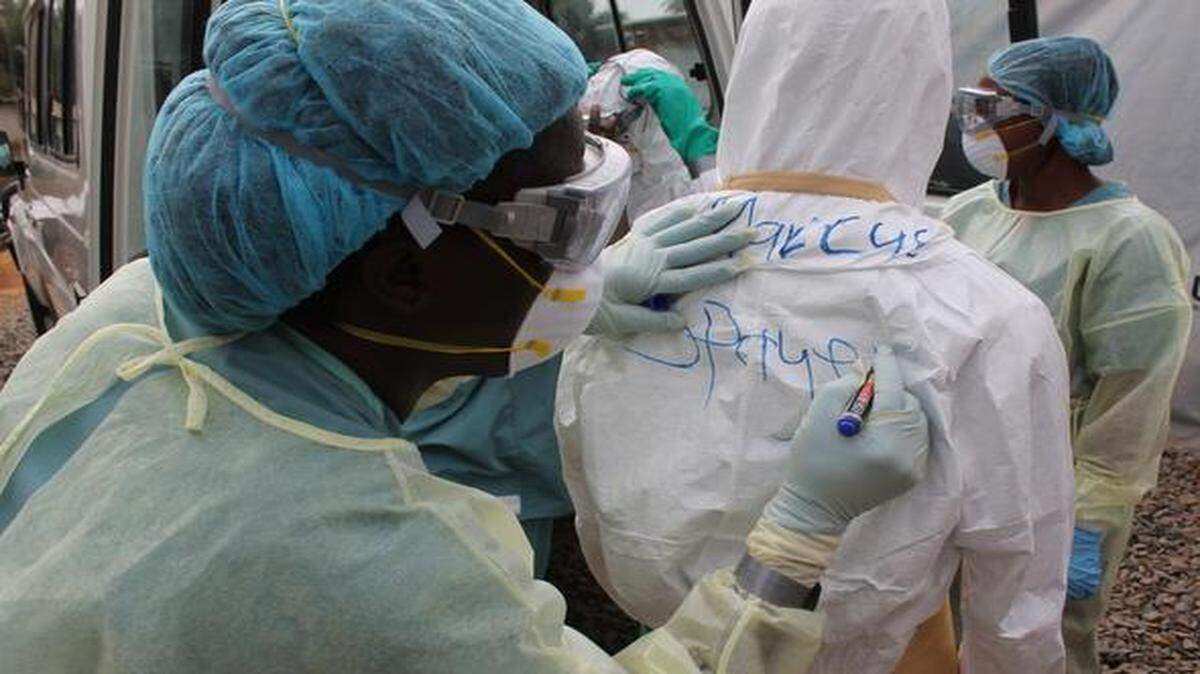
Prairie Village physician George Reisz had no clear vision of what to expect when, in November, he began treating Ebola patients in Liberia. In his first weeks, he found himself deluged by tragedy.
“You would see children where their entire families had all died,” said Reisz, 61 and retired from Truman Medical Center, where he was a trauma physician. He traveled to Liberia in the first wave of medical workers linked to the Lenexa-based medical humanitarian group Heart to Heart International.
Lately, though, Reisz is seeing reasons for hope. New infections and deaths from Ebola in the three countries most affected — Liberia, Guinea and Sierra Leone — had begun to drop even by the time he arrived in Kansas City in December, and continue to do so.
The World Health Organization and other medical groups, pushing caution and vigilance, are far from declaring the epidemic over, but they note that weekly data compiled by the health organization show positive trends.
“While the drop in new Ebola cases in West Africa is encouraging,” Tim Shenk, the U.S. press officer for Doctors Without Borders, wrote last week, “it is clear that we are not out of danger yet and much remains to be done.”
Since the World Health Organization’s Africa Regional Office first noted an outbreak of Ebola in Guinea in March, the disease has infected as many as 22,000 people and killed more than 8,600. At its peak in summer and fall, Ebola was infecting and killing hundreds of people each day. Even now, death rates of those infected remain close to 60 percent.
But last week, the World Health Organization’s regular report signaled optimism, noting that “case incidence continues to fall in Guinea, Liberia and Sierra Leone.” A combined 145 confirmed cases were recorded for the week in the three countries, 117 of them in Sierra Leone.
But Shenk and others noted that Ebola has so ravaged the existing health care infrastructure in West Africa — shutting down hospitals, killing some medical workers and causing others to flee — that it can be all too easy for the disease to flare.
“We cannot let our guard down given the unpredictability of this outbreak, where in the past we have seen the number of new cases dip only to spike again a short time later,” he wrote. “Any complacency now would jeopardize the progress made.”
Reports from Guinea, for example, note that some people continue to too closely handle Ebola-infected corpses in manners that can inadvertently spread the disease.
Health advocates also continue to work to educate a frightened populace about the need to seek care when symptoms arise and to not be wary of bringing their loved ones to an Ebola treatment unit.
“This started with one case,” said Rebecca Gustafson, spokeswoman in Washington, D.C., for the International Medical Corps, which has some 1,300 health workers and four Ebola treatment units in Liberia and Sierra Leone. “All it takes is one case, one person to be symptomatic and travel to a city, and this can happen all over again.”
An area is officially deemed Ebola-free only after 42 days have passed since the last patient tested negative for the disease.
“Zero,” Gustafson said, when asked what case count would constitute the end of concern over Ebola. “Everyone is aiming for zero cases.”
Jim Mitchum, chief executive officer of Heart to Heart International, said his organization is under contract to the U.S. Agency for International Development to operate an Ebola treatment unit in the Tappita area of Liberia until the end of April.
Whereas Reisz, the Prairie Village physician, volunteered for a six-week stint in Liberia, the Heart to Heart effort in Tappita is using paid employees whose work is largely being underwritten by the USAID contract, as well from money donated by Heart to Heart supporters.
Reisz worked initially with the International Medical Corps in Liberia’s Bong County while Heart to Heart’s own Ebola treatment unit was being constructed elsewhere.
Working 12-hour shifts, dressed in protective gear in 100-degree jungle heat — “The most physically exhausting thing I ever did,” Reisz said — he cared for 30 to 40 infected and bedridden people each day while 10 or more others suspected of carrying the deadly hemorrhagic virus lay nearby.
Even for those who lived, the stories often were filled with sadness.
“One case I remember was this guy who survived. You’re as thrilled as you can be when you have someone who survives,” Reisz said. “He said, ‘Yes, I survived. But my wife died. My four kids died.’ Then, if that is not bad enough, the village he was in burned down his house (out of fear) and told him not to come back.”
Reisz said that after spending about two weeks in Bong County, he fell ill with symptoms that suggested he might have Ebola, but he later tested negative for the disease at a medical unit in Monrovia.
After recovering for several days, he said he spent the rest of his stint at an Ebola treatment unit in an area called Kakata. Unlike in Bong County, he said, he treated far fewer Ebola cases in Kakata as the disease seemed to become under control.
Mitchum said the same holds for Heart to Heart’s treatment unit in Tappita. Most of those on the health team there are Liberians, but it also includes three nurses and a physician from Kansas City. The team arrived there in December.
“At this point we have had no Ebola cases since we opened” the treatment unit, said Mitchum, who left for Liberia in October to conduct logistics for Heart to Heart. Mitchum returned to Kansas City in December.
The Ebola treatment unit, he said, has been built alongside a hospital that was all but abandoned after Ebola began to sweep the nation. As a result, Heart to Heart workers have been working to educate local people about Ebola, performing some primary health care with Liberian medical teams while working on projects with other organizations, such as one that is working to improve the area’s water supply.
“We feel very good,” Mitchum said. “We’re not done and Ebola isn’t necessarily over. There are still hot spots. But we think it is really under control.”
Mitchum said his team is committed to fulfilling its USAID contract in Liberia, if the agency deems it necessary. He added, though, that there is a “high possibility we will close early.”
But a falling number of deaths and infections is not zero deaths and infections.
“We’re not totally out of the woods,” Mitchum said. “It is getting closer.”
To reach Eric Adler, call 816-234-4431 or send email to eadler@kcstar.com.
This story was originally published January 24, 2015 at 6:41 PM.