
Kansas City area dentists reopen: Your visit will be vastly different in COVID-19 era
Everything about your next visit to the dentist will look different, thanks to COVID-19.
You will answer a screening survey over the phone when you make the appointment. When you get there you will call the front desk from the parking lot and someone wearing protective gear will come to your car and take your temperature.
Then you will wait in your car until the dentist is ready to see you. You will be escorted directly to the dentist’s chair — the waiting room will likely be closed — where you will rinse your mouth with a hydrogen peroxide solution.
And when the dentist comes, she might be wearing a clear-plastic face shield over a surgical mask.
But as dentists in the Kansas City area reopen their offices this month from shutdown orders, some worry they might run out of that protective gear. And hygienists across the country are being advised to look into the safety procedures their bosses have adopted.
“If masks with either goggles or face shields are not available, please understand there is a higher risk for infection,” says the American Dental Association. “Therefore, use your professional judgment related to treatment provided … and the patient’s risk factors.”
Most dentists followed a recommendation from the American Dental Association and suspended all but emergency procedures at the outset of the coronavirus pandemic in March.
Two months later, dental offices are telling patients what to expect, emphasizing new safety measures, everything from “mobile check-in” and removal of magazines and toys from waiting rooms to mandatory squirts of hand sanitizer before you enter.
When they closed, dentists furloughed employees and watched nervously as income dried up. Some donated their masks, gloves and gowns — personal protective equipment — to local hospitals and first responders. And now, with stay-at-home orders being lifted, they are reopening with new COVID-19 safety precautions for patients and staff, and new concerns about whether they will have enough protective equipment over the coming weeks.
When the Missouri Dental Association surveyed its members earlier this month to find out what they need as they reopen, N95 masks, the gold standard, topped the list.
“It’s no different from any health care entity that’s out there,” said Vicki Wilbers, executive director of the group. “Everybody’s dealing with the lack and shortage of PPE across the board.”
When his practice slowed down in March, “we had a pretty good supply of PPE at that time,” said Dr. Jeremy Bowen at Dental Arts in Independence, who like many dentists has worked with a skeleton crew the last two months.
Even though business slowed, he kept ordering supplies, “so we would have a little bit of supply if we were able to start back up. But I can’t say that every dentist I know did that.
“As far as getting them now? Most of our orders are back-ordered. So when I’m trying to order through different companies I’m seeing that the ship date is unknown.”
The American Dental Association has warned that PPE supplies might not match demand until mid- to late summer, though some dentists think that’s an optimistic projection.
The situation has forced dentists to be creative, even to the point of local dentists making their own plastic face shields with 3D printers. Wilbers recently heard of one Missouri dentist who reached out to a local hospital for help — “and the hospital gave them 10 N95 masks. I said ‘man, that’s gold,’” she said.
Everyone in a mask
It is not business as usual at North Kansas City Dental, where safety is the name of the game at the private practice of the official dentist of the Kansas City Chiefs, Dr. Bill Busch.
Patients wait in their cars in the parking lot and get a text or call when it’s time to go in. They are asked to come by themselves, but exceptions are made here, and elsewhere, for children and other patients who need assistance.
They’ll have their temperatures taken with a no-contact thermometer. Only half the dental chairs are used so patients can be spaced out every other one.
And when Busch, who has been a dentist for 31 years, works on his patients now, he might be wearing a plastic shield over his face. The patients are asked to wear masks while they’re in the office, too, and sometimes they forget they have them on.
“And I have to say, ‘Well, you’ll have to lower your mask. I can’t work through your mask,’” Busch said, laughing.
He was able to stay busy over the the COVID break, taking care of emergency root canals, tooth extractions and wisdom tooth issues for his patients and those referred by other dentists.
He’s been planning a major renovation for two years and many of the changes are ready-made for doing business in the era of COVID-19, he said.
For instance, there will be private suites that have doors — he’ll have a “Mack Daddy” model suite open soon to test it out. He also made sure to put a sink in every treatment room so people can watch him wash his hands, which he thinks will make them feel comfortable. “Because a lot of offices in the past just have an area to wash your hands outside and the patient doesn’t get to see,” he said.
There will be specialty ultraviolet lighting that can be turned on after-hours to sterilize the rooms, with UV paint on the walls to reflect the light so it gets “underneath the counters, on the floor, everywhere,” he said.
Dentists are now a target market for all manner of safety equipment. Some research has shown that viral particles that can be turned into aerosols and sent flying through the air by a cough or sneeze also can be aerosolized by dental instruments. That’s why you might see hygienists using hand instruments instead of powered ones for some procedures, such as deep-cleaning gums.
Some dentists are not convinced of that risk, however. Many point out that no reported coronavirus outbreaks have been linked to dental care and that dentists already are by training well-versed in safety precautions.
Busch decided not to buy an “aerosol collector,” a heavy box-like device on wheels “that is like a siphon, it sucks up any of the extra aerosol,” he said. “And I think those are in the $7,000, $8,000 range.
“To me that’s overkill. Because if you use your shield, you use your mask and you do all the proper things and clean your room like you always cleaned it, you’re going to be good. And the aerosol in that room is constantly being cleaned by the air filtration system, so I don’t think you need that extra piece of equipment in there.”
Hesitant hygienists
Some dentists were prepared to open up without their dental hygienists because they know some are uncomfortable about returning to work. The American Dental Hygienists’ Association is being cautious and following the lead of the Centers for Disease Control and Prevention, which has not yet updated its recommendation that dentists postpone elective procedures and non-urgent dental visits.
Recognizing that many states are reopening businesses, the hygienists group developed a back-to-work guide for its members based on safety guidelines and regulations from several sources.
“One of the concerns we’re hearing from members across the country is the availability of PPE, which in many cases is challenging,” said Matt Crespin, president of the Chicago-based group. “We’re saying if it’s not available, it’s not safe.”
The group encouraged its members to talk to employers before dental offices open about safety issues — current supplies of equipment and how many new supplies will be needed, how aerosol production will be reduced or eliminated, social distancing strategies and whether enough time will be left between patients to allow for “appropriate disinfecting.”
The group also advised its members to make sure their malpractice insurance is current. Though many hygienists are covered by their employer’s insurance, Crespin said, he recommends they have their own coverage, especially now.
“We’re seeing a lot of questions from hygienists asking us, say for example a dental hygienist is providing routine and care and through contact tracing come to find out a hygienist tests positive,” he said. “Would there be the potential a patient could file a malpractice suit?”
Dr. Nicole Medley of Independence understands why some hygienists might be uncomfortable at work; all of hers have returned. “I get where the fear came from. I was scared, too,” she said. “But then it just hit me that we’ve been doing this forever.
“We already had very, very strict infection control policies in place. And we’ve always followed them, so it wasn’t a huge change for us, other than the distancing stuff that’s been kind of strange.”
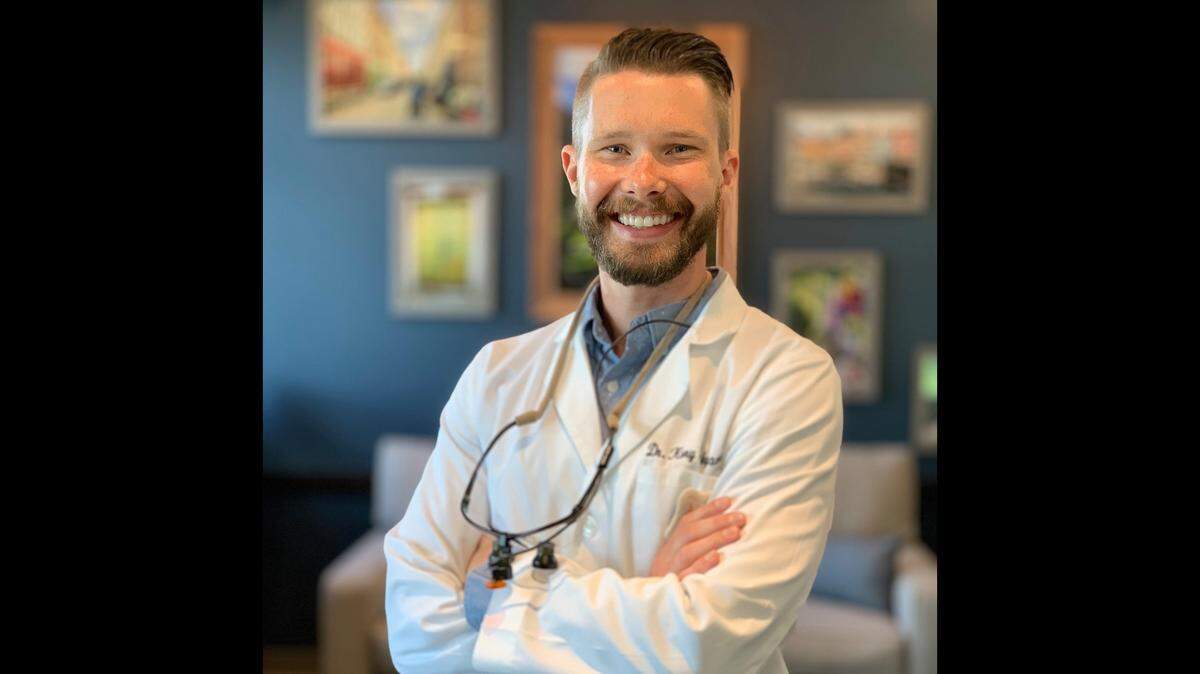
Dr. K and his masks
Last week, Dr. Kory Kirkegaard at The Art of Dentistry in Overland Park “tiptoed” back back into business with a few appointments.
Opening slowly was a deliberate choice so he can see if increased COVID-19 testing in Kansas reveals higher concentrations of the disease.
He’s still in his start-up phase, having opened his office on Dec. 1, 2018. Running on a skeleton crew the last two months and trying to maintain enough masks and gloves, even though he only treated a dozen patients since March, “has been one of the tricky things,” he said.
Kirkegaard said he wanted a “really technologically advanced office because I love, love, love digital dentistry, as it’s known to the geeks like myself.” Pre-COVID, he was putting a 3D printer through its paces making dental crowns.
Now, to address shortages of protective equipment, he collaborated with Dr. Baron Grutter, a Gladstone dentist, to create frames for surgical masks that can be molded against the face to give an N95-like seal. He’s offering the frames and 3D-printed face shields to other dentists who need them.
Grutter designed the equipment. “It prints all flat, you heat it up and it’s a custom fit,” said Kirkegaard. “Each person has their own little one.”
Dr. K, as he’s known, spent the last month or so collecting information on how to safely do business during the pandemic. He said he found guidance from the American Dental Association, the Kansas Dental Association and the CDC, but not the Occupatinal Safety and Health Administration.
“This is just one of the things that’s a little frustrating from the government, kind of a federal standpoint,” he said. “So OSHA, they’re usually the ones that provide us very distinct guidelines in this type of environment.
“And unfortunately, they’ve been rather quiet throughout this thing. And I understand there’s probably a lot of thought going on behind the scenes. Usually they help to establish what our minimum safety requirements will be.”
Every dental office will use different safety practices, and some will do more than others, said Kirkegaard, who is confident with the changes he has made at his practice.
Like other dentists, he’s screening patients over the phone and has closed his waiting room until at least the end of June. He’s also asking employees to leave their shoes at the office so they don’t take any potential contamination home with them.
“We kind of just developed (a plan) that works for us that I think crosses off a lot of the check boxes of trying to be safe and trying to do our part in the community to take care of ourselves and my staff,” he said.
His wife is keeping a particularly close eye on his safety, he said. They’re having a baby next month.
This story was originally published May 21, 2020 at 5:00 AM.