
Chiefs ‘not my heartbreakers.’ But Super Bowl win triggers Missouri woman’s heart attack
Before the Super Bowl, a newspaper story on Facebook caught Angela Manville’s eye. The headline warned that Kansas City Chiefs fans could have a heart attack while watching the Super Bowl.
“Yeah, whatever,” chuckled the long-time fan known to scream so loud at the living room TV that her family banishes her to another room.
Two and a half hours after the game on Sunday, 49-year-old Manville was in the emergency room at Saint Luke’s North Hospital-Barry Road.
“I wasn’t laughing after that,” she said.
Manville had suffered a SCAD — spontaneous coronary artery dissection — a tear inside a coronary artery that caused a heart attack. The heart emergency is said to be the leading cause of heart attacks in women under 50.
SCAD doesn’t give any warning signs and researchers don’t know yet what causes it, according to the American Heart Association.
Healthy women, “with few or no risk factors for heart disease,” are the typical patients, says the association, which sponsors American Heart Month every February.
Many things about SCAD remain a mystery and it might even be underdiagnosed. So the Mayo Clinic in Minnesota has launched a national registry to collect information from patients across the country.
Saint Luke’s is one of 10 sites participating in the registry. Manville, who lives in Dearborn, Missouri, will be one of those patients now.
She doesn’t blame the Chiefs for any of this.
“Oh heck no,” she said. “They’re not my heartbreakers.”
Indigestion or a heart attack?
Manville wasn’t the only Chiefs fan to have a heart attack over the Super Bowl.
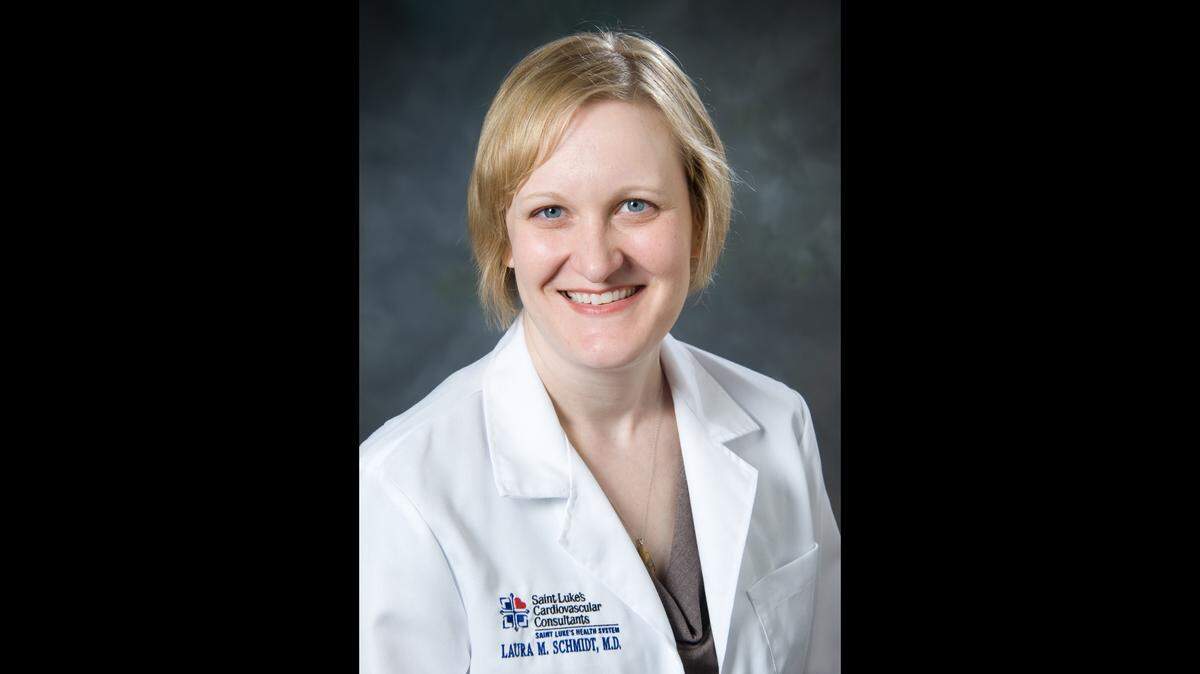
Over the last few days Saint Luke’s cardiologist Laura Schmidt has been making rounds at the Barry Road location, where three heart attack victims came in on Monday morning, “one right after the other,” she said.
“And it all seems to be related to the game. So we’ve been pretty busy with heart attacks this week.”
Manville, who is the administrative assistant to the transportation director of Platte County schools, watched the game with about six other people in her living room. They had typical Super Bowl munchies — chips and dip, a pizza ring.
She’s never been to a Chiefs game, but she can get Arrowhead-loud in her own home.
She got quiet late in the game when it looked like victory was slipping away.
“Mom, you’re not yelling, they can’t hear you,” her 17-year-old son told her. “You gotta yell, you gotta get pumped up because that’s why they’re not doing so well.”
So Manville got loud.
She watched the post-game interviews. then realized it was 11 p.m. and she had to be to work by 6 a.m. “So I went to lay down and that’s when it started,” she said.
The pain “was almost immediate. As soon as I laid down and I went to roll over, I started feeling a pain in my shoulder.”
She thought she had laid on it wrong, so she sat up. That didn’t help.
She got out of bed and the pain in her shoulder shot down her arm, then “started going up the back of my neck into the back of my head. And i thought, ‘well that’s not right.’
“But it wasn’t like a sharp pain. It wasn’t what you would typically think of as a heart attack.”
She chewed two aspirin, figuring it couldn’t hurt. “Then I looked at my husband and said, ‘Take me to the hospital.’
“God tells you something is wrong, you listen,” Manville said. “You don’t wait.”
Not at risk for heart disease
Schmidt was at Saint Luke’s when she arrived.
“She told me she had developed chest pain right after the ending of the Chiefs game, just an aching in her chest that went down her arm. She thought maybe it was heartburn, didn’t think much of it,” Schmidt said.
By the time she got to Saint Luke’s, Manville’s troponin protein levels — a marker for a heart attack — were elevated and rising. Even before she underwent a cardiac catheterization that looked at her heart, doctors suspected she had SCAD. She fit the profile, Schmidt said.
SCAD “most commonly affects women in their 40s and 50s, though it can occur at any age and can occur in men,” according to the Mayo Clinic.
“And she really didn’t have any other risk factors for coronary artery disease, which is a more traditional heart attack,” said Schmidt.
Manville said she’s never taken medication for any health problem and had only ever been in a hospital to give birth to her five children.
The cardiac cath did, indeed, reveal SCAD.
What is SCAD?
This is how the condition is explained in an animation on the Mayo Clinic’s website.
“A tear develops on the inside of a coronary artery allowing blood to create a split between two layers of the wall,” which can result in “a loose flap of tissue on the inside of the artery.
“Sometimes the split remains small. but the blood in between the layers can clot ... and may cause the normal artery channel to become narrow, blocking blood flow to the heart.”
Manville said the cath revealed two tears inside one of her arteries.
SCAD can cause a heart attack, make the heart beat abnormally, or can kill you, the Mayo Clinic says.
“I had never heard of it,” said Manville. “I’m familiar with the plaque build-up and arteries closing, things like that. I was not familiar with anything like this.”
A three-year SCAD study
Manville needed stents placed in the affected artery. She went home from the hospital on Tuesday in time to watch the Chiefs victory parade on TV the next day. “She did well,” said Schmidt.
She has medications to take now, and cardiac rehabilitation and participation in the new SCAD registry coming her way.
Since last month, Saint Luke’s has enrolled 16 SCAD patients and expects to have 80 signed up by the summer, according to a Saint Luke’s spokesperson.
About 170 patients nationwide have been enrolled so far, with a goal of 2,000 patients that doctors can follow over the next three years.
Initial data from the Mayo Clinic suggest that 5 percent of people who experience SCAD suffer a recurrence, Schmidt said. But that is something else the registry studies will shed light on, she said.
Manville’s initial reaction sounded all too familiar to Schmidt: “We hear that over and over from women that they don’t think they’re at risk for heart problems.”
Manville’s takeaway is not to ignore her body when it’s signaling like a referee that something is wrong.
The penalty, she believes, could have been fatal.
“If you’re in pain or something doesn’t feel right, have it checked out. Don’t wait. Don’t hesitate,” she said. “Because my biggest thing was, if my pain had subsided I would have gone to bed and who knows if I would have even woken up.”
.jpg)