
High-tech centers let med students practice on holographic patients. Worth the cost?
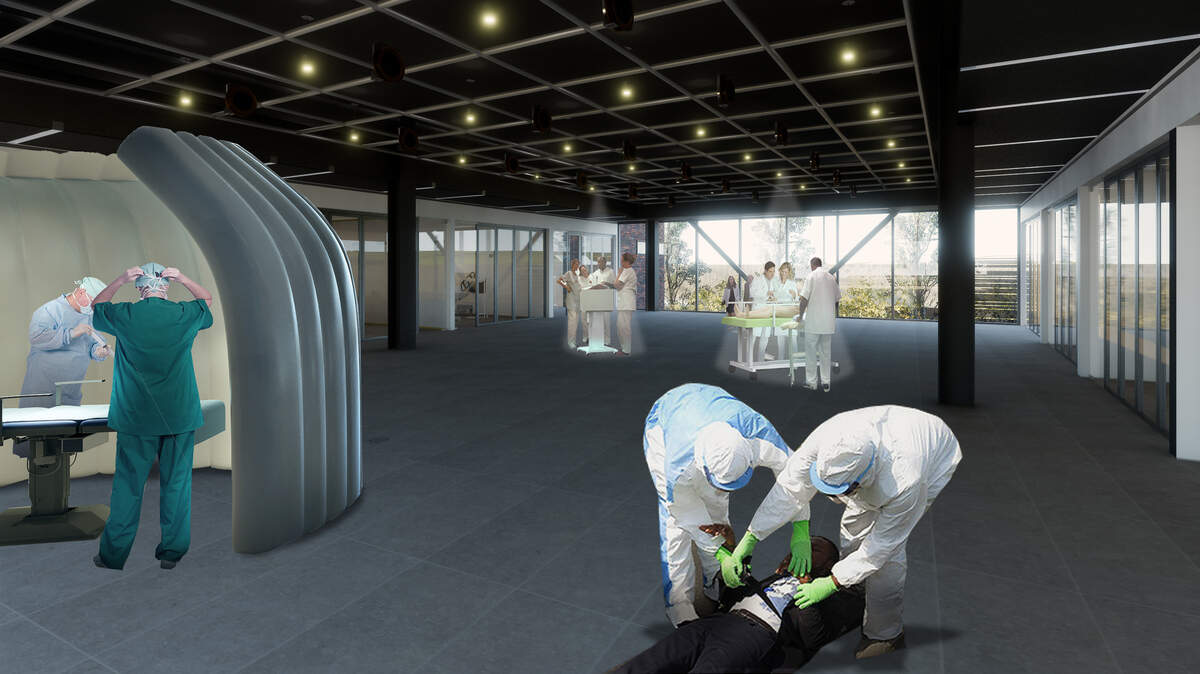
When Kansas City University of Medicine and Biosciences broke ground on a state-of-the-art simulation center earlier this month, Darrin D'Agostino revealed the instructions the school's president, Marc Hahn, had given him for its design.
D'Agostino, the dean of the university's osteopathic medical school, said Hahn told him to "make it future-proof."
“By the way, I’m a hologram right now, I’m not actually here," D'Agostino said at a ceremony that included Mayor Sly James and several donors. "This is one of the technologies (at the new center). If I start flashing and everything, you will know why.”
D'Agostino was joking, but only partially.
It was him, in the flesh, speaking, but holograms are being used in medical education now, and when the $33 million, 56,000-square-foot KCUMB simulation center opens next year, it will be equipped with virtual reality and haptic technology, which recreates the sense of touch.

So what will that mean for patients?
D'Agostino said it will mean better care by reducing medical errors, which cause about 250,000 deaths a year in the U.S.
“It’s unacceptable and the way we have to fix that is to come up with new ways of training people,” D'Agostino said. “... We want to make sure our physicians that graduate from here have the skills and the tools to do things right.”
KCUMB is joining medical schools in Kansas City and across the country in moving to more training through simulation before students ever put their hands on an actual patient.
The University of Missouri-Kansas City opened an orthopedic surgery sim center in 2014. When the University of Kansas Medical Center opened its new $82 million health education building last year, it included a significant expansion of its sim center, the Zamierowski Institute for Experiential Learning.
David A. Cook, a doctor and researcher at the Mayo Clinic, said studies have produced enough evidence to show that simulation is not just beneficial for medical students, it's basically essential.
It leads to fewer bloodstream infections and fewer complications in common procedures such as colonoscopies.
“In today’s training era, there is no reason why a doctor or medical student or nurse should be first practicing a procedure on a patient," Cook said. "In a first world country, that is no longer state of the art. Everyone should be practicing a procedure in a simulated setting before they do it on a patient.”
But Cook said that doesn't mean that simulated setting has to be loaded up with fancy, expensive technology.
In fact, he said, the Mayo Clinic is using low-tech, low-cost simulation. Its surgical trainees are operating once a week on models made of rubber hoses, vacuum tubes, cardboard and felt that can be constructed for $5 or less.
“They work 80 percent as effectively as a $50,000 or $100,000 (model), and in some ways they actually work better,” Cook said. “... I’m a firm believer that these low-cost, low-tech simulations are really the wave of the future.”
Medical care, including medical education, is becoming increasingly expensive and Cook said that's not sustainable if the U.S. and other countries are going to extend the best care to everyone.
“If we can do simulation at a lower cost, we can do more simulation for the same amount of money and that’s where I think the future is,” Cook said. “We have to figure out a way to do this at a lower unit cost if we’re ever going to meet the needs of everyone who could benefit.”
Cook said he advises medical educators to first think about what they need to accomplish in terms of simulation, what they can't accomplish now, and what tech they need to accomplish it.
Doing things in that order prevents them from being wowed by new tech and buying something they don't really need and won't use much.
At the groundbreaking event, D'Agostino said he's putting the high-tech aspects of the new sim center in perspective.
The possibilities are exciting, he said, but it's the faculty that makes the difference when it comes to making doctors. Not virtual reality headsets or haptic technology gloves.
“They’re only tools,” D'Agostino said.