Tensions rise as industrial projects boom in Kansas City and get close to housing
A proposal to build two industrial warehouse buildings next to a Northland neighborhood will test the Kansas City Council’s willingness to go against the opinions of residents, city staff and appointees who help guide the city’s development.
Liberty-based Star Development wants to build a pair of 288,000-square-foot industrial buildings on 36 acres of undeveloped property immediately east of the Chouteau Estates neighborhood, which is just north of the Missouri River and a few miles from Worlds of Fun.
The city’s planning department recommended that the city turn down Star Development’s request to use those vacant 36 acres, currently designated for low-density single-family housing, for light industrial use.
City planners worried about building industrial buildings so close to an established neighborhood.
“Staff is very concerned with the proposed development and land use with adjoining and surrounding properties,” said city planner Christopher Hughey in a recent meeting.
The City Plan Commission, which gives the Kansas City Council guidance on development proposals, voted to recommend that the city deny Star Development’s proposal.
“Generally I wouldn’t want to live near a truck facility plant even though it’s necessary in the city,” said James Baker, a member of the City Plan Commission. “But there’s also plenty of places in the city where this could be developed.”
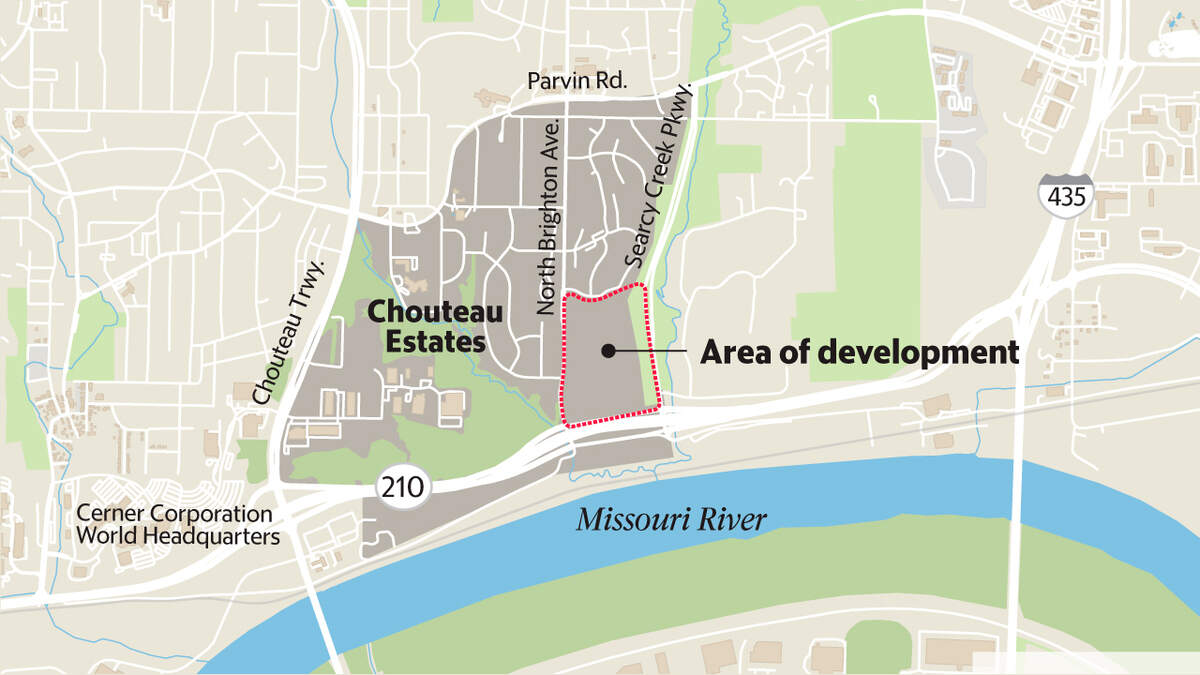
And the Chouteau Estates neighborhood has misgivings about the proximity of industrial development on land that has been zoned for residential land use.
“When I moved I moved in here in 2004 that’s one of the things they talked about then,” said Shaun Johnson, president of the Chouteau Estates Neighborhood Association. “It’s supposed to be houses built there.”
But Star Development believes the property can’t practically support single-family housing the way it is zoned.
Patricia Jensen, an attorney representing Star Development, said the developer analyzed what it would cost to build a new residential subdivision on the vacant property in accordance with its low-denisty zoning. She said the cost to build homes would range from $330,000 to $370,000 apiece, which doesn’t factor in the recent skyrocketing costs of lumber, in an area where the value of current houses are below $200,000.
Jensen said she believed the industrial development wouldn’t affect Chouteau Estates.
“We believe our buildings are very attractive and will fit into this neighborhood and will not negatively impact the neighborhood at all,” Jensen said.
On May 5, the City Council’s Neighborhood, Planning and Development Committee went against the planning commission’s recommendation, voting to approve Star Development’s project. That sends Star Development’s project on to the full City Council, which may take a vote on Thursday.
Star Development’s project is far from the biggest industrial project in the Kansas City region. But economic development leaders in Kansas City have identified industrial development — warehouses, distribution facilities and manufacturing — as a key industry for a region surrounded by an extensive railroad and highway network to attract new jobs and investment.
The COVID-19 pandemic and the increased demand for buying products online has accelerated the need for warehouses and distribution centers.
“There is a need for what we’re proposing in Kansas City as we’ve responded to COVID and all the changes in COVID,” Jensen said. “There is a lot of requirements for distribution facilities and warehouse facilities we didn’t have pre-COVID.”
And while most industrial developments tend to be located on the outskirts of cities in the region, there’s increasing tension about the expansion of such projects near residential areas.
On the other side of the state line in Edgerton, where the rapid growth of Logisitics Park Kansas City has exceeded most people’s expectations, there’s concern from residents in unincorporated Johnson and Miami counties about warehouse developments coming close to their homes. Some are even considering incorporating a new city to keep some distance from the industrial growth.
Edgerton’s experience is on Johnson’s mind as he protests Star Development’s proposal.
“A general concern is what kind of precedent they’re setting,” Johnson said. “The Edgerton issue is turning into a big deal, moving all these parks into the country and now in here they’re moving them into the suburbs.”
Johnson wonders if homeowners should ever buy a house near land that hasn’t been improved.
“The way they’re going I don’t know if it’s safe to buy any property next to anything that’s undeveloped,” Johnson said.
During the May 5 committee meeting, Kansas City Council member Lee Barnes said he supports the development of light industrial and manufacturing in the region, but questioned the effect Star Development would have, particularly with the truck traffic it would likely attract.
“I’m just saying I don’t think I would appreciate this many added number of trucks coming in on a daily basis,” Barnes said.
Fellow council member Andrea Bough expressed similar concerns about industrial development so close to an existing neighborhood.
But their views didn’t win the day.
“When you go down (Highway) 210 there it mostly is either commercial and industrial of some sort,” said City Council member Teresa Loar.
City Council members Heather Hall and Kevin O’Neill, whose council districts include the Star Development proposal, have sponsored the ordinance to allow industrial development on the property.
Hall implored her colleagues to approve the project.
“We understand our district,” Hall said. “Just like you all when you come before us know what’s best in your district, we know what’s best in ours.”
Barnes pointed out the neighborhood in Hall’s district didn’t appear to support Star Development’s proposal.
“I don’t know if anyone in the neighborhood actually said they were supportive of it,” Barnes said. “It’s not a question of whether we as your colleagues are trying to determine what’s best for your district.”
This story was originally published May 20, 2021 at 5:00 AM.