Despite neighbors’ outcry, Kansas City Council members advance Waddell & Reed plan
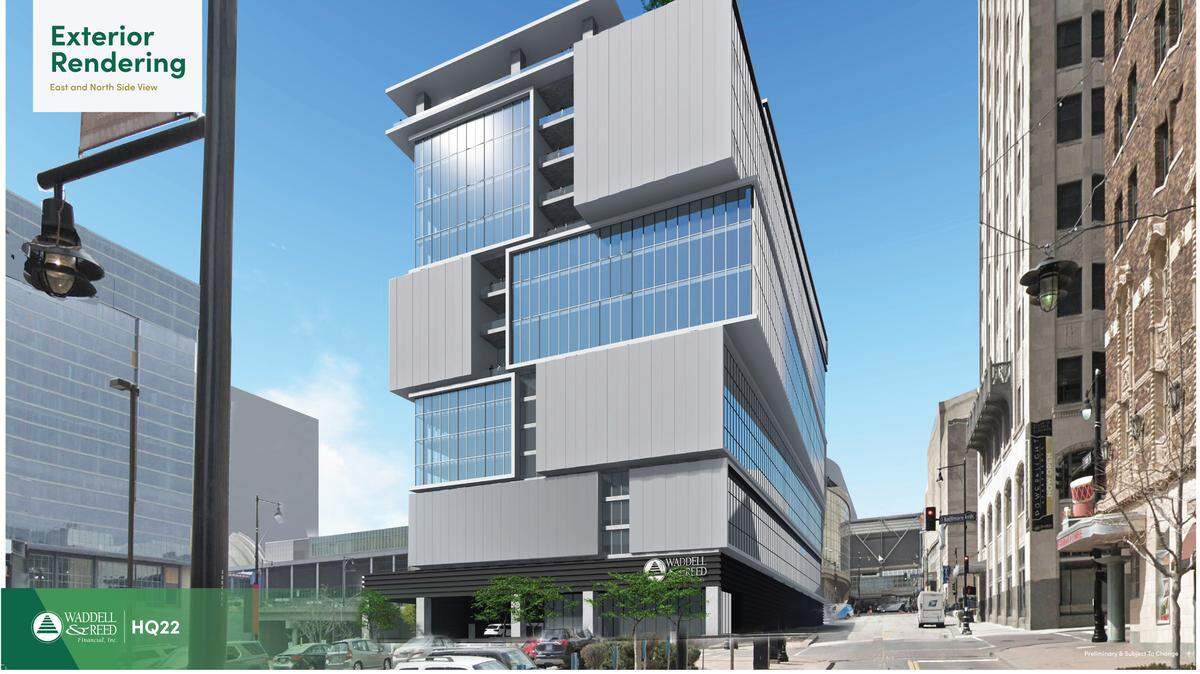
Putting aside the generous and controversial tax subsidies it’s getting to move a few miles from Overland Park, Waddell & Reed’s decision to bring more than 900 jobs to a prime street corner in downtown should have been a win for the neighborhood.
“We love seeing development. We are not going to be complaining that a building is too high or has too many windows. That stuff doesn’t bother us,” said Josh Boehm, vice president of planning and design for the Downtown Neighborhood Association.
But when developers briefed downtown neighbors on the design of the building, the reception was anything but warm. Plans called for no ground-floor retail and only a small lobby to welcome visitors off of Baltimore Avenue. Neighbors said the building seemed designed around cars. They want Waddell & Reed to integrate its $140 million tower into the neighborhood it sought subsidies to join.
“They’ve said they want to be downtown, and what the neighborhood association would like to see is for them to show us that in the design,” he said in an interview this week.
Crews have already started site work for the building at 14th Street and Baltimore.
Since January, some elements of the design have changed. There will be some ground-level retail at Baltimore and Truman Road and an “urban park” along 14th to the north. But neighbors still aren’t satisfied with the design, which they feel prioritizes cars over pedestrians. City planning staffers agree the project is planning far too large a parking garage.
In an unusual move on Wednesday, a City Council committee advanced the project and asked that developers work with staff on the parking issue before the city approves their construction permits. Normally, Kansas City seeks changes to developers’ plans before the City Council signs off on them. Staffers had yet to review the latest version of Waddell & Reed’s plans when the committee voted 4-1 Thursday to advance them.
Councilman Brandon Ellington, 3rd District at-large, was the lone vote against the proposal.
Despite the neighborhood and planning staffers’ concerns, several city council members were comfortable with the 913 parking spaces developers want to build, especially because they may soon have to close nearby Barney Allis Plaza and the parking garage underneath, which serves the city’s convention business. The Waddell & Reed site has no minimum parking requirements, and staff recommended 575 spaces.
But designers at Burns & McDonnell stressed several times that their project was designed to suit the market’s needs.
“I don’t want to substitute our judgment for a developer or a bank that’s putting a lot of money into it,” said Councilman Dan Fowler, 2nd District.
Sean O’Byrne, executive director of the downtown and River Market community improvement district, pushed the council to move forward on the project now because of the economic uncertainty brought on by the spread of the novel coronavirus, or COVID-19.
“Every day that we delay is another chance for a financial collapse,” he said.
Car-centric design
Of the Waddell & Reed tower’s 18 floors, 10 are set aside for parking. Rather than expecting some workers to catch a bus, the streetcar or walk in, it appeared that the company would funnel everyone through the massive 1,000-car parking garage and into elevators.
City planning staffers highlighted that issue in a February analysis of the project.
“While this parking will be available to the public during non-office hours, there is not enough justification for the vast over-parking of this site when more space could be dedicated to active uses,” the report says. “The number of spaces, combined with the garage’s layout and the numerous access points, create a perception that the intent is simply to get employees in and out by car.”
Boehm reiterated the neighborhood’s concern about the parking in public testimony Wednesday.
“The fact that the developer is proposing a 900-space parking garage in 2020 is climate change denial, plain and simple,” he said.
Aside from that, the city’s Transportation-Oriented Development Plan requires garages to be built in a way that they can be converted to other uses if they are no longer needed in the future. Waddell & Reed’s parking garage doesn’t follow those guidelines.
Under the plan the committee passed Wednesday, developers are to work with city staffers to reduce the parking or redesign the garage to be suitable to conversion.
Rather than build — and heavily subsidize — new downtown parking, Boehm said the city should find ways of better managing its current inventory, much of which is dedicated to a single use, like one employer or apartment building. Waddell & Reed has said its garage spots would be made available to the public after work hours.
“We’re not only asking the school district, the city, all the taxing jurisdictions to pay for office space, but we’re asking them to pay for parking spaces. And if downtown had no parking that would be one thing. But the real issue is we have an oversupply of parking that’s poorly managed.”
Boehm said other developers have found ways to integrate parking structures into their downtown buildings. Specifically, he said the Power and Light Apartments at 13th and Baltimore managed to create a transparent ground floor experience for pedestrians, while also concealing a parking garage. Likewise, H&R Block included a main lobby that sits above its below-ground parking garage. But the city’s earlier approval of tens of millions of dollars in economic development incentives for Waddell & Reed has made it more difficult for neighbors to now influence the design process.
“It was an idea and concept that some folks got very excited about and were able to support with financial incentives” Boehm said. “But then when the details come to light, it’s a little bit hard to put the toothpaste back in the tube.”
Designers with Burns & McDonnell said that H&R Block project and other recent downtown office buildings have had parking ratios similar to that planned for Waddell & Reed.
Little for pedestrians
Councilman Eric Bunch, 4th District, said while he was concerned by the substantial amount of parking, he wasn’t fighting that fight anymore. When the City Council approved tax incentives for the deal, it knew about the massive garage. He’s concerned about the lack of street-level activity for passersby.
Bunch noted the Waddell & Reed building will front the street on four sides, something rare for downtown, and said designers had “not managed to make any one of them pedestrian oriented.”
“It’s great that there are going to be more trees there and some benches and nice stuff,” Bunch said, “but it’s still a blank wall.”
In a letter to city officials, the Downtown Neighborhood Association said it was “clear that the neighborhood’s concerns were not considered” in the design of the project. Specifically, the group said the plan should eliminate one of three planned parking garage entrances on 14th Street to preserve the pedestrian experience there. Additionally, the neighborhood wants to see “active uses and transparency” on the ground level so pedestrians can see into the building.
“There is a win-win solution for the neighborhood and the applicant, but a hasty design and development approval process will leave both parties with regrets that last a generation,” the letter said.
In February, the City Plan Commission awarded conditional approval of the project, seeking several changes to the design, including changes to improve the street-level experience. That led to the addition of ground-level retail on Baltimore.
A controversial deal
The Waddell & Reed project has been a hot-button issue since long before developers unveiled the design.
In September, the state of Missouri granted the company up to $62 million in tax incentive to move its operations and employees less than 10 miles from Overland Park.
In December, a divided City Council approved $35 million in local aid to the project in the form of a six year 75% tax abatement followed by nine years at 37.5%, a sales tax exemption on construction materials and a redirection of earnings and utility taxes.
The combined $97 million in subsidies was approved only a short time after officials in Kansas and Missouri agreed to stop using their tax incentive programs to poach jobs from each other. That practice, dubbed the “border war,” for many years moved companies back and forth across the metro without necessarily creating any new jobs.
Both states have agreed only to use their subsidy programs to lure companies from outside the area or to create new jobs, rather than move them around the metro.
Weeks after passing Waddell & Reed, the City Council voted to limit itself to 10-year tax abatement deals for companies moving from Kansas border counties. Kansas Gov. Laura Kelly made it clear her approval of a border war truce was contingent on that step because local governments in Kansas can only offer abatement up to 10 years. She argued that put them at a competitive disadvantage.
The full City Council was expected to discuss the Waddell & Reed plan Thursday.
This story was originally published April 15, 2020 at 5:36 PM.