Despite no state funds and stiff JoCo competition, Great Mall project forges on
Leaders hoping to redevelop the Great Mall of the Great Plains site in Olathe are giving up on ever getting major state incentives — funding city officials once said was crucial for the project to move forward.
But leaders say they aren’t giving up on building a hockey arena there — even with a competing project rising nearby in Overland Park.
Allen Pickert, a spokesman with the Kansas Department of Commerce, told The Star that developers of the 100-acre Great Mall site, at Interstate 35 and 151st Street, no longer have an active application for Kansas sales tax revenue, or STAR bonds. The incentives would have helped fund the $300 million Mentum development, which includes a hockey arena and other sports, entertainment and retail amenities.
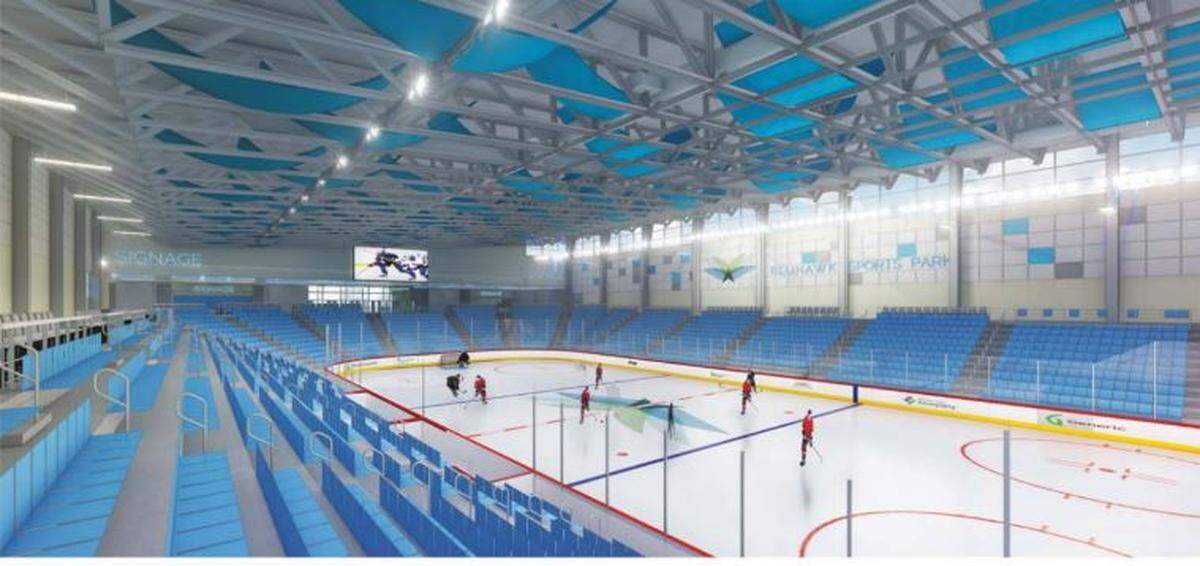
Last fall, the department awarded Overland Park $66 million in STAR bonds for a $400 million project at the Bluhawk site, 10 miles away at 159th Street and U.S. 69, with a nearly identical centerpiece: a large hockey arena and multi-sports complex that will also host concerts and events.
Out of the two rival arenas, the one proposed for Olathe was originally thought to have the sharpest competitive edge. In large part, that was due to the promise that Loretto Sports Ventures — the company of Lamar Hunt Jr., owner of the Kansas City Mavericks hockey team — would manage the center.
But even with the latest setback, a spokesman for Loretto said the company remains committed to the proposed arena in Olathe, which could help redevelop the site where the Great Mall was demolished about four years ago.
“The project is still on,” said spokesman Mike Swenson. “We are moving forward with the city of Olathe with a plan that does not require STAR bonds. And we continue to work with the entire community to grow the sport of hockey in the region.”
A spokeswoman for developer Woodbury Corp. declined an immediate interview, but said more information could be announced in a few weeks.
Meanwhile, the Overland Park project also faces some uncertainty, as city leaders race to issue the STAR bonds knowing the state program — which has been under scrutiny by legislators — sunsets June 30.
“It’s so fluid that we are proceeding on our process because we can’t control necessarily what the state Legislature will do,” Overland Park City Manager Bill Ebel said at a recent committee meeting.
The Commerce Department has introduced legislation that would reauthorize the incentive program for five more years, but that move could come with some major changes.
Bluhawk moves ahead
With STAR bonds awarded, Overland Park developers have been moving quickly to be the first to open a new youth hockey mecca west of U.S. 69 in south Johnson County.
A feasibility study commissioned by Overland Park found that the development of two hockey arenas so close to each other would likely cause one or both venues to fail.
At a finance committee meeting last month, city leaders said they aren’t as worried about their competition in Olathe.
“We’re not thinking that they’re going to beat the city of Overland Park to the market,” Deputy City Manager Kristy Stallings said.
The Bluhawk site is already partly developed, with a neighborhood shopping center, restaurants, hospital, police and fire stations, single-family homes and apartments.
Bart Lowen of Bluhawk’s developer, Price Brothers, said the next phase is well underway, with some shops already open within the STAR bond district. Construction on the core retail area and sports arena should be visible this year.
The STAR bonds, which provide upfront dollars for tourism-related developments, would be paid back with local and state sales tax money generated on the site.
The sports park could open in late 2021, Lowen said.
With eight basketball courts that can convert into 16 volleyball courts, project leaders have said Bluhawk could become one of the region’s largest sports complexes.
In the West Bottoms of Kansas City, Hy-Vee Arena holds a dozen basketball courts. But that venue has struggled financially in its first year since its redevelopment from Kemper Arena.
Bluhawk developers have not yet announced a hockey tenant for their arena.
“We are in various-stage discussions with sponsors, partners and tenants and anticipate making a comprehensive announcement later this year, closely tied with the start of vertical construction,” Lowen said.
Bluhawk developers reported to the state that they plan to have a United States Hockey League team as the primary tenant. But so far, the hockey arena in Olathe has had a firmer commitment with Loretto Sports.
Financing in Olathe
With Loretto saying it is still moving ahead in Olathe, its developers must now rethink the feasibility and financing of the project.
Olathe originally requested $69 million in STAR bonds from the state, which could have reimbursed the costs of constructing the roughly $40 million arena and infrastructure improvements.
Some residents and city leaders previously said the STAR bonds were necessary to develop the site.
“Without tax incentives, this project would not be built in Olathe,” Alan Marston, who ran for City Council in November, told The Star before the election.
The City Council last March discussed creating a tax increment financing district to aid the project, but it was never established. There are no city incentives existing on the site, said city spokesman Tim Danneberg.
Several council members did not return calls from The Star asking about the project. Councilman Adam Mickelson declined an interview.
Despite missing out on the state incentives, the Olathe developers have cleared other hurdles.
Work stalled last year when developers were named in a lawsuit against the city of Olathe — a suit that attorneys warned could hurt the chances of winning STAR bonds.
Legato LLC, which owns 88 acres adjacent to the former mall property, sued the city over stormwater runoff issues. But this past fall, a Johnson County District Court judge largely sided with the city, saying it has followed city ordinances.
In October — around one week before the state awarded Overland Park its STAR bonds — the judge disposed of all counts against the Great Mall developers.
The court case wrapping up could clear the path for developers to make more progress at the Great Mall, although financing remains in question.
Future of STAR bonds uncertain
Overland Park City Councilman Paul Lyons said the city has learned from a previous STAR bond-fueled project — the Prairiefire development that most agree has largely failed to meet expectations.
Overland Park issued nearly $65 million in bonds in 2012 for the retail and entertainment development along 135th Street, between Nall and Lamar avenues. Prairiefire, with its $27 million museum, has been struggling financially as it attracts far fewer visitors than expected.
“We saw the feasibility study and it was very positive. It was a very favorable report,” Lyons told The Star in a recent interview. “I totally bought into it. But as time went by, I began to wonder about these numbers not making sense. The museum wasn’t attracting the number of people it said it was going to attract.”
The firm that conducted the Prairiefire feasibility study, Canyon Research Southwest, also conducted a feasibility study for the Bluhawk project, which was submitted to the secretary of commerce.
The Bluhawk study, which did not look at the impact of a nearby and nearly identical Olathe project, projected 3.1 million visitors. Around 1.12 million annual visitors were projected to come from 100 miles or more away. That projection is double the number of fans who attended Royals home games all last season.
With questions about the accuracy of the report, the city decided to move ahead with additional feasibility studies by a different firm.
“With Bluhawk, we had a discussion that we want to make sure we get a research report and feasibility study from a neutral third party that we all agree to,” Lyons said.
Hunden Strategic Partners conducted a study that was required by the commerce department and took into account competition from the Olathe facility. It concluded that Overland Park’s proposal is best suited for success.
The STAR bonds were awarded to Overland Park based on those two studies.
The city also engaged in a separate study to validate the conclusions of the Canyon study, which was not required by the state. Another report is being prepared to examine the first phase of the Bluhawk development.
Lyons said the process shows the City Council is working to avoid the problems that arose from Prariefire’s STAR bond submission.
But officials are still preparing to market the STAR bonds without knowing how the program might change.
Under the state program, cities sell bonds to provide upfront capital to a developer. The bonds are paid back over 20 years with sales tax generated by the development.
The program has been criticized by some lawmakers who argue it has been used to subsidize local quality of life projects, rather than the unique tourist attractions the it aims to support. An investigation by The Star revealed the state does not track whether developments meet basic requirements for the program.
The commerce department introduced legislation in January that would authorize the program for five more years, but the plan has been met with some resistance in the Legislature.
Proposed changes could include tightening some rules, although the legislation could allow corporate headquarters and hospitals to benefit from the program. Some argue those types of projects would qualify because they bring large numbers of people to the state.
Many have called for greater accountability within the program before it is reauthorized.