
Missouri prairie grass group knows it’s hard to be natural
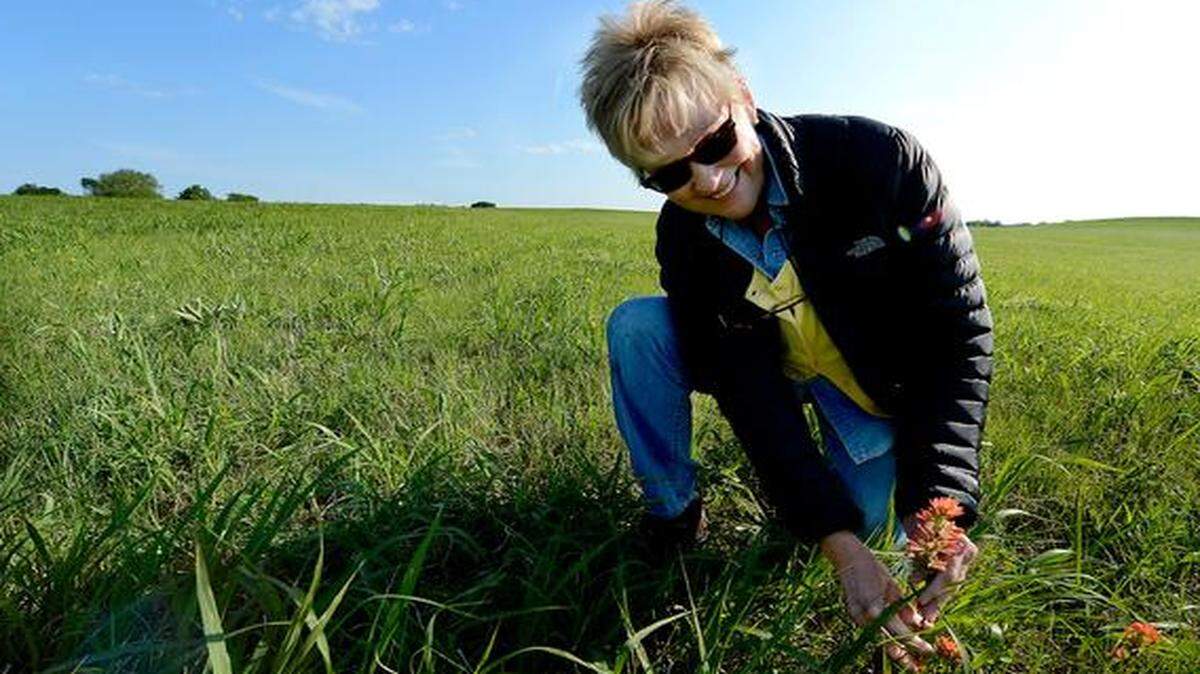
Bonnie Teel inherited a landscape that many would call boring.
Hardly any shade, for one thing.
But Teel plans to spend much time and money in retirement to keep more than 600 acres of virgin tallgrass prairie just as it is. Fellow members of the Missouri Prairie Foundation will help her along.
Sometimes they come to squirt poison on young trees. They might even dab herbicide on narrow fescue blades that shouldn’t be there. They’ll kneel to gather seeds of flowering native plants and grow them elsewhere.
People who don’t know their grasses may puzzle over an irony well known by the foundation and its volunteer army of tallgrass prairie advocates: It takes a lot of work to keep a patch of ground natural.
It is especially hard for a statewide nonprofit with a $330,000 annual budget and a paid staff of two.
One of them, Richard Datema, wheels a pickup around the state to eradicate invasive species on most of the 16 locations of tallgrass prairie the foundation owns.
And it’s getting harder, in these years of high crop prices, for the foundation to help landowners hang on to the few, struggling native lands that remain.
After all, why gaze at a bunch of grass, flowering shooting star and scissor-tailed flycatcher (a bird) when a grower can turn that sod and profit from corn and beans?
Teel, a prairie foundation director, acknowledged: “I could have a whale of a farm here. I could drive a real nice car and take lots of vacations. I’m never going to do that.”
She’ll instead pay contractors to burn a third of her tallgrass field every year to keep it viable.
It was nice for Teel to reward herself, on Mother’s Day, by just spending hours out there enjoying.
She stepped through the rarest of Midwest scenery: Never plowed, never re-sodded, never developed. Just a sun-soaked vista of tallgrass and native plants such as blue spiderwort and rattlesnake master.
From a hillside she could see how at least a third of Missouri once looked.
Iowa, Minnesota and Illinois, too.
No longer. In Missouri all but half of 1 percent of the 15 million acres of native tallgrass prairie are gone.
More would have vanished. But since the late 1960s, about 3,000 acres have been bought by, or bequeathed to, the Missouri Prairie Foundation.
“These individuals who have saved Missouri prairie on their own are just gold to us,” said Bill Graham, a spokesman for the state Conservation Department. It partners with the foundation, the Nature Conservancy and state and federal agencies to preserve some 25,000 acres of native tallgrass, widely sprinkled across Missouri public lands.
Besides maintaining the 16 properties it owns, the foundation hosts prairie hikes, campouts and planting workshops that draw from a small but passionate base of 1,600 members.
In two years the organization celebrates its 50th anniversary and this summer will launch a $4 million fundraising effort to expand its activities.
“It’s not a big club,” said Stephen Mowry, a Kansas City area lawyer and former foundation president.
He said the mystery in 2014 is why anyone would bother.
“You have to stop, climb out of your car, cross a fence and take a walk to understand what’s out there,” Mowry said. “Most people these days don’t want to slow down.”
What’s left
Much of what is left of tallgrass prairie, which once covered 400,000 square miles of North America, can be seen in the Kansas Flint Hills.
It survived only because the eastern Kansas soil was too rocky for farmers to plow.
“Once tallgrass prairie is plowed, it’s lost forever,” said Tom Thompson of the conservation department’s Grassland Systems Field Station in Clinton, Mo. “If tallgrass prairie isn’t burned or managed in some way, it’s going to turn into a forest.”
In parts of Missouri and more tillable, black-dirt states to the north, white settlers swiftly dug in and planted row crops. They discontinued the Native American practice of setting fire to the grasses when lightning didn’t do it.
The burning did no harm to roots that stretched 15 feet deep. It drew buffalo and elk to a fresh layer of green.
Within Kansas City, where half the landscape once was treeless and grassy, only 80 acres of native tallgrass prairie remain — near utility lines at Jerry Smith Park on the city’s far south side.
By the mid-20th century in rural Missouri, undisturbed prairie landscapes fell victim to a perfect storm of agricultural trends: Factories made bigger plows. Nitrogen supplies that helped produce World War II bombs would be used in fertilizers that pumped up crop yields.
Imported fescue turf for year-round cattle grazing replaced the summertime tallgrass that buffalo ate.
“For a few farm families, it was just a tradition to keep that north 40 or 80 acres native,” often kept as unplowed hay fields, said Daryl Smith of the Tallgrass Prairie Center at the University of Northern Iowa. “But, sadly, when it comes to crunch time, most are going to use the ground for the highest economic value.”
Economic value hardly applies to preserving tallgrass, Missouri Prairie Foundation members can attest.
“People would be probably surprised,” said property manager Datema, “at how terribly hard it is to keep something in a natural state.”
Over the years, non-native sapplings and thistle will pop up, the seeds carried in bird droppings, on trowser cuffs, truck tires and wind gusts.
Datema can eyeball hundreds of native plant species in a prairie and spot the pesky sericea lespedeza, an Asian weed, from a distance.
“You can never get all of it,” he said.
Sometimes volunteer crews will use thin brushes to swab a fescue blade with Roundup and not touch the surrounding grasses.
“It’s daunting,” said Teel from her Prairie View Farm in northern Vernon County, just south of Rich Hill. “See all the tree sprouts below that ridge? We were going around with a backpack sprayer to hit each, one at a time.”
She earns a modest income off her prairie by rotating crops of hay and selling native seeds. “As money comes in I’ll do my best,” Teel said. “You have to. Soon as you turn your back on this ground, you start to lose it.”
The payoff blooms at her feet, at least 220 native plant species.
“With each step you see something different,” state conservation agent Scott Sudkamp said during a visit. He, along with the prairie foundation, has taught Teel almost all she knows about tallgrass prairie since she inherited the land from her husband’s family.
Blue indigo. Indian paintbrush. White shooting star and pink phlox.
“You’re just starting to see the prairie wake up,” Sudkamp said last week. “In a month it’s going to be spectacular and just shoot up” to waist-level.
Pricey passion
Not far from Teel’s Prairie View Farm, the 376-acre Stilwell Prairie extends beyond an unmarked metal gate at the junction of narrow dirt roads.
The Missouri Prairie Foundation has owned it since 1995. Donated by the Kansas City Southern Railroad, the prairie was named for railroad founder Arthur Stilwell.
Half of the rolling land leading to the tracks was nearly pristine native prairie. The other half had been degraded by hedge trees and other invasive plants that had drifted in over the decades.
The foundation in recent years tapped grants and member dues, which account for two-thirds of its income, to pay for removing trees with trunks 5 feet wide.
“Thousands of trees,” Sudkamp said. “You’d see a dozen cars lined up” when the foundation hosted workdays for volunteers helping in the cleanup.
What fuels a personal, and often pricey, passion for the prairie? It’s different for each foundation supporter:
For Teel, it was the death of husband, Fred. She felt compelled to do what she could to preserve the “hay meadow” his family had maintained since 1883.
“My husband’s sister had lived here, and we just stumbled onto the land after she died,” said Teel, who is 70. “It’s like God wanted us here...
“My two daughters now have this prairie bug, too. So that’s good.”
Mike Arduser is passionate about pollinators — bumblebees and butterflies, including the monarch, which fed off the Missouri prairie and is in decline.
“Whenever people are interested in learning about bees, I throw my hat in,” he said.
For foundation co-founder Bill Crawford, who is 96, the catalyst was his concern for a dwindling population of prairie chickens.
As a researcher for the state Department of Conservation in the mid-1960s, “I’d drive a route from Columbia to Kirksville where I used to see 200, 300 chickens” romping in the tallgrass, Crawford said. “Then it got down to 20 or 30.
“The state said it just didn’t have the money to further prairie preservation,” he said. So he and colleague Don Christisen called a meeting at a Columbia tavern to launch the nonprofit.
“I’ve never seen a membership as strong as in the Missouri Prairie Foundation,” Crawford added. “They go out and do what others just talk about.”
Executive director Carol Davit said that “we have a lot more hard work to do” against the forces of invasion and economics.
Even around the prairies of Vernon County, landowners are finding more profitable options tough to resist, said conservation agent Sudkamp.
Three years ago, one of his neighbors sold a 160-acre tract of native grasses and flowers to a buyer who converted the patch to clean-row crops.
After herbicides were dumped on the field and high-priced corn started growing, Sudkamp said he’d drive by and see native indigo sprouting here and there.
He laughed: “Like it was crazy to try to remove the stuff. But you know it’s doomed.”
To reach Rick Montgomery, call 816-234-4410 or send email to rmontgomery@kcstar.com.
Prairie Foundation event
The public is invited to an overnight “Prairie BioBlitz” June 7 and 8, hosted by the Missouri Prairie Foundation at Gayfeather Prairie southeast of Nevada, Mo. The free event includes nature study, night-sky observation and tent camping. To RSVP, go to www.moprairie.org or call 888-843-6739.
This story was originally published May 22, 2014 at 9:18 PM with the headline "Missouri prairie grass group knows it’s hard to be natural."