In Kansas, the biggest counties have less say over their elections. Some want a change
When Sedgwick County Election Commissioner Tabitha Lehman disclosed this month that Kansas Secretary of State Scott Schwab wouldn’t reappoint her, the announcement spurred an outpouring of support for Lehman and anger toward Schwab.
Lehman, the top elections official in the state’s second-largest county, was informed her appointment will end in July after she violated an I.T. policy issued by Schwab. She said she decided not to follow the directive in order to work from home while undergoing treatment for cancer.
The controversy has prompted a reassessment of whether the state law that allows Schwab to name election commissioners in the most-populated counties is the best system for running elections. As elections grow more complex and public confidence in them is increasingly threatened by baseless allegations of fraud, some Democrats and Republicans are calling for a change.
In Kansas, four counties — Sedgwick, Shawnee, Johnson and Wyandotte — have election commissioners appointed by the secretary of state. Locally-elected clerks administer elections in the other 101 counties.
Critics say appointed commissioners, accountable to the secretary of state, limit the power of residents in the largest counties to administer their own elections. The arrangement can also lead to partisan tensions because the secretary of state is almost always a Republican and some of the counties are Democratic strongholds.
“The voters put me in office, they put everyone in this building in office,” said Rep. Vic Miller, a Topeka Democrat. “Why are they not competent, capable of putting someone in the office of election commissioner or election official?”
Controversies involving appointed commissioners have also piled up in recent years. Wyandotte County Election Commissioner Bruce Newby, who is retiring, faced criticism for how he deployed mail ballot drop boxes in 2020. Former Johnson County Election Commissioner Ronnie Metsker came under intense pressure over late reporting of primary night results in August 2018.
Another former Johnson County election commissioner, Brian Newby — no relation to Bruce Newby — had an affair with a woman he had promoted. Emails obtained by The Associated Press showed he then used her to avoid oversight of their lavish expenses.
Schwab spokeswoman Katie Koupal said the current system “maintains the delicate balance of protecting local election officials from potential conflicts of interest while also holding them accountable” to county leaders who set their budgets. Koupal said she was referring to the possibility a local election official could be put in the difficult position of losing their position or having their funding cut if an official on the county’s governing body is unhappy with the results of an election.
“County election commissioners are directly accountable at two levels of government - state and county. The Secretary of State is responsible for oversight of policy and the administration of elections, while the county is responsible for oversight of operating budgets and personnel policies and procedures of the office,” Koupal said in an email.
Koupal said Schwab supports the system with the caveat that local officials play a key role in hiring. Local input isn’t required, but Schwab has used a committees that include local leaders in making appointments. The secretary of state’s office is open to putting the process into law, she said.
Kansas model unusual
Kansas’s elections model, with its sharp divide between population centers and everywhere else, appears to have few parallels. Judd Choate, who helps lead the University of Minnesota’s certificate program for election administration, said he isn’t familiar with any other state that uses the same set up.
Twenty-two states have single, local officials who oversee elections, usually at the county level. They are often elected, according to the National Conference of State Legislatures.
“You just have to think about, ‘what do each one of the systems mean practically?’ The system that Kansas employs, it’s saying we allow partisan elections at the local level but then we want to appoint … at higher populations,” said Choate, who is also Colorado’s director of elections but said he wasn’t speaking in an official capacity.
“Well, I mean really, what is an appointment?” Choate said. “An appointment is just a different person making the same decision that an electorate could make.”
Douglas County, home to Lawrence, is on the cusp of making the switch from having the elected county clerk run elections to having a commissioner. Under Kansas law, counties with more than 130,000 people have election commissioners. Douglas County’s population was about 122,000 in 2019.
Jamie Shew, the Douglas County clerk and the county’s top election official, acknowledged advantages and disadvantages to both systems. More important to him is whether there’s local control and oversight of the official, either from voters or local leaders.
“Whether they’re appointed or elected, I think it should be based at the local level,” Shew said.
The secretary of state’s office is reviewing state law and the historical record to “educate ourselves on the process,” Koupal said. If Douglas County crosses the threshold, Schwab’s office will make sure local officials are involved in the transition, she said.
Frustrations surface
Consternation over Kansas’s use of appointed election commissioners has come and gone over the years. In 2018, then-Gov. Jeff Colyer signed a bill giving county commissioners more say over the budgets of election commissioners after a dispute over spending by Shawnee County’s election commissioner.
Schwab’s decision to not re-appoint Lehman has brought frustrations back to the surface.
Lehman revealed in a tweet that Schwab won’t reappoint her when her term expires in July, citing her use of a remote connection to access a voter database as she prepared for the 2020 elections.
Schwab had forbidden her to do that, she said.
Lehman, who was being treated for cancer, has said she was under doctor’s orders to not risk catching COVID-19 by going into the office. Her oncologist and infectious disease specialist told The Wichita Eagle she faced a one-in-four chance or more of dying if she got COVID.
Schwab’s office has said Lehman was never told she couldn’t work from home, but was told, along with every other local election official, that she couldn’t access the voter registration database from her home.
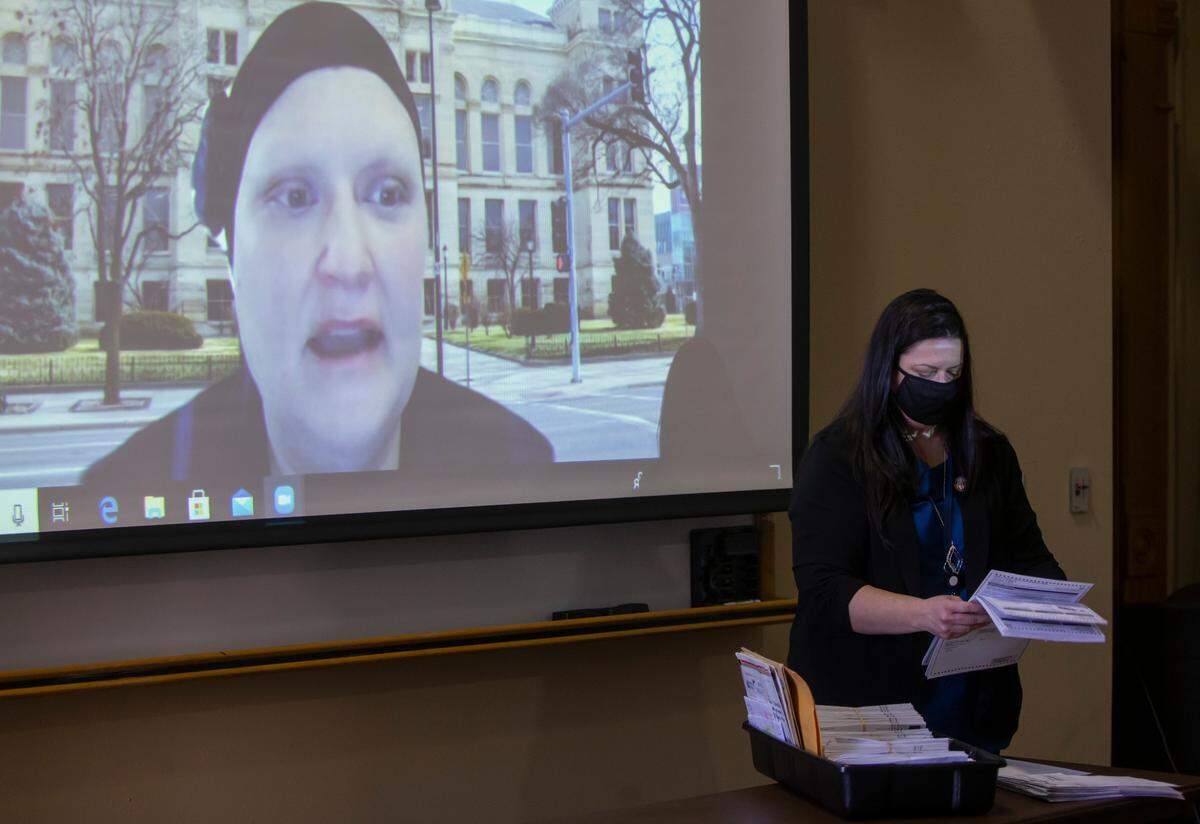
Schwab’s actions caused the Sedgwick County Commission to briefly consider pushing back. The commission weighed urging the Legislature to scale back Schwab’s authority, but ultimately opted against it, persuaded they would have sufficient say in the hiring of the next commissioner.
The commission was satisfied with Schwab’s promises to use a five-member committee to interview and screen applicants for Lehman’s position. The panel has three members from the secretary of state’s office and two from the county. Schwab has agreed to abide by the committee’s choice except in the case of a tie between two applicants.
Schwab used a similar process to pick the newest Johnson County election commissioner, Fred Sherman, who was sworn in on Wednesday. Sherman replaced Connie Schmidt, who never intended to continue after the 2020 election.
“People bring up that changing the appointment process or having an election, that it’ll somehow get better. But when it’s handled locally without that separation of powers and arm’s-length relationship, there could be a lot of problems,” Johnson County Commissioner Michael Aschraft said last year. “I’m not saying it would be in Johnson County or has been in Kansas. But look nationally, that is a constant problem with political influences, suspicions and accusations in those systems.”
‘Let the people elect them’
Others want to see the system changed.
Republican Sen. Carolyn McGinn, a former Sedgwick County commissioner from the rural community of Sedgwick, said she would prefer direct election of election commissioners. Having either the secretary of state or county commissions make the choice is “a little too close” to their own interests as elected officials, she said.
“I have always supported taking a look at, just let us elect our election commissioner, let the people elect them,” she said.
While Sedgwick and other counties have proposed changes over the years, “It’s never got any traction,” she said. Whenever it has come to the floor, “It’s always been offered as an amendment and never as a bill to have that conversation,” she said.
David Alvey, mayor of the Unified Government of Wyandotte County/Kansas City, Kansas, said Bruce Newby, who is retiring Feb. 1, did a good job managing the election office.
Alvey said he would hear complaints about slow reporting of election results after polling locations closed. There was also a controversy with Newby moving a polling location in Argentine from a community center to a police station, where it was feared that some voters would be reluctant to cast their ballots.
“People would question his decisions and start personally accusing him of trying to control the outcomes,” Alvey said. “I would look into it, find no, no there was a very valid reason it was done this way.”
Last year, Newby blamed the UG for not installing ballot drop boxes the election office received or requesting additional funding for more drop boxes. UG officials replied they had asked Newby if he needed additional resources and were told no. Newby also could have requested more drop boxes from the Secretary of State.
While Alvey generally applauded Newby’s work as election commissioner, the mayor said it made no sense to him why the largest counties in Kansas can’t appoint their own.
“Whether it was meant to solve a problem before, whatever that problem was...is no longer present,” Alvey said. “Now the fact we leave it the way it is opens it up to accusations of partisanship, and that’s not good. So if every other county does it within their own process, let the big counties do it the same way.”
The Star’s Sarah Ritter contributed reporting
This story was originally published January 31, 2021 at 5:00 AM with the headline "In Kansas, the biggest counties have less say over their elections. Some want a change."