
“Enough is Enough”, the path of hobbyist to a career in making, meet Kris Johnson of Mekanika Studios
.jpg)
A decorated longboard stands on end, a quiet greeter to the pungent Parkville home of Mekanika Studios. ”That’s right. I moved to Kansas City to skateboard,” says Mekanika’s founder and creative visionary, Kris Johnson. A native Californian, Johnson made his way to Kansas City via Nixa, Missouri 16 years ago. A move that was unplanned and full of uncertainty. “I came here with no place to live, no job, just a need to skateboard.”
Finding a home with a casual acquaintance, at best, he took up residence and landed a job with a local printing company, managing large-format printing, vinyl decals and signage. The work paid the bills, but that was about it. “I think we sold more used cars than signs,” he says.
”I was self-taught in design, making t-shirts for my skateboarding team - it made us seem more legit,” he says of his adolescent foray into the world of graphic and ultimately three-dimensional design. During his time of engaged employment, Johnson was continuing to develop his craft, expanding into digital illustration, comic book shows and conventions where he pitched his freelance art. Beneath an orderly pile of papers, sketches and pending work, he extricates a signed copy of “Markosia’s, “Kong: King of Skull Island,” which he was instrumental in coloring and completing interiors of the book. The comic book became a movie and Johnson earned a publishing credit. ”This is when I knew this is what I wanted to do,” Johnson recounts. “I told my boss I was going to go on my own.”
Working on comic books, and discovering the fantasy table-top gaming industry, Johnson wasn’t exactly a banker’s dream and needed to control costs. “I found someone who let me live in their basement,” Johnson explains. “He and his wife and baby lived upstairs and I lived in the basement, trading work for room and board. If I wanted any romance or to date, I was going to have to move out of the basement,” he says of his temporary living arrangements.
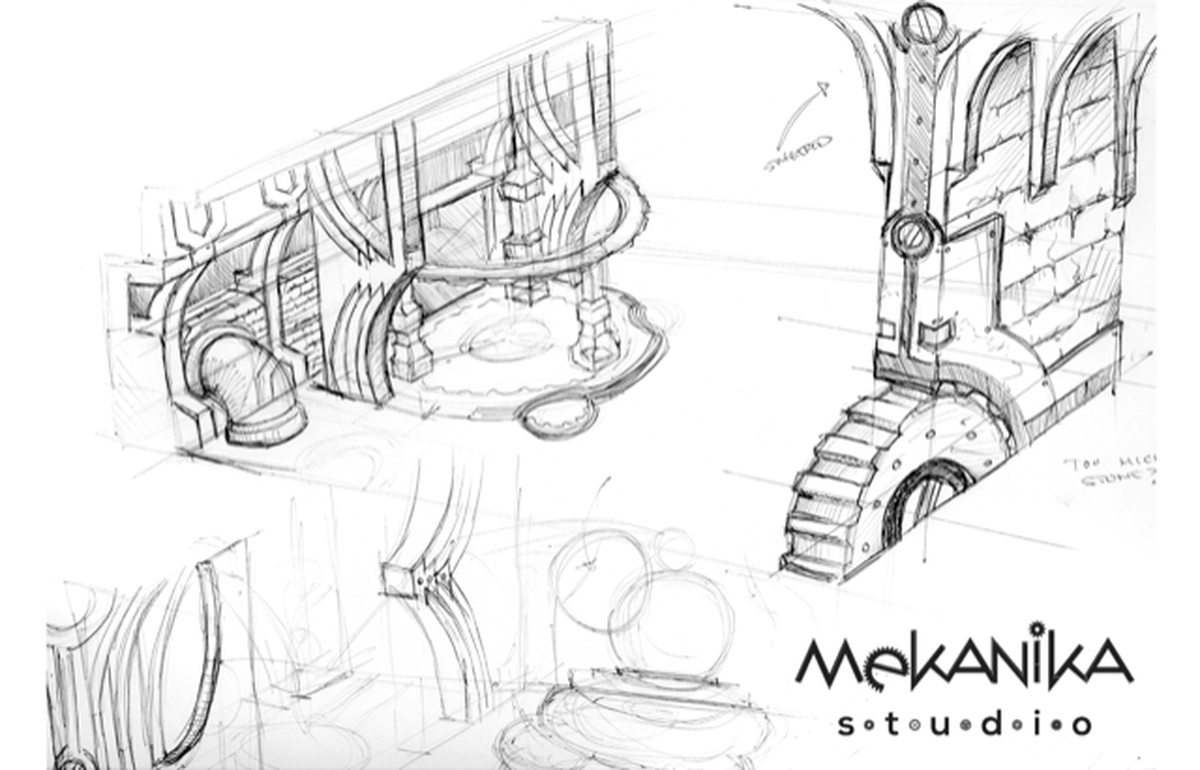
He abandoned his barter arrangement to hone his design chops at Unchained Creative, which led to work in trade show exhibits and experiential marketing initiatives, including tricking out a tractor trailer for a traveling Build-A-Bear exhibit. At this time he also contracted to work on another interactive project highlighting life at the front lines during World War I. He was the lead designer from start to finish on a project funded by Waddell & Reed.
The work became overwhelming, he recalls, adding that he enjoyed the creative part, but was worn down with the tedium of the business elements. He pursued simplicity. ”I became a print floozy. I worked pre-press and ran six printers and machines. I was a nobody.” On the side he kept designing and began developing his three-dimensional modeling skills. “My grandpa was into model trains and that always intrigued me,” he says, applying that history to his introduction into the $12 billion a year table-top gaming industry. ”I made an expandable tray for myself. I used it to move my miniatures from game to game at tournaments,” he explains. Soon other gamers were asking for his innovation. “I couldn’t keep them in stock,” he adds. Then he started creating unique three-dimensional trophies for the weekend-competitions and then crafted elaborate, thematic tables. ”The experience, the game was chess on crack,” he quips. “I was working. I was freelancing and finally, I thought, ‘enough is enough.’ I’m going to make a career of this and began working from home.” Mekanika -- a spelling derivation of mechanica, which in Johnson’s world of fantasy gaming, translates to “machinist, maker, gear-head,” he allows -- was born. It was just a web-store, with an innovative tray. The year was 2012. While back in his basement-dwelling days, he did find romance and his wife, Marcie. They married and had their first child, Indiana. Returning to a subterranean work environment, he found stimulation, albeit short-lived in his own home. “I was printing and designing in our basement for about six months and it became obvious there were too many fumes, too much noise and too much commitment,” he admits.
He ventured to iWerx, a North Kansas City coworking space and business incubator. “I learned 3-D modeling with no intention of building a company like this,” he admits. “I shudder to think how much money I dropped at Hobby Lobby, but my work was getting attention at events and from game companies.” One of those companies came to him and its related demands grew to the point where work again consumed him. ”The client was growing and I had to grow and I realized I had too much reliance on that one client,” he admits, seeking balance. “That’s when I walked into Cinder Block Brewery.” ”I want to talk to somebody about tap handles,” he recounts, eventually reaching founder Bryce Schafer. “I told him I think I can do this. I want to do it.” Johnson made free prototypes and Schafer was sold. That’s when the former realized his small volume, design manufacturing venture was unique in the marketplace. With his design expertise and burgeoning three-dimensional modeling capabilities, Mekanika could make custom products, produce them in small volumes and bring them to market in short order.
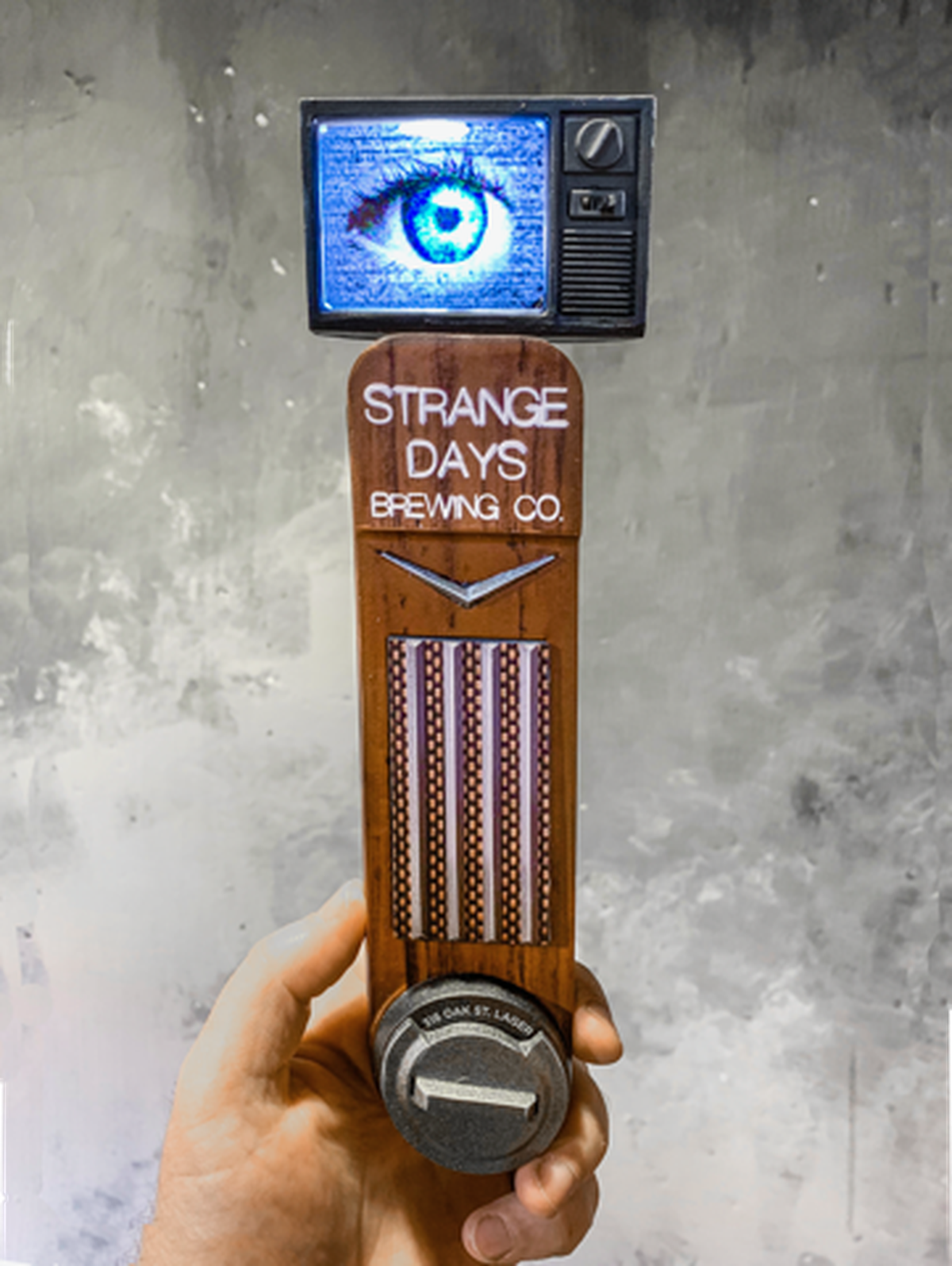
Referrals materialized and he needed to find his own shop. He needed enough space to support his print fulfillment, digital UV printing, resin casting, silicon molding, dye sublimation, heat presses, 3-D modeling and a partner. ”He’s the yin to my yang,” Johnson says of his new business partner and collaborator, Jasen Roberts. It didn’t take long for the partnership to bear fruit. ”(Roberts) was in the brewery and asked if we had ever thought about custom tap handles,” recalls Christopher Beier, Managing Member of Strange Days Brewing Company. He gave Johnson a call. Mekanika is now developing a tap handle that features an LED-lit scaled television --featuring the brewery’s iconic eyeball logo -- and a rotating disc that changes to identify the specific beer tapped to that handle. Innovatively economical. ”With Kris, the sky’s the limit with anything we want to do, to create,” Beier says, adding Mekanika’s 816 area code also influenced the business decision. “Working with local companies is a big thing for us,” he explains. “It was a big reason we started working with him.” While Mekanika’s design and production capacity satisfy Johnson’s creative inclination, he knows what still butters his bread. “There’s nothing quite as profitable as cueing up a machine and let it run,” he claims, referring to the efficiencies of a printed product.
With open orders from Strange Days, Messenger Coffee, and clients in its gaming market, Mekanika is at a crossroads. “My whole story’s been reactive,” Johnson says. “Now we’re looking forward, loving what we’re doing, but I want it to stay that way. I’m not sure what the company will be, but I want us to be doing it well.”
This story was originally published February 20, 2019 at 5:00 PM with the headline "“Enough is Enough”, the path of hobbyist to a career in making, meet Kris Johnson of Mekanika Studios."