
50 abstract baby names related to art and creativity

There’s nothing easy about naming a child. Some parents would even say there’s an art to it.
But instead of trying to break down the art of naming a child, let’s try something different and use art as inspiration for the actual baby name.
And just like that, a new baby-naming trend was born: Baby names related to art and creativity.
Perhaps the best example of names related to art and creativity is the name Art — a shortened variant of the names Arthur, Arturo and Artemis.
Art didn’t crack the top 1,000 most popular names in the U.S. in 2023, but Arthur (No. 128, boys), Arturo (No. 621, boys) and Artemis (No. 856, girls) did, according to the Social Security Administration (SSA).
The names Artie or Artsy would also fit this trend, albeit more rare than those listed above.
Then again, you could always name your child after your favorite artist, such as Leonardo da Vinci, or after one of his famous works, the Mona Lisa.
The name Paris would also work, considering it’s the city currently housing the Mona Lisa as it hangs behind bulletproof glass in a gallery of the Louvre Museum.
Color names such as Hue, Matte and Iris (which means “rainbow” in Greek) would also work, as would musical names, such as Octavia, Lyre, Viola and Reed.
Continue reading for more unique baby names related to art and creativity!
50. Sonnet
A sonnet is a 14-line poem usually written in iambic pentameter, meaning each line has 10 syllables with a rhythmic pattern of an unstressed syllable followed by a stressed one, like William Shakespeare.
The word sonnet, derived from the Italian word sonetto and Latin word sonus, could make for a beautiful baby name — almost like a cross between Sonia (meaning “wisdom”) and Bennett (meaning “blessed”).
49. Hymn
A hymn is a religious song or poem that’s often written to praise or honor a deity and generally sung during worship services or religious ceremonies. In a Christian context, hymns are written to honor God.
The word hymn comes from the Greek word hymnos and Late Latin word hymnus, both of which translate to “festive song.” It would make an excellent boy’s name, considering how close it is to the word “him.”
48. Harper

The name Harper comes from an English surname that originally belonged to a person who played or made harps. It’s derived from the Old English word hearpe, referring to the large stringed instrument.
Harper is one of the most popular baby names related to art and creativity. It first appeared on the SSA’s top 1,000 in 2004 and hasn’t skipped a beat since. In 2023, it was the 11th most popular girl’s name.
47. Poem
Since word names are becoming more popular by the year, names like Poem are very much relevant in today’s society. Your child will likely be the only one in their class with this name, but that’s totally okay!
The word poem, which refers to a written composition that uses a concentrated, lyrical arrangement of words, is derived from the Latin word poema — which could be a feminine variant of the name Poem!
46. Lyric
Believe it or not, the name Lyric has been popular in the U.S. for nearly three decades. It first appeared in the SSA’s top 1,000 in 1995 and was most recently ranked the 536th most popular girl’s name in 2023.
But don’t pigeonhole it as a feminine name. Lyric also appeared in the SSA’s top 1,000 boy names between 2007 and 2020. It has fallen off the boy’s list since, but it’s still very much popular among girls.
45. Harmony
The name Harmony comes from the English word harmony, which is derived from the Greek and Latin word harmonia. It’s a musical term referring to the combination of simultaneous musical notes in a chord.
Furthermore, the term harmony could refer to any pleasing arrangement of parts or a period of internal calm. Perhaps that’s why Harmony (and Harmoni) have appeared in the SSA’s top 1,000 since 1997.
44. Mural
The word mural is derived from the Latin word muralis, meaning “of a wall,” which itself comes from the Latin word murus, meaning “wall.” A mural is a painting or other work of art executed directly on a wall.
You won’t find Mural in the SSA’s top 1,000, but it’s strikingly similar to names like Mary, Maria, Miriam and Miryam — a Biblical name. It can also be linked to the name Murali, which means “flute” in Sanskrit.
43. Muse
A muse is a source of inspiration often associated with creativity and artistic expression — making it perfect for names related to art and creativity. It’s also closely tied to the Somali form of Moses (Muuse).
The term muse originates from Greek mythology, where the Muses were nine goddesses who presided over various arts, sciences, and intellectual pursuits. The Muses were thought to inspire creativity.
42. Mosaic
If you like the name Muse, then you’ll love the name Mosaic — which comes from the Medieval Latin word musaicum and Italian word mosaico, both of which happen to be derived from the word muse.
A mosaic is an art form in which small pieces of materials — such as glass, stone, ceramic, or other objects — are arranged to create a decorative design or image. These pieces are known as tesserae.
41. Ode
An ode is a type of lyrical poem that expresses admiration, praise, or deep emotion for a person, thing, or idea. In Ancient Greece, odes were generally meant to be sung, but today’s odes are more flexible.
Some of the most famous odes of all-time include “Ode to a Nightingale” by John Keats, “Ode on a Grecian Urn” by John Keats and “Ode to Joy” by Friedrich Schiller (famously set to music by Beethoven).
40. Saga

The name Sage was the 143rd most popular girl’s name and 422nd most popular boy’s name in the U.S. in 2023, but let’s give it a bit of a makeover — instead of an e at the end, we’re replacing it with an a.
A saga is a long narrative, often rich in detail, that tells a story about heroic deeds, family histories or a significant event. The term originated from Old Norse literature and is also the name of a Norse goddess.
39. Rhythm
The word rhythm is derived from the Ancient Greek word ῥυθμός (rhythmós), meaning “measured flow or movement, symmetry, arrangement, order and form.” It has a similar meaning to Harmony and Hymn.
It also somewhat sounds like the name Ryan, so it won’t be too unrecognizable — albeit rare and unique. Rhythm exists in music, poetry, speech, dance, and even everyday life, like the rhythm of your heatbeat.
38. Melody
We can’t mention the names Harmony and Rhythm without highlighting the name Melody — which refers to a sequence of musical notes that are arranged in a pleasing or memorable way. It’s the “tune” of music.
The word melody is derived from the Greek elements μέλος (melos), meaning “song,” and ἀείδω (aeido), meaning “to sing.” Believe it or not, Melody was the 103rd most popular girl’s name in the U.S. in 2023.
37. Allegra
The name Allegra is of Italian origin and is derived from the Italian word for “cheerful” and “lively.” In this case, we’re using it as a feminine form of the musical term allegro, referring to a fast and lively tempo.
Allegro is often used to describe a section of a musical work that is energetic, bright, and lively — making it the perfect name for a newborn baby who is sure to bring a lot of energy, light and life to your family.
36. Carol
The word carol is derived from the Old French word carole, meaning “kind of dance in a ring, round dance accompanied by singers.” Today, a carol is a religious folk song or popular hymn (like a Christmas tune).
In regards to names, Carol is often used as a short form of Caroline, which itself is a feminine form of the name Charles — a derivative of the Latin name Carolus. It translates to “free man” or “free woman.”
35. Cadence

In music, cadence refers to a sequence of chords or a harmonic progression that marks the end of a phrase or section, creating a sense of resolution or pause. It provides closure and inspires transition.
It’s also a popular boy’s name in the U.S. The name Cadence first appeared in the SSA’s top 1,000 in 2002 and hasn’t fallen off since. In 2023, it was the 951st most popular boy’s name in the country.
34. Fresco
A fresco is a unique type of painting technique in which pigments mixed with water are applied onto a freshly laid layer of wet plaster. The term comes from the Italian word affresco, which means “fresh.”
One of the most famous frescoes in the world is “The Sistine Chapel” by Michelangelo, which covers the ceiling of the chapel in Vatican City. “The Last Supper” by Leonardo da Vinci is another popular example.
33. Gesso
Gesso is a primer or base layer applied to surfaces, such as canvas, wood, or paper, to prepare them for painting. It creates a smooth, absorbent surface that enhances the adherence of paint and adds texture.
This name could work as a diminutive of Gessica, which itself is a variant of Jessica. It’s also closely related to the name Gustav, meaning “staff of the Greats,” yet you likely won’t find anyone named Gesso.
32. Piper

The name Piper comes from an English surname that was originally given to a person who played on a pipe or flute. It can also refer to tropical flowering plants that belong to the pepper family, Piperaceae.
Though not as popular as Harper, Piper has appeared inside the SSA’s top 1,000 every year since 1999. It cracked the top 100 between 2012 and 2021 and was the 133rd most popular girl’s name in 2023.
31. Requiem
A requiem is a type of musical composition or service that is typically associated with a Roman Catholic funeral mass. It’s traditionally and specifically designed to honor and pray for the souls of the deceased.
The term requiem comes from the Latin word requiem, meaning “rest.” It appears in the opening line of mass prayer — “Requiem aeternam dona eis, Domine” — meaning “Grant them eternal rest, O Lord.”
Color names related to art and creativity

We can’t talk about art without talking about color — which means we can’t talk about art names without mentioning color names!
Plus, color names seem to be what all the cool kids are getting these days.
Kansas City Chiefs quarterback Patrick Mahomes and his wife, Brittany Mahomes, have three children with color-related names — Sterling Skye, Bronze and Golden Raye, who was born on Jan. 12.
“The Masked Singer” host Nick Cannon also has a son named Golden, whom he shares with former Miss Arizona Brittany Bell.
And let’s not forget about Blue Ivy Carter, the daughter of Beyoncé Knowles-Carter and Shawn “Jay-Z” Carter.
Even the names Violet (No. 16), Scarlett (No. 17) and Hazel (No. 19) were listed among the SSA’s top 20 most popular baby names of 2023. Those names were given to roughly 19,000 baby girls that year.
Here are a few other color-related names related to art and creativity!
30. Bianca
Origin: Bianca is of Italian origin.
Derivation and meaning: The name Bianca is derived from the Italian word bianca, meaning “white.” You can also use the masculine form, Bianco, as a name.
Similar-sounding names:
29. Aurelia

Origin: Aurelia is of Latin origin.
Derivation and meaning: The name Aurelia is the feminine form of Aurelius, which itself is derived from the Latin word aureus, meaning “golden” or “gilded.”
Similar-sounding names: Bianka, Blanca, Biana, Beatrice, Brianna, Bonnie, Belinda, Bianca-Marie, Brielle, Bianka-Rose
28. Sienna

Origin: Sienna is of English origin.
Derivation and meaning: The name Sienna is derived from the English word sienna, referring to a kind of ferruginous earth used as a pigment in painting. It’s known for its orange-red color.
Similar-sounding names: Selena, Lienna, Siena, Serafina, Selina, Sierra, Sina, Sia, Sienna-Rose, Serena, Simone
27. Giallo
Origin: Giallo is of Italian origin.
Derivation and meaning: The name Giallo is derived from the Italian word giallo, meaning “yellow.” It’s also a genre of murder mystery fiction in Italy.
Similar-sounding names: Gianna, Giovanni, Giana, Giulia, Giuliana, Julie, Julia, Gioia, Gilda, Gisela, Galina, Gloria, and Gaia
26. Rosa
Origin: Rosa has multiple origins.
Derivation and meaning: The name Rosa is derived from the Latin word rosa, meaning “rose,” but is also the word for the color pink in German, Spanish, Italian and Portuguese.
Similar-sounding names: Rosalie, Rosalinda, Rosie, Rosa-Maria, Rosina, Rosetta, Rosemary, Rosaura, Roxana, and Rosina
25. Cobalt
Origin: Cobalt is of German and English origin.
Derivation and meaning: The name Cobalt is derived from the German word kobold, a type of house spirit. It also refers to the chemical element with the symbol “Co” or the color — a shade of blue.
Similar-sounding names: Colby, Colt, Cody, Cole, Cobie, Calvin, Caelan, Colleen, Coletta, and Corbin
24. Azul

Origin: Azul is of Spanish and Portuguese origin.
Derivation and meaning: The name Azul is derived from the Spanish and Portuguese word azul, meaning “blue.”
Similar-sounding names: Azura, Azalea, Azuza, Zuleika, Azurae, Azulita, Aliza, Azizi, and Azura-Mae
23. Bruno
Origin: Bruno is of Italian origin.
Derivation and meaning: The name Bruno is derived from the Italian word bruno, meaning “brown.” It can also be derived from the Old German element brunna, meaning “armor” or “protection.”
Similar-sounding names: Bran, Bruce, Brody, Brian, Bruno-Marc, Byron, Bryant, Bruno-James, Bret, and Benno
22. Azure

Origin: Azure is of Italian and English origin.
Derivation and meaning: The name Azure is derived from the English word azure, referring to the color between cyan and blue on the spectrum of visible light. It can also be derived from the Italian word azuro, meaning “blue.”
Similar-sounding names: Azura, Azzura, Zara, Zuri, Azalea, Asa, Avery, Asaiah, Aziel, and Aidan
21. Cyan
Origin: Cyan is of English and Greek origin.
Derivation and meaning: The name Cyan is derived from the Greek word κύανος (kyanos), referring to the bright, greenish-blue color that falls between blue and green on the color wheel.
Similar-sounding names: Ciana, Sian, Sienna, Cyanne, Cian, Ciel, Zyan, Cyanne, and Siena
Famous names related to art and creativity

When most people hear the word “art,” they don’t picture themselves painting, drawing or playing an instrument.
Instead, most people picture one of the many famous and iconic artists who have shared their work with the world throughout history.
Icons like Leonardo da Vinci, Pablo Picasso, and Vincent van Gogh have become synonymous with the concept of art itself — and their works have transcended time and culture.
Today, millions of people every day visit museums, galleries and other historic landmarks to marvel at the masterpieces that were once created by hand.
So, why not name your newborn baby — a masterpiece in and of itself — after one of your favorite artists?
20. Pablo
Origin: Pablo is of Spanish, Roman and Latin origin.
Derivation and meaning: The name Pablo is the Spanish form of Paul, which itself is derived from the Roman family name Paulus, meaning “small” or “humble” in Latin.
Pablo Picasso (1881–1973) was a Spanish painter and sculptor, widely regarded as one of the most influential artists of the 20th century. A co-founder of Cubism, Picasso’s work spanned a wide range of styles and mediums, with iconic works such as Guernica and Les Demoiselles d’Avignon.
19. Vincent

Origin: Vincent is of Roman and Latin origin.
Derivation and meaning: The name Vincent comes from the Roman name Vincentius, which itself is derived from the Latin word vincere, meaning “to conquer.”
Vincent van Gogh (1853–1890), a Dutch Post-Impressionist painter, is known for his vivid colors and emotional depth, despite struggling with mental illness throughout his life. His masterpieces, such as Starry Night and Sunflowers, were often painted in the last years of his life
18. Frida

Origin: Frida is of Old Norse and Germanic origin.
Derivation and meaning: The name Frida is derived from the Old Norse word fríðr, meaning “beautiul” or “beloved.” It can also be derived from the Germanic word fridu, meaning “peace.”
Frida Kahlo (1907–1954), a Mexican painter, is celebrated for her deeply personal and often surreal self-portraits that explore themes of identity, pain, and Mexican culture. Despite suffering from physical and emotional hardship, Kahlo became a feminist icon, known for her unapologetic approach to body image and her vivid use of color.
17. Claude
Origin: Claude is of French and Latin origin.
Derivation and meaning: The name Claude is the French masculine form of Claudius, which is derived from the Latin word claudus, meaning “lame” or “crippled.”
Claude Monet (1840–1926) was a French painter and a key figure in the Impressionist movement, known for his ability to capture light and color through rapid, loose brushwork. His iconic series, such as Water Lilies and Impression, Sunrise, revolutionized the way artists approached the depiction of nature.
16. Michelangelo

Origin: Michelangelo is of Italian origin.
Derivation and meaning: The name Michelangelo is a combination of the names Michael, meaning “who is like God?” in Hebrew, and Angelo, meaning “messenger” or “angel.”
Michelangelo Buonarroti (1475–1564) was an Italian Renaissance sculptor, painter, architect, and poet, widely regarded as one of the greatest artists in Western history. He created masterpieces like David, the Pietà, and the frescoes on the ceiling of the Sistine Chapel.
15. Artemisia
Origin: Artemisia is of Greek origin.
Derivation and meaning: The name Artemisia is the feminine form of Artemisios, which is derived from the name of the Greek goddess Artemis — the goddess of the moon and hunting.
Artemisia Gentileschi (1593–1653) was an Italian Baroque painter known for her dramatic and realistic depictions of biblical and mythological subjects, often portraying strong female figures. Her works, such as Judith Slaying Holofernes, challenge traditional gender roles and highlight her mastery of light and composition.
14. Raphael

Origin: Raphael is of Hebrew origin.
Derivation and meaning: The name Raphael comes from the Hebrew name רָפָאֵל (Rafaʾel), which itself is composed of the Hebrew elements רָפָא (rafa), meaning “to heal,” and אֵל (ʾel), meaning “God.”
Raffaello Sanzio da Urbino (1483–1520), known simply as Raphael, was an Italian Renaissance painter and architect renowned for his grace and clarity of composition. His frescoes, such as The School of Athens and The Transfiguration, epitomize the ideals of the Renaissance, blending classical harmony with Christian themes.
13. Rembrandt

Origin: Rembrandt is of German origin.
Derivation and meaning: The name Rembrandt is derived from the Germanic elements regin, meaning “advice, counsel, decision,” and brant, meaning “fire, torch, sword.”
Rembrandt van Rijn (1606–1669) was a Dutch Baroque painter and etcher, renowned for his mastery of light and shadow, as well as his psychological depth. His works, such as The Night Watch and Self-Portrait with Two Circles, demonstrate his ability to capture the complexity of the human experience.
12. Salvador
Origin: Salvador is of Spanish, Portuguese and Latin origin.
Derivation and meaning: The name Salvador comes from the Late Latin name Salvator, which itself is derived from the Latin word salvus, meaning “safe, healthy, savior.”
Salvador Dalí (1904–1989) was a Spanish surrealist painter known for his eccentric personality and his dreamlike, often bizarre imagery. His best-known work, The Persistence of Memory, explores themes of time, memory, and the unconscious mind, pushing the boundaries of artistic expression.
11. Auguste

Origin: Auguste is of French and Latin origin.
Derivation and meaning: The name Auguste is the French form of Augustus, which is derived from the Latin word augere, meaning “to increase.” It can also refer to the eighth month of the year.
Auguste Rodin (1840–1917) was a French sculptor, often considered the father of modern sculpture for his revolutionary approach to form and expression. His famous works, such as The Thinker and The Kiss, break away from traditional forms, emphasizing movement, emotion, and the complexity of the human body.
Mythology names related to art and creativity
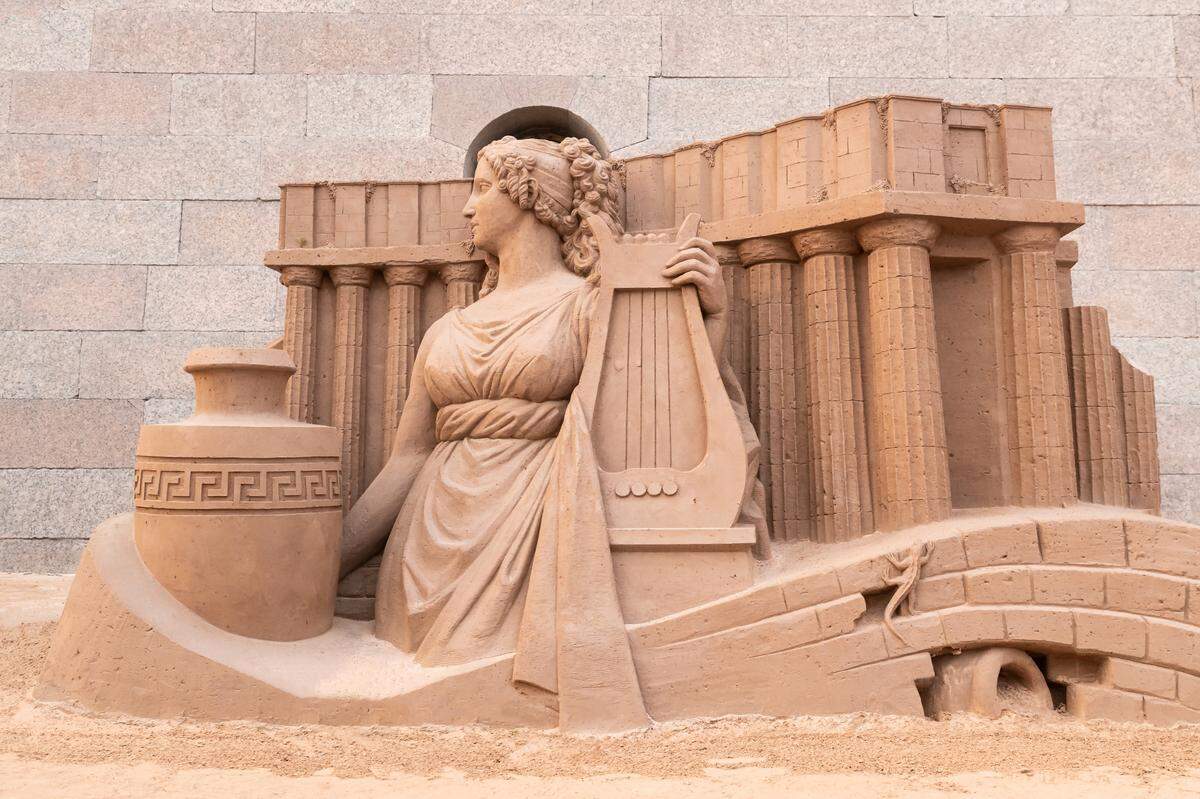
While we’re at it, let’s take a deeper look at one of the baby names we already talked about — Muse.
As explained above, a muse is a person or personified force who is the source of inspiration for a creative artist, but it also refers to the nine Muses — daughters of Zeus and Mnemosyne — in Greek mythology.
Each of the nine Muses presides over a specific aspect of the arts and sciences. So, if you’re looking for a name directly tied to poetry or music, use the Muses as inspiration!
Don’t worry, we’ll highlight the names of each of the nine Muses below!
10. Calliope
Calliope is the Muse of epic poetry and eloquence in Greek mythology. Often depicted holding a writing tablet or a scroll, she is considered the eldest and wisest of the Muses.
Her name comes from the Greek elements kallos, meaning “beauty,” and ops, meaning “voice.” She is said to have inspired Homer to write “The Iliad” and “The Odyssey.”
9. Clio
Clio is the Muse of history and the recording of important events. She is often represented with a scroll or a book, symbolizing her role as the keeper of historical knowledge and the narrator of the past.
Her name is derived from the Greek word kleo, meaning “to make famous” or “to celebrate.” She is credited with introducing the Phoenician alphabet to Greece.
8. Erato
Erato is the Muse of love poetry and lyric poetry, often depicted with a lyre or a plectrum. She is associated with the emotional and passionate aspects of poetry, particularly those dealing with romance.
Her name is derived from the Greek element eros, meaning “love” and “desire.” She is said to make those who were guided by her desirable and worthy of love — kind of like Dane Cook in “Good Luck Chuck.”
7. Euterpe
Euterpe is the Muse of music and lyric poetry, particularly the flute. Often shown playing the flute herself, she embodies the joy and harmony of music, inspiring composers and performers to embrace their talent.
Her name is composed of the Greek elements eu, meaning “good” or “well,” and terpo, meaning “to please” or “delight.” She’s credited with developing various musical instruments, including the aulos.
6. Melpomene
Melpomene is the Muse of tragedy and dramatic poetry, often portrayed with a tragic mask and a club. She represents the sorrow and catharsis that come with theatrical tragedy.
Her name is derived from the Greek verb melpo, meaning “to sing” or “to celebrate with song or dance.” She is closely associated with and often depicted alongside Dionysus, the god of wine and ecstasy.
5. Polyhymnia
Polyhymnia is the Muse of sacred poetry, hymns, and dance, often shown in a contemplative or meditative pose — though she is also associated with geometry and the sciences.
She’s often depicted wearing a tunic and veil and is credited with explaining the origin of the name of the month of May. If you want to use this as a baby name, Hymnia would work as a feminine form of Hymn.
4. Terpsichore
Terpsichore is the Muse of dance and choral song, often depicted with a lyre or dancing shoes. She embodies the grace and rhythm of movement, inspiring dancers and choreographers to use their talent.
Her name comes from the Greek elements terpsis, meaning “delight,” and choros, meaning “dance.” She’s credited with saving Hymenaeus from destruction during the war of Dionysus against the Indians.
3. Thalia
Thalia is the Muse of comedy and pastoral poetry, depicted with a comic mask and a shepherd’s staff. She brings joy and laughter through her influence on lighthearted works.
Her name is derived from the Greek word thallo, meaning “to bloom” or “to flourish.” According to Apollodorus, she and Apollo were the parents of the Corybantes — a group of armed, crested dancers.
2. Urania

Urania is the Muse of astronomy and celestial navigation. She’s portrayed with a globe and compass, symbolizing her connection to the heavens, and inspires scientists and poets to explore the mysteries of the universe.
Her name is derived from the Greek word ouranos, meaning “heaven” or “sky.” She’s also the great-granddaughter of Uranus and is believed to be the mother of Linus and Hymenaeus.
1. Brigid
Greek mythology is just one of the many mythologies with deities related to art and creativity.
Brigid, also known as Brigit or Brighid, is a prominent goddess in Celtic mythology, particularly within Ireland and Scotland. She’s the ancient goddess of the poetic arts, crafts, prophecy, and divination.
She’s the equivalent of Minerva, a Roman goddess, and Athena, a Greek goddess — so either of those two names would work, as well.
Naming a child can be hard, especially with so many options, but Mamas Uncut is here to help. Feel free to check out our baby name blog or try our baby name generator for more unique baby name ideas.