
Steal a kiss under this plant if you wish, but know you’re standing under a parasite
Standing under the mistletoe is a holiday tradition. But how many of us know much about these green sprigs hanging in doorways, begging us to steal a kiss from a loved one?
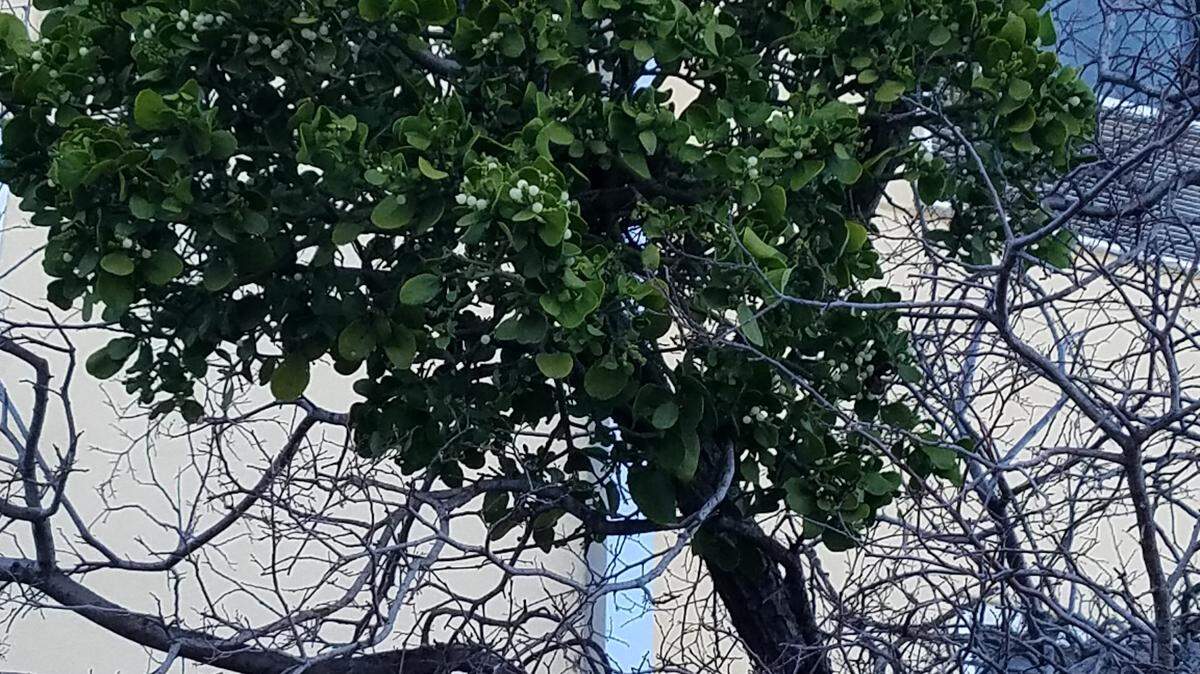
Mistletoe is not a typical plant but a parasite. The plant sends out root-like structures into the branches of host trees, stealing water and nutrients for survival. Mistletoe contains chlorophyll, enabling it to manufacture food. It is possible for multiple plants to attach to host trees, which include oak, hickory and maple.
Mistletoe is recognizable as a rounded ball of green growth up to 2 to 3 feet in diameter. More than 1,000 species of mistletoe can be found around the world. This evergreen plant is hardy to zone 6 or 7, which makes it native to the extreme corner of southeast Kansas and much of the southern United States.
On my Thanksgiving trip to Texas, these bright green growths could be seen in the leafless trees. I have seen it growing in Johnson County once on a young tree. My guess is the tree was shipped from a southern climate, and a warm winter here allowed it to survive for a short time.
Mistletoe produces white berries, an excellent source of food for native birds. Birds are the primary method of dispersal from tree to tree. Hungry birds devour the tasty berries, passing them through their digestive system. Once eliminated, the seeds are covered by a sticky film residue, enabling the seed to attach to the branch of the host where they germinate and grow.
Mistletoe has another method of seed dispersal. Ripe seeds can explode, moving at the rate of 60 miles per hour, scattering them up to 50 feet away to start a new plant.
Areas with more mistletoe have a higher number of birds because of the attraction to the tasty seeds, but beware — the seeds are poisonous to humans. Consuming the white berries leads to nausea, diarrhea and affects blood pressure. Take caution when decorating with mistletoe around children.
So how did a parasite lead to a Christmas kiss? There is no definitive explanation.
One theory suggests that since the plant remains green in winter, it was seen as a sign of life and fertility. Another theory includes a tale of Norse mythology. After a mistletoe arrow killed a goddess’ son, her tears turned into white berries and brought her son back to life. The goddess promised a kiss to all those who passed beneath the mistletoe plant.
Mistletoe traditions have evolved over time to become a part of the holiday season. Whether you get a kiss or not under the plant, it is interesting to know a parasite of trees found around the world has become part of our holiday culture.
Dennis Patton is a horticulture agent with Kansas State University Research and Extension. Got a question for him or other university extension experts? Email them to garden.help@jocogov.org.