
Neighbors’ crimson clover lawn is not a sign of lazy housekeeping
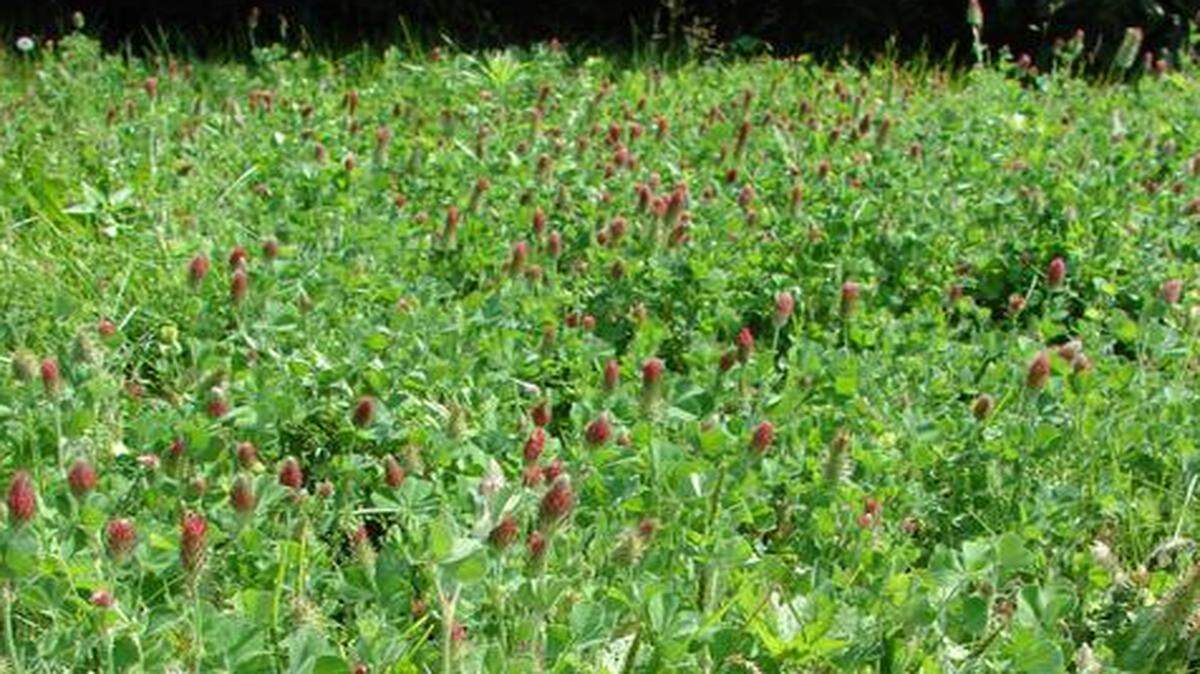
Most people consider clover a weed. Not my neighbors Jerome Van Wert and Stephen Mulrooney. They’re replacing all the grass in their central Hyde Park yard with it.
This spring, they bought four types of clover seed online and at Planters Seed & Spice Co. on Walnut Street and sprinkled it liberally over every square foot of their lawn. They see it as a means of replenishing nutrients in their soil, offering a prime habitat for beneficial insects, conserving water and avoiding chemicals.
Van Wert has been researching it for months.
“So many things I called weeds are not weeds at all. They were brought here on purpose by settlers to be part of their yards,” he says. “They were brought here as food, for their nutrients — like dandelions, they can be used to make wine and salads, and their roots can be used for tea.”
Van Wert and Mulrooney’s front yard is covered with crimson clover, which reaches between 7 and 19 inches tall and produces fuzzy red flowers. The patches between the sidewalk and street surrounding their property are covered in white clover.
The look is not crisp and clean like the manicured fescue in other Hyde Park yards, but it’s also not cringe-inducing like the weeds, vines and other invasive plants I’ve seen overrunning other yards.
The clover actually reminds me of Martha’s Vineyard, where my aunt-in-law has landscaped her lush and pastoral yard by carving paths through native plants.
But not everyone is happy about the Hyde Park experiment.
“Sometimes the clover gets kind of high, so people don’t understand it,” Van Wert says. “People will ask if we’ve been away, or if we need to borrow a lawn mower. Once I explain to them what’s going on, they’re pretty supportive and see it differently.”
Clover lawns are growing in popularity out west in water-starved and environmentally friendly cities in Colorado and California.
The website CloverLawn.org lists many benefits, including how clover grows in bad soil, resists pet urine and needs less water to stay green.
Still, Richard Peeper, store manager at the Grass Pad on Barry Road, said he hasn’t seen too much interest locally in replacing lawns with clover — yet.
“There has been a little bit of discussion in the industry about mixing it in with turf,” Peeper says. “There’s a new micro clover on the market that can be added into turf grass. The grass canopies over it, and the clover is not very noticeable. But not too many homeowners are savvy on trying it in their turf grass.”
He did note that he gets requests for clover seed to cover fallow farmland and gardens.
“It prevents erosion and, being a legume, it fixes nitrogen,” he says. “Then when it’s time to bring that section of the garden into production again, you till or turn under the clover, and they call that green manure.”
Stuff we covet: Clay cookware
The doors of George, a Lifestyle Store were flung open for a sidewalk sale recently. The boutique, which is among the Crestwood Shops at 55th Street and Brookside Boulevard, sells antiques, books, textiles, tableware, jewelry and clothing. Upon entering, I was drawn to a table of black clay cookware.
“If you were in Portugal, you would see a lot of this, not just in people’s homes but in restaurants,” said shop manager Connie Bell. “They fire it at a very high temperature, so it’s heat-resistant in the oven up to 450 degrees and on stove tops, though not electric. After you use them a while they change colors and get a nice patina.”
The cookware’s soft, rounded lines and matte blackness are rustic, elegant and a refreshing alternative to European cookware brands such as LeCreuset.
Prices range from $15 for salt cellars to $140 for a large oval bake dish.
Also in the Crestwood neighborhood, an eye-catching piece of garden art hangs from a home’s brick wall.
Turns out it’s the home of Christopher Filley, owner of the antique shop in Westwood that bears his name, and Richard Hoffman.
“We call it a garden trophy,” Filley said. “We have another one in the back garden that’s prettier because it has color.”
Filley said that Hoffman makes the pieces, which are weathered tools that seem strung through wood handles that are screwed together. The result looks like a rustic sundial. It looks simple enough to make, but something tells me that it probably is not.
Look for an upcoming Houseguest Q+A with Filley and Hoffman.
Got a fall home tour?
Fall home tours are right around the corner. If your neighborhood is hosting one, we’d like to know where and when it will be, how many homes are on the tour, the price and how to contact your group for more information. Please send the information to cgregorian@kcstar.com by Aug. 18 for future publication.
To reach Cynthia Billhartz Gregorian, call 816-234-4780 or send email to cgregorian@kcstar.com.