
Kansas Citians to be honored for their efforts to save historic buildings
On Sept. 29, 2006, the shroud came off.
David Johnson had been wondering what tall, skinny thing was lurking beneath it on the roof of the building across from his Crossroads Arts District condominium. Was it a cellphone tower or antenna?
Would it mar the beautiful downtown views from his living room?
Nope. It was a replica of the building’s original Moonliner II rocket, sitting pretty atop the former TWA headquarters, looking like part of Johnson’s artsy decor.
“I came home from work and saw it and said, ‘OK, that’s awesome. Who can say they have a rocket outside their building?’” he said.
It was as though the gods of historic preservation had smiled upon him. He’d soon repay them by launching campaigns to save downtown historic structures.
Johnson is one of about three dozen people who are being recognized by Historic Kansas City in its “I’m a Preservationist” campaign, which kicks off Friday with a dinner at the Guild KC. Historic Kansas City, a nonprofit group dedicated to the preservation of the area’s heritage, neighborhoods and historic built environment, is also celebrating its 40th anniversary this year.
The goal of the campaign is to update the image of what preservation means and to build the group’s membership.
Historic Kansas City wants to show that preservation isn’t just for professionals who save architecturally significant buildings or manage historic sites. That there are thousands in Kansas City who don’t realize they are preservationists — people who care about sustainability, economic development, urban revitalization and community vitality. They are business owners, neighborhood activists, environmentalists, history buffs and urban dwellers.
The organization wants to attract more younger professionals like Johnson, a project manager with Pinsight Media, to the pursuit of preservation. Others being recognized include artist Peregrine Honig and chocolatier Christopher Elbow.
Together, they make preservation functional and hip.
Updating a Runnels home
Christopher Elbow has a shop in a historic building at 1819 McGee St. downtown. But it’s his homes that really illustrate his love of old architecture.
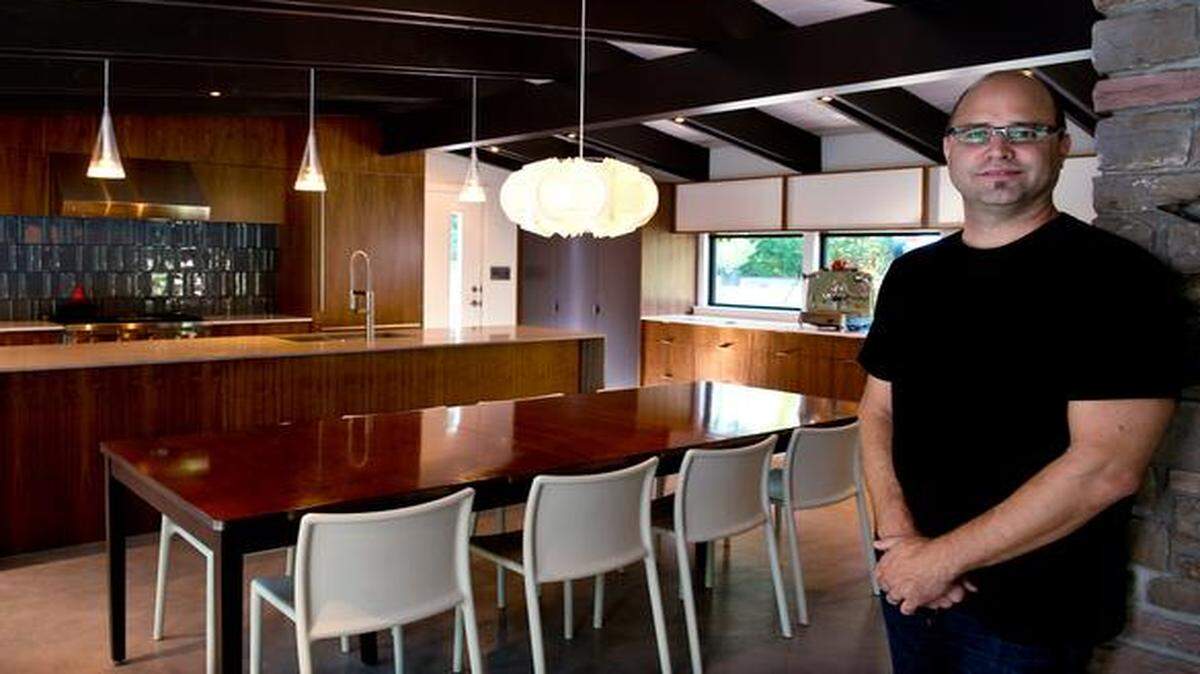
Elbow, 40, has restored homes in the Northeast neighborhood and Brookside. In 2010, he and his wife, Jenifer, stumbled onto a midcentury modern home in south Kansas City that was designed by noted architect David Runnels in 1950.
“Literally the day we finished the last project — and I mean literally the last day — I found this house on a website, and we came and looked at it, and I said, ‘This is it,’” he says. “We love this type of architecture. This has been a dream for us, to have this house.”
Elbow was told that the home, which was featured in House Beautiful in 1950, was built as a winter home for someone from Minnesota and was an early study in green housing. It has a wall of south-facing windows that run the length of the home and radiant heating under concrete floors.
The Elbows interviewed several architectural firms about restoring it. Most suggested tearing it down and starting over. Other plans were expensive and complicated.
The Elbows decided to live in the space for a while to figure out what they really wanted. Last year, they stumbled onto architect Jerad Foster, of Studio Build in Kansas City, who came up with the right design.
According to Elbow, tile and carpeting negated the effects of the radiant heating, so they tore it all out and had the concrete floors beneath polished.
They expanded the kitchen by about 100 square feet to connect the house and garage. It now has crisp, modern walnut cabinets and midcentury modern furniture. Ann Sacks tiles cover the backsplash behind a Wolf gas range.
They kept the floor-to-ceiling windows but swapped the custom-wood framed glass for energy-efficient anodized aluminum.
“The challenge to the builder was for people to come in here and never know we did it,” Elbow says.
They added a copper front to a large brick fireplace at the center of the house. Elbow replaced original luan mahogany paneling with walnut paneling in the common living areas.
The home is elegant but by no means ostentatious. It has three bedrooms and one bathroom that have yet to be remodeled. Elbow expects it’ll take another six years to finish.
“Our goal was not to make a huge house. It’s just the two of us, and I have learned that the bigger the house, the more junk you put in it. Moving in here and getting rid of stuff, it was sort of cleansing.”
Elbow is just happy to be living in a Runnels house.
“There’s just not a lot of them left,” he says. “It would have been a shame for someone to buy this for the property and tear the house down.”
Vintage, modern, chic
Peregrine Honig’s studio and Birdies, her lingerie boutique, are both in historic buildings in the Crossroads Arts District, specifically Film Row.
From the 1920s through the 1970s, Film Row was occupied by about 20 buildings in roughly a four square block area between 17th and 19th streets on Central and Baltimore. Tenants included United Artists, Warner Bros., MGM, Paramount and 20th Century.
“I love old architecture, and I appreciate new architecture,” the artist and one-time Bravo TV reality star says while working in her studio on Wyandotte Street. “I have great landlords. They are invested in me and my studio practice and my entrepreneurial efforts, so I have freedom to build up the spaces I work in.”
When deciding on lighting for her windowless studio, Honig, 38, looked at “epic lighting” by firms like El Dorado Architects, which takes a modern approach. She wanted to find a way to meld styles from two eras without ruining the integrity of either one. She installed large, orb-shaped lights recovered from a defunct mall’s parking lot. The midcentury modern fixtures and 1920s architecture blend seamlessly.
Birdies sits around the corner, at 116 18th St. The lower part of the storefront is covered with reclaimed ceramic tiles from New Orleans, birdcages hang above the shop windows, and a bird-shaped brass knocker created by an Argentinian artist friend hangs on the front door. Just inside, a decaying wall has been preserved by covering layers of peeling paint and crumbling plaster with espresso-tinted polyurethane.
The shop feels like a Turkish boudoir with its antique furnishings, Victorian curiosities and misprints of high-end damask wallpaper that have an aged patina.
A downtown advocate
David Johnson’s interest in preserving downtown buildings can be traced to his first-floor condominium at 1819 Baltimore Ave., which he bought in 2004. He was, he says, among the first wave of people to move into the Crossroads district.
He found the 1939 Kansas City White Goods Manufacturing building during a First Friday event. Chris and Nate Accardo had developed the former linen factory into loft condominiums.
“What sold me was they had a unit across the hall open that was a model that had been staged. I came back the next week and put money down on it,” he says. “I loved how industrial the space was.” Other places he had looked at downtown “were more traditional, they had more molding, and the floors weren’t as raw,” he says, pointing with his foot at two thick wooden beams embedded in the loft’s polished concrete floors.
During the past four years, Johnson, 41, has worked to save four other historic downtown buildings using social media: the Cosby Hotel, at Ninth and Baltimore; the Midwest Hotel, 1925 Main St.; the Lane Building at 1520 Main St.; and the Orion Pictures Building at 170 W. 17th St.
The first was the Cosby Hotel in 2010, after he found out that a demolition permit had been issued for it.
“I had been down here long enough to know how stuff works, politics, etc., and thought that’s just a tragedy. It had been standing since 1889,” he says. “The culture of knocking stuff down and not respecting architectural value is ingrained here. So I started a Facebook page called ‘Save the Cosby Hotel.’”
That called enough attention to it that the demolition money was redirected to shore up the building until a developer could be found, he says.
“The cost was about $3,000 to shore it up; it would have cost way more than that to knock it down,” he says.
The Sunflower Development Group took on the project, and the old hotel now houses the Milwaukee Delicatessen Co. and Sasha’s Baking Co. on the ground floor. The upper floors are devoted to office space.
Inside, there are cow skulls and flowers carved into the moldings, a ceiling covered in painted leather, marble flooring and stained-glass windows.
“Most of it had been covered up, and all of it has been restored,” he says. “I’ve talked to people in historic architecture (who) said they have never seen anything quite like it.”
He has had mixed success with the other projects.
Owners of the Lane Building have put off demolition plans and stabilized the property. The fate of the Midwest Building is questionable. But Shirley Helzburg, a philanthropist and owner of Webster House, razed the Orion Pictures Building last year and replaced it with a parking garage.
He has also become an urban transit advocate and the creator of kclightrail.com, one of the city’s top platforms for transit news and advocacy. Last year, Johnson received Historic Kansas City’s Richard Nadeau Award for being a tireless advocate for preservation and embodying the idea that “advocacy is the willingness to annoy people.”
The 960-square-foot unit that Johnson shares with his partner, Stephen Powell, has one bedroom, one bathroom and a kitchen that opens to the living room. Floor-to-ceiling wood-framed windows in the living room open to a patio, offering a stunning view of City Hall, the Power & Light Building and Bartle Hall pylons.
And, of course, that perfect rocket.
To reach Cynthia Billhartz Gregorian, call 816-234-4780 or send email to cgregorian@kcstar.com.
Anniversary celebration
Historic Kansas City will celebrate 40 years and kick off its “I’m a Preservationist” campaign with an evening of “food, cocktails, entertainment and giving back.”
When: 7-10 p.m. Friday
Where: The Guild, 1621 Locust St.
Admission: $125
Info: HistoricKansasCity.org
This story was originally published October 31, 2014 at 7:00 AM.