
Living a remote-controlled life
Remember the Clapper, that revolutionary technology of the ’80s that allowed you to turn out the light by clapping your hands? The sound-activated device, still on the market, is a primitive form of the automated lifestyle we have at our fingertips 30 years later with the advent of the smartphone. We now have the ability to control not just the lights but everything in our lives.
According to a recent Lowe’s consumer report, 70 percent of smartphone users in America wish they could control something in their homes without getting out of bed. In order of importance, they ranked adjusting the thermostat (44 percent), turning on the lights (39 percent) and starting the coffeepot (27 percent).
It’s all part of a growing trend that connects about 10 billion devices to the Internet today, with estimates of up to 50 billion connections by the end of the decade.
Its implications are broad and powerful. In the near future, every device and appliance in your home, from your door lock to your refrigerator, will be capable of being integrated into this system and accessed remotely — from your bed or anywhere in the world.
“In general, Americans feel positively toward products that will make their homes safer, more energy-efficient and easier to manage. It is added evidence that the smart home and Internet of Things are here to stay,” said Kevin Meagher, Lowe’s vice president and general manager of the smart home division.
Slickly designed automation systems include Nest, which started as a thermostat that “learns” your temperature preferences, and has expanded to incorporate loads of cool features.
Partners like Whirlpool can refresh your laundry while you are away, and Jawbone’s wearable device alerts your thermostat when you awaken so it can adjust to your preferred setting before you slip out of the sheets.
Belkin’s WeMo has an award-winning app for monitoring energy usage and creating lighting plans, and it, too, has partners that add value — Crock-Pot and Mr. Coffee — so dinner can be started while you’re stuck in traffic, and that pot of coffee really can be ready for you first thing in the morning.
LG recently unveiled three household machines with a mobile messaging app so that you can text your fridge from the grocery store to see if you need milk, heat up a casserole in the oven while you’re picking up the kids or start washing clothes in between emails.
While the all-inclusive, mobile, automated lifestyle is definitely here, it’s in its infancy. Currently, the focus of most smart home users is limited to controlling security systems, the thermostat and lighting. Safety is the top concern for most consumers.
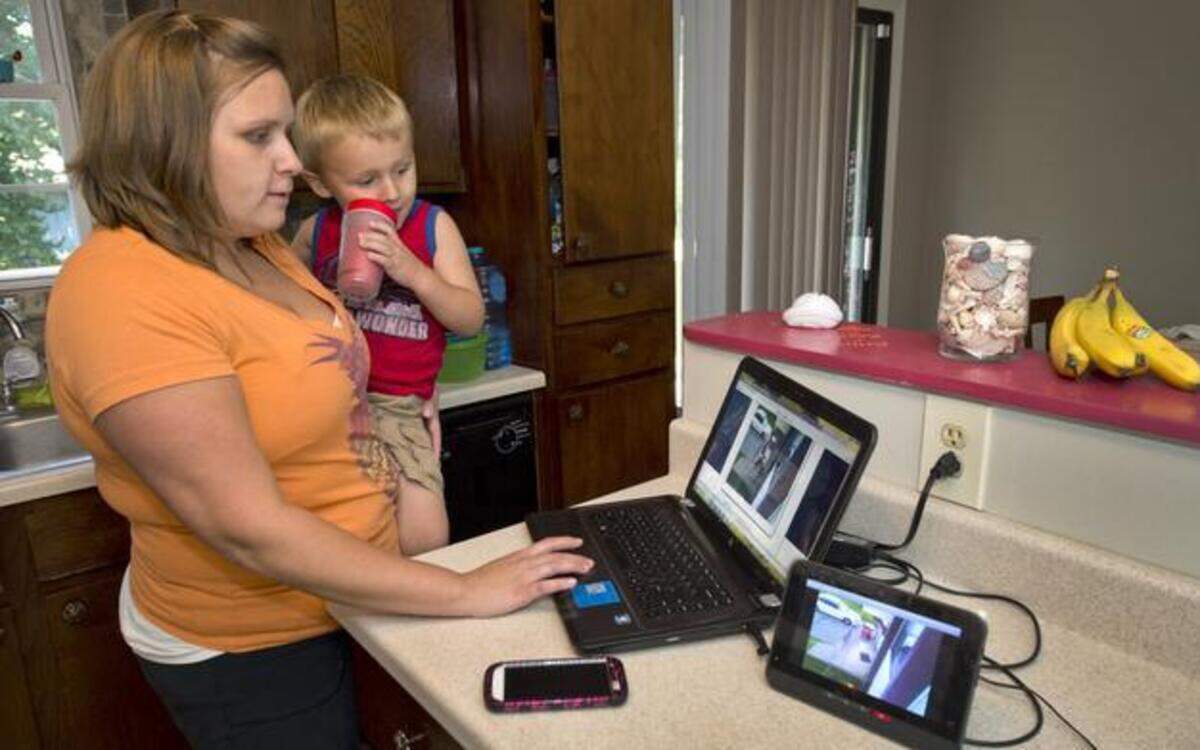
After her previous home was broken into, Emily Estrada needed to find a sense of peace for herself and her kids, Lilly, 12, and Charlie, 3. She found it in a camera set up outside the front door of her Grain Valley home that snaps a photo of visitors and sends it to her phone so she knows who’s there, whether she is home or not. It is also available on a tablet set up at her kitchen counter and on her computer.
Estrada likes the portability of the system because she can move it anywhere while renovations are being made to the house. “We’re not stuck working around it,” she says.
Security systems aren’t new and neither is home automation, but what is new is their real-time connection to you, informing you of current happenings and allowing you to remotely access the system, say, from a point down the road. “In the morning, I don’t have time to set the alarm,” Estrada says. “I’m running out the door, my hair’s wet and I’m missing a shoe. I set it when I get to a stoplight.”
She also has sensors at the doors that let her know when one has been opened, helpful whether it’s an intruder coming in or a toddler running out. She knows whether Lilly has followed through on her duty to let the dogs into the yard or a subcontractor has arrived to do some work.
Estrada sets the rules through her settings, choosing to activate or deactivate alerts for any of the sensors or camera. The system is user-friendly, with the functions most smartphone users are already familiar with.
Secondary to security, smart home users want to control their home’s temperature and turn lights on and off while they’re away from home to save on energy costs and make coming home more welcoming. Add-on products, from water sensors to carbon monoxide detectors, can enhance the smart home experience, helping prevent damage to belongings and even offering life-saving warnings.
“We perceive a major boom with the ability to connect with these products on the go,” says Sam Hassan, director of sales and marketing for Comcast, which provides Xfinity Home to Estrada.
Signing up with a telecom provider is one way of hooking into a smart home program. “It is a natural extension of our business,” Hassan adds. “As a telecom provider, it makes for an easier installation because we’re already there.”
Any broadband connection will work with Xfinity Home, but bundling with the company’s other services can save money. Average installation costs $99, with a monthly fee of $39-$49. Time Warner offers a similar program for its customers called IntelligentHome, starting at $34 per month, with no installation fee, but it requires TWC Internet service.
Installing a system like one of these can save 10 to 20 percent on homeowners insurance.
There are other options outside of your telecom provider. Not surprisingly, in the Lowe’s survey respondents cited cost as an important factor in their decision to purchase smart home products. Half would prefer a DIY solution without a monthly fee over a professionally installed and monitored system.
In answer to that, the company introduced Iris, a comparable smart home management system with a start-up cost of $179, no long-term contract and no monthly fee unless you want premium service for $10 per month.
Whatever, however, wherever — you can be connected to your home with that little screen in your pocket that used to serve the single function of making a phone call. How primitive indeed.
This story was originally published September 19, 2014 at 7:00 AM with the headline "Living a remote-controlled life."