
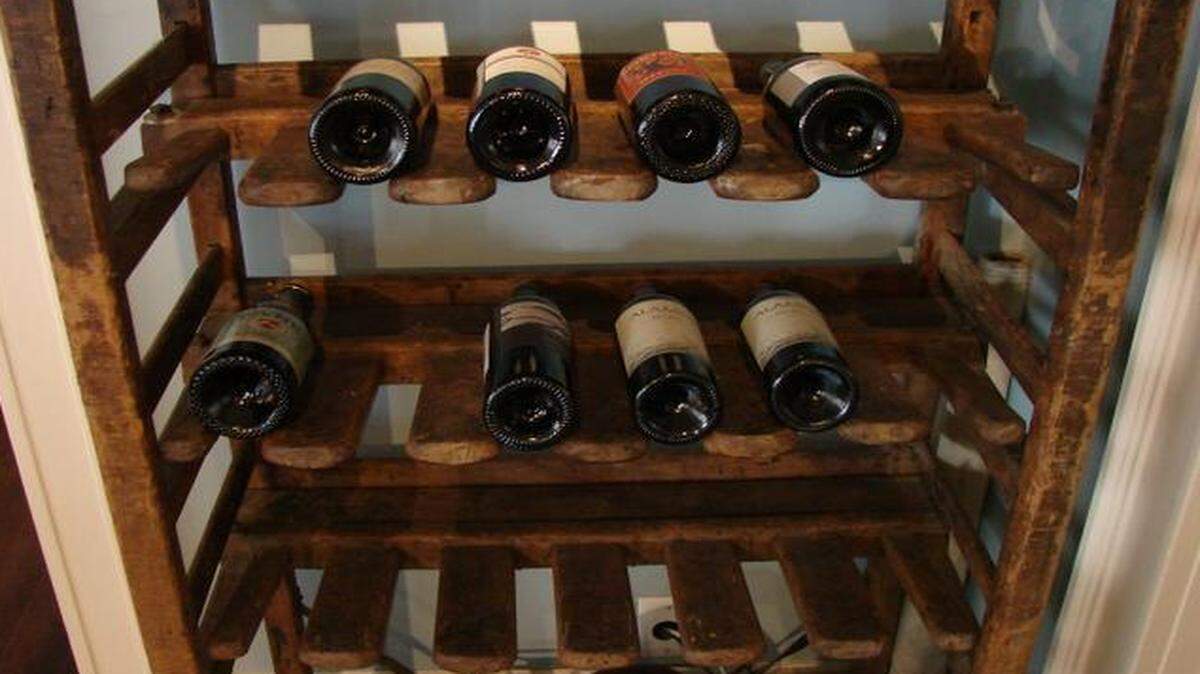
Stuff of Life: Antique cart is now a wine rack, but what was it before?
If you want a good giggle, Google the following: “SNL skit what the hell is that.”
You’ll find a 1979 video clip of Bill Murray and Steve Martin staring at something off screen and yelling, for two solid minutes with escalating bewilderment, variations of the phrases: “What the hell is that?” “How’d that get here?” and “Don’t put your lips on it.”
That’s pretty much the reaction of guests when they see an antique cart sitting in our dining room.
I bought the rack several years ago at a yard sale for $80. I’ve found similar ones online — usually baker or shoe racks — but nothing that matches it exactly.
I use it as a wine rack. The chunky wood slats that form the shelves tilt down toward the back so that when bottles are stored with their bottoms to the front, their corks won’t dry out. Glass stemware can also be hung from the slats.
Most people who see it don’t think it was originally intended for this. So they stand and speculate. What about you, readers? Have you ever seen a cart like this? Do you know what it is? What do you think it is? To weigh in, go to the House + Home section's Facebook page.
By the way, the framed picture sitting on top of the rack is a 1961 cover of Arab Week featuring my husband as a baby and his mother. My husband was born in Beirut, Lebanon. His parents were living there temporarily while my father-in-law worked on his dissertation titled “The Emergence of Modern Afghanistan.”
The magazine ran a story about young American mothers living in the Middle East, and my mother-in-law was recruited as a last-minute model. She was quite the bombshell, no? She also drew the sketch of my father-in-law sitting, next to the framed cover, about 15 years ago.
I love decorating with stuff that has personal meaning. We also have an amazing photo of my mother-in-law, from her milky white shoulders up, lying on a beach with her eyes closed and her hair fanned out around her. She looks like a Hollywood starlet.
We debated whether to hang it in the bathroom, so we called her to ask if she’d be all right with it.
With her classic wit, she responded: “By all means. It’s the most used room in the house.”
Michael Graves and his legacy of design
Postmodern architect and designer Michael Graves died March 12 at age 80.
Graves made his name in the 1980s for designing postmodern buildings and iconic household products for Alessi, the premium Italian housewares company. His architecture rejected modernism and referenced European design by adding a whimsical twist. And according to Alessi’s website, his household products, such as the whistling bird teakettle ($184), “fused influences from Art Deco to Pop Art and even the language of cartoons.”
Graves also partnered with national retailers Target and J.C. Penney to create similar products that the masses could afford. J.C. Penney carries his playful looking 12-cup coffee maker for $69, and a matching 2-quart enameled cast iron sauce pot for $49.99. Meanwhile, his stainless steel colander sells for $4.99 at Target.
After Graves was paralyzed from the waist down by a spinal cord infection in 2003, he began designing health care products such as wheelchairs and bathroom handrails for people with disabilities.
About that Thai pillow …
Trish Goodfriend shed some light on the colorful, hand-stitched pillow covers that I bought in Thailand in January.
Goodfriend emailed to tell me that she has traveled several times to Thailand, where she buys merchandise for her shop, Teal Lotus in Leawood. Most of it is clothing and jewelry, though she does carry a selection of pillow covers that are very similar — though not identical — to mine.
Like me, she bought them in an open market in Chiang Mai, where she learned that Hmong women embroidered them. Hmong tribes live in the hills and mountains of northern Thailand (as well as China, Vietnam and Laos), and Hmong women teach their young daughters and granddaughters how to embroider and copy motifs. The skills make them more attractive marriage material, because they can make beautiful clothes for their future husbands and family members.
“No one in the market spoke English,” Goodfriend recalled. “An elderly woman, who I suspect may have been the primary weaver, watched me comb through the many colorful piles. I also purchased handbags in a different Hmong weave. Her grandson did the negotiating, and fortunately I was with a Thai friend who speaks both languages, so he helped me through the compensation proceedings.”
This story was originally published March 21, 2015 at 7:00 AM.