
Hearty meals fuel firefighters and strengthen bonds
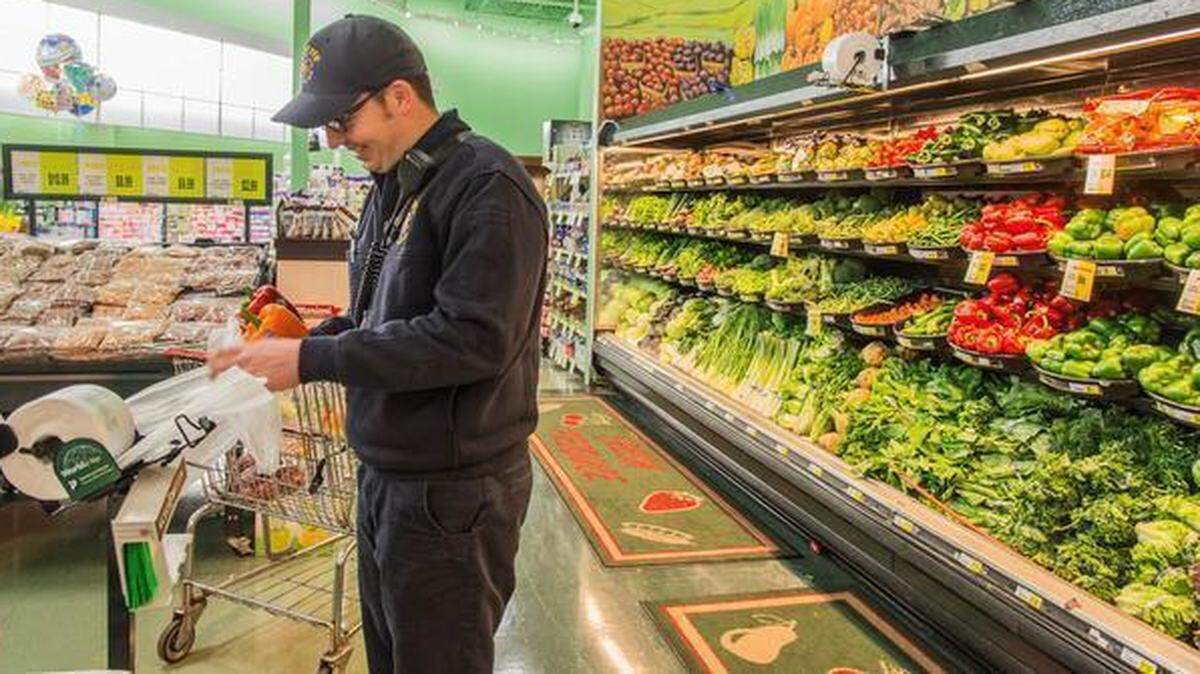
Weekly sales circular in hand, Michael Rutten maneuvers a grocery cart through the produce section of an Olathe Price Chopper on a recent Saturday morning.
The Olathe Fire Station 1 firefighter-EMT quickly bags onions, garlic and broccoli before sprinting to the bakery aisle.
“Chicken’s on sale, so it’s chicken Parmesan and roasted broccoli for dinner,” he says, twirling a loaf of garlic bread in the air. “And sweet pepper hash for brunch.”
Rutten, 33, is husband to Candace and father of two. But he’s shopping for ingredients to feed his second family: eight first responders working the A shift, a 24-hour stint at the fire station on Old 56 Highway.
Although the budget is tight — each guy contributes $10 for two meals — Rutten, a professionally trained chef, enjoys the challenge of creating menus on a shoestring.
“This,” he points to the sales flier peeking from underneath a growing mound of groceries, “is key. Whatever’s on special usually ends up on our table.”
Acting battalion chief and fire Capt. Bill Schneider and firefighter David Miller trail Rutten as he scours shelves. Radios strapped over their shoulders, ensuring constant contact with the dispatcher, are a reminder that the three aren’t like the other shoppers meandering through the aisles.
As Rutten tosses cans of crushed tomatoes, a bottle of Italian dressing and a package of bulk sausage into the cart, a voice crackles over the radios with details of a medical emergency, sending the first responders into split-second action.
Rutten races to the front of the store, handing off the half-filled cart to an employee. Schneider is already in his SUV, engine running; Miller, engineer Sean Brooks and acting Capt. Ryan Tatchell are in the massive rescue rig as Rutten hops on board.
Sirens and lights blare as the emergency vehicles spill onto the street and in an instant, grocery shopping is a distant memory for the five members of Fire Station 1 as they concentrate on the call.
“Welcome to our world,” 28-year firefighter Schneider says, consulting the large computer screen to the right of the steering wheel. “You never, ever know what a day will bring.”
En route to the call, the unit is diverted. “Johnson County Med-Act has it,” Schneider explains as he pulls back into the Price Chopper parking lot. Inside, Rutten retrieves the cart from a walk-in cooler and finishes shopping.
Back at the station, he loads groceries into the small, sparsely equipped, u-shaped kitchen. Firefighter Wes Simmons, the crew’s newest member, joins Rutten in prepping the brunch entrée, dicing and tossing red potatoes with olive oil in a well-used roasting pan.
“I’m our shift’s designated cook,” Rutten says. “Guys pitch in, slicing vegetables, cleaning up.”
Rutten hails from Plainfield, Ill., and attended culinary school at Joliet Junior College. “I worked in restaurants after graduation but decided that wasn’t for me,” he says, piling chopped onions and minced garlic onto a scarred plastic cutting board. “I didn’t want to work nights and weekends the rest of my life.”
Rutten’s uncle was a Chicago-area firefighter, something that always fascinated him. He decided to pursue a firefighter-EMT career and moved to Shawnee, where he worked for five years before joining the Olathe Fire Department three years ago.
“Guess what — I work weekends and nights,” Rutten says with a chuckle, slipping a pan of potatoes into the oven, “and I love it.”
In addition to emergency responses to protect life and property, fire station shifts include various duties: vehicle, equipment and uniform maintenance; training, studying, scheduling; workouts in the second floor weight room to keep in optimum shape for the physical requirements of fire and rescue.
The station is also home to the Special Operations Group. Firefighters are trained and certified in confined space rescue, water rescue, structure collapse, hazardous materials response, and technical search and rescue.
As in most firehouses, meals on the A shift are communal, family-style affairs. The gleaming, custom-made table filling Station 1’s dining room is repurposed from a bowling alley lane; station personnel names are inscribed in it, along with the distinctive blue-and-red emblem.
“Deciding what we’ll eat might be our most difficult decision each shift,” Rutten says. “It’s an important part of our life — not just sustenance, but the opportunity for us to be together, joke around, offer support.”
Rutten and Schneider acknowledge that a day in the life of any fire station can be rough, with each emergency call representing a different circumstance and outcome.
“We’re here for each other, just like family,” Rutten says. “I grew up second out of nine kids, so having these guys around me and cooking for them is a natural.”
The hash’s fragrant aroma wafts through the station, attracting Rutten’s hungry co-workers to the dining room, plates in hand. The group good-naturedly ribs rookie Simmons.
“That looks real good, Wes, and RuRu, this looks good enough to eat,” Brooks volleys one of Rutten’s nicknames as he splits several biscuits, slathers them in gravy and adds a generous helping of hash to his plate.
Firefighter-paramedic Erik Kallauner sits down and digs in, smiling at remarks swirling around the table. “Yep, Rutten, mmm good,” Capt. Mark Godbold chimes in, dispensing bottled water to the group before settling in to eat.
Brunch conversation focuses on food, Rutten’s culinary skills and the friendly throw-down cooking competitions between him and firefighter-paramedic and third shifter Tom Hoegler, a self-taught cook and fan of food reality shows.
“Right now I’m one point ahead,” Rutten says, describing foods he and Hoegler have trotted out for the contest’s different themes. “Ultimate burger night — mine lost because they were too big.”
Hoegler had an unfair advantage on diner night: His in-laws own a diner, so he brought a milkshake machine to the station.
Meanwhile, “the guys said my interpretation of an open-faced roast beef sandwich was too extravagant with the addition of a cherry-mushroom sauce,” Rutten says.
But Rutten rebounded and won grill night, whipping up an impressive surf-and turf combination. “Man, that was good,” engineer Ted Ford says, rolling his eyes in between forkfuls of hash.
And Rutten and Hoegler went head-to-head on Italian night, where Rutten’s fresh, handcrafted pasta received a resounding thumbs-up.
“The entire kitchen was full of drying pasta,” Rutten laughs. “One of the guys walked in and told me there wasn’t enough, so I cranked out more.”
Kallauner groans at the recollection of gorging on pasta. According to Schneider, everyone in the crew is a critic, anxious to judge each creation’s merits and shortcomings.
“We take food seriously,” Schneider, known for a signature smoked salmon, says, nodding at the men assembled around the table.
Rutten’s workmates agree that he hasn’t served a stinker yet since assuming A shift cooking responsibilities three years ago. “We pretty much like everything RuRu does,” Brooks says as he polishes off his hungry-man portion of biscuits and gravy and hash, helping himself to seconds.
Rutten adopts a simple meal-planning strategy to accommodate the unexpected nature of firehouse activity: few ingredients, minimal steps and a short cooking time. As he begins evening meal preparation — Caesar salad with sweet onion straws, red sauce, pasta, chicken Parmesan and broccoli — Rutten notes he’s never alone in his kitchen endeavors.
“It’s an unwritten rule: If you’re not doing something else in the firehouse, and there’s activity in the kitchen, you lend a hand,” he says. “I have to be organized, because anything can, and will, happen.”
As if on cue, the intercom signals an emergency call. Rutten turns off the burner under the sauce, racing to the garage where he and three fellow firefighters jump into a rescue truck and head to a medical emergency at an Olathe high school. Schneider is right behind them.
Ninety minutes and four emergency calls later, the entourage returns to Fire Station 1. Rutten resumes his position in the kitchen, dredging giant chicken breasts — “these beauties were $1.99 a pound” — in a seasoned panko breadcrumb mixture, stirring and tasting the sauce.
He retrieves a green can of Parmesan cheese from a pantry marked for A shift, the number “51” scrawled across the front in black marker. “There are some things I’m not proud of, but I make them work,” Rutten says, referring to the processed cheese he purchases instead of fresh to keep within the budget.
Rutten deep fries sweet onion straws for the Caesar salad as Simmons and Brooks set the table. Firefighters appear, patiently waiting for the official dinner bell. “Fellow firefighters, come and get it, supper’s on,” Rutten speaks over the firehouse intercom in his best “Attention, shoppers” voice.
Plates are filled with pasta and sauce, bubbling chicken, chunks of garlic bread and roasted broccoli. Tonight the band of brothers talks about their dream for firefighter-EMT-chef Rutten: a food truck. “It’d be called the Rut Truck,” Godbold says. “The concept would be one meal a day — a supersized portion of something.”
Rutten quietly listens to the business plan banter, munching Caesar salad, glancing around the table at his friends and colleagues. “This is what it’s all about,” he says. “We bond because of our work and are friends because of what we share beyond that.”
The A shift at Fire Station 1 finishes Saturday supper uninterrupted by dispatch calls. Rutten rises from the table, transporting minimal leftovers to the kitchen.
“The thing about firehouse food is that it doesn’t have to be fancy,” he says, “but there better be plenty of it.”
Kimberly Winter Stern is an Overland Park-based freelance writer and frequent contributor to Chow Town. Reach her at kimberly@sternwrites.com or @kimdishes.
Firehouse Sunday Sauce
Makes 4 servings
2 to 3 tablespoons olive oil
1 small sweet onion, minced
3-4 garlic cloves, minced
1/2 cup Pinot Noir or other sweet red wine
2 (28-ounce) cans crushed tomatoes
1 (28-ounce) can diced tomatoes, undrained
Salt and pepper, to taste
Heat olive oil over medium-high heat in a large saucepan. Add onions and garlic and cook until soft. Deglaze the pan with wine, scraping up any brown bits. Add all of the tomatoes and turn heat down to a low simmer and season to taste. Continue to simmer, stirring frequently, until sauce is reduced by at least one quarter, about 2 to 3 hours.
Per serving: 273 calories (26 percent from fat), 8 grams total fat (1 gram saturated), no cholesterol, 45 grams carbohydrates, 9 grams protein, 975 milligrams sodium, 8 grams dietary fiber.
Chicken Parmesan
Makes 4 servings
4 large chicken breasts, trimmed of visible fat and pounded to 1/4- to 1/2-inch thick
1 (8-ounce) bottle zesty Italian dressing
2 cups all-purpose flour
3 large eggs, whisked for egg wash
2 cups panko breadcrumbs
1/4 cup fresh Parmesan cheese
1 teaspoon salt
1 teaspoon garlic powder
1 teaspoon onion powder
1 teaspoon Italian seasoning
Olive oil, for frying
Firehouse Sunday Sauce (see recipe)
8 ounces Provolone cheese slices
Place chicken and Italian dressing in a ziptop food bag and marinate meat for 6-8 hours in the refrigerator.
Preheat oven to 400 degrees. Place flour in a shallow bowl or pie plate. Whisk eggs in a shallow bowl. In a third bowl, stir together panko, cheese, salt, garlic powder, onion powder and Italian seasoning.
Remove chicken and pat off any excess marinade with a paper towel. Dredge breast in flour and then dip into egg wash. Place floured chicken breasts in breadcrumb mixture, pressing to get panko mixture to coat evenly. Flip breast over and press again to ensure full coverage.
In a skillet, heat 1 inch of olive oil over medium-high heat. Fry breaded chicken 3 to 4 minutes per side or until golden brown. Place breasts in 9- by 13-inch casserole or baking dish and cook until chicken is fully cooked, 15 to 20 minutes, depending on size of breast.
Top cooked chicken breast with a ladle of Firehouse Sunday Sauce and top with a slice of cheese. Return to the oven until cheese is melted. Serve immediately.
Per serving: 926 calories (56 percent from fat), 57 grams total fat (17 grams saturated), 268 milligrams cholesterol, 48 grams carbohydrates, 54 grams protein, 1,760 milligrams sodium, 2 grams dietary fiber.
Sweet Pepper Hash
Makes 4 servings
2 pounds red potatoes, diced
Olive oil, to coat
1 pound breakfast sausage
1 red pepper, diced
1 small sweet onion, diced
2 garlic cloves, minced
Salt and pepper, to taste
Fresh parsley, chopped
4 eggs, cooked over-easy
Preheat oven to 450 degrees.
In a mixing bowl, toss the diced potatoes with olive oil to coat; on a rimmed baking sheet roast potatoes until they begin to soften, about 10 minutes.
Meanwhile, cook sausage until brown; drain fat and crumble.
Remove baking sheet from the oven and add red pepper, onion, garlic and sausage; stir and return to oven until potatoes are golden brown, another 10 to 15 minutes
Prepare four over-easy eggs. Top each serving of hash with an egg and garnish with fresh parsley.
Per serving: 739 calories (62 percent from fat), 51 grams total fat (18 grams saturated), 289 milligrams cholesterol, 45 grams carbohydrates, 25 grams protein, 842 milligrams sodium, 4 grams dietary fiber.
Oven-Roasted Broccoli With Prosciutto
Makes 4 servings
2 large crowns broccoli, separated into smaller florets
Olive oil, to coat
1 1/2 teaspoon garlic salt
1 teaspoon pepper
4 ounces prosciutto, diced
1/2 cup fresh Parmesan cheese
Preheat oven to 425 degrees.
Toss broccoli with olive oil to coat, season with garlic salt and pepper; place in a roasting pan with prosciutto. Roast for 8-10 minutes, or until the broccoli crowns turn light brown and crispy. Sprinkle with Parmesan cheese and return to oven until melted. Serve immediately.
Per serving: 179 calories (61 percent from fat), 12 grams total fat (4 grams saturated), 28 milligrams cholesterol, 4 grams carbohydrates, 14 grams protein, 1,734 milligrams sodium, 2 grams dietary fiber.
This story was originally published February 10, 2015 at 6:00 AM.