
What will the world look like 29 years from now?
Here’s a cold shiver down your back, Royals fans. What if — after taking 29 years to return to the World Series — the Boys in Blue don’t make it back to the postseason for another 29 years?
That’s a long time. Just think how much the world has changed since 1985: Smartphones. Internet. Honey Boo Boo.
What will the world be like in 2043? Will we drive flying cars to our homes in the sky like George Jetson? Don’t count on it. Will we have our own robots, like those Jetsons and Disney’s new “Big Hero 6”? Well, we might.
If you believe some of America’s top futurists, the changes could be wild. Robots. An elevator into space. Perhaps immortality. Here are some possibilities:
UCLA roboticist Dennis Hong believes humanoid robots will master the skills of walking and running and perform a variety of dirty, dangerous and domestic tasks: fighting fires, cleaning up after chemical plant leaks, even tackling household chores such as vacuuming and doing the dishes.
“My dream is to have robots living with us in our homes,” Hong said on the science show “Nova.”
That could happen by 2043. And by 2050? He says cybernetic soccer players could take on the human World Cup champions — and beat them.
Humanoid robots are advancing faster than most people realize, Hong said. Sophisticated robots are already building our cars. And in Japan scientists are designing robots to take care of the elderly.
But by then, the elderly might not need much care. In fact, immortality is not only possible, but “highly likely,” according to inventor, computer scientist, futurist — and Google’s director of engineering — Ray Kurzweil.
Kurzweil, 66, is so convinced that immortality is coming he has arranged to have himself cryogenically preserved after death so he can be revived when cybermedicine makes it possible to live forever.
“Artificial intelligence will reach human levels by about 2029,” Kurzweil said in an interview on PBS in 2012. “Follow that out further, to say, 2045, and we will have multiplied the intelligence — the human, biological machine intelligence of our civilization — a billionfold.” As a result, he said, “our thinking will become a hybrid of biological and non-biological thinking.”
So will our other biological functions, as humans and computers begin to merge.
“We will put computerized devices the size of blood cells inside our body to keep us healthy,” he said. “When a new biological virus comes out, these little nanobots could download new software to combat that new pathogen. We’ll get to a point 15 years from now according to my models where you will be adding more than a year every year to your remaining life expectancy.”
At the very least, cybermedicine will extend our lives, says Michio Kaku, a futurist and theoretical physicist at the City College of New York.
“DNA chips, perhaps placed in our toilets and bathroom mirrors, may detect telltale traces of cancer proteins and individual cancer colonies years before a tumor forms,” he wrote in The New York Times. “With these tiny sensors constantly and silently analyzing our bodily fluids, the word ‘tumor’ may be excised from our vocabulary.”
He also says MRI machines will be miniaturized. “Eventually they will be the size of cellphones, becoming similar to the ‘tricorders’ in ‘Star Trek,’ capable of analyzing diseases with a simple wave over a body.”
You don’t have to go to the coasts to find futurists. They’re everywhere these days. In fact, the board chairman of the Association of Professional Futurists, headquartered in Houston, lives in Leawood.
Cindy Frewen, who is also an architect, envisions a variety of advancements by 2043. For instance, she said, doctors may routinely provide 3-D-printed fingers and ears to their patients who may have lost those body parts.
And there likely will be an abundance of 3-D-printed artificial meat made from enzymes. “Right now that’s a science experiment,” she said. “But in 30 years it won’t be an experiment any more. It will be in your grocery store.”
If not flying cars, she does foresee more driver-less cars.
Others are planning on constructing an elevator into space by 2050. A Japanese firm plans to build it out of carbon nanotubes to transport both materials and people. One researcher, Yoji Ishikawa, told ABC News that these tubes are almost 100 times stronger than steel cable.
“Right now we can’t make the cable long enough,” Ishikawa said. “We can only make 3-centimeter-long nanotubes (and) we need much more. … We think by 2030 we’ll be able to do it.”
Space elevators make use of small “climbers” to carry their cargo along the nanotubes into space. The space elevator would revolutionize our access to the great beyond. For instance, it would slash the cost of building a manned space station. Japanese researchers are confident they can one day make a climber large enough to deliver up to 30 passengers into space, according to ABC.
Now, if we could just get ourselves a handy wormhole, like in the new movie “Interstellar,” we could take that travel much further.
Kaku of City College of New York also had these predictions:
▪ Parents will design their offspring. “In a few decades, parents may be able to choose many genetic characteristics of their children,” he said. “Our genes will be sequenced and recorded at a cost of less than $100. Many damaged and dysfunctional genes in our genome may be cured using gene therapy, possibly leading to genetic enhancement.
“Already, ‘smart mouse’ and ‘mighty mouse’ genes have been isolated that can create mice with superior memory and strength, and these genes have human counterparts. This amounts to tinkering with the genetic heritage of the human race, so there must be a vigorous ethical debate about how far to push this technology.”
▪ Augmented reality will be everywhere. “If the Internet is accessible via contact lenses, biographies will appear next to the faces of the people we talk to, and we will see subtitles if they speak a foreign language. … These lenses would revolutionize the lives of actors, politicians, surgeons, tourists, soldiers and astronauts by delivering maps, scripts, speeches, translations, biographies and charts with the blink of an eye.”
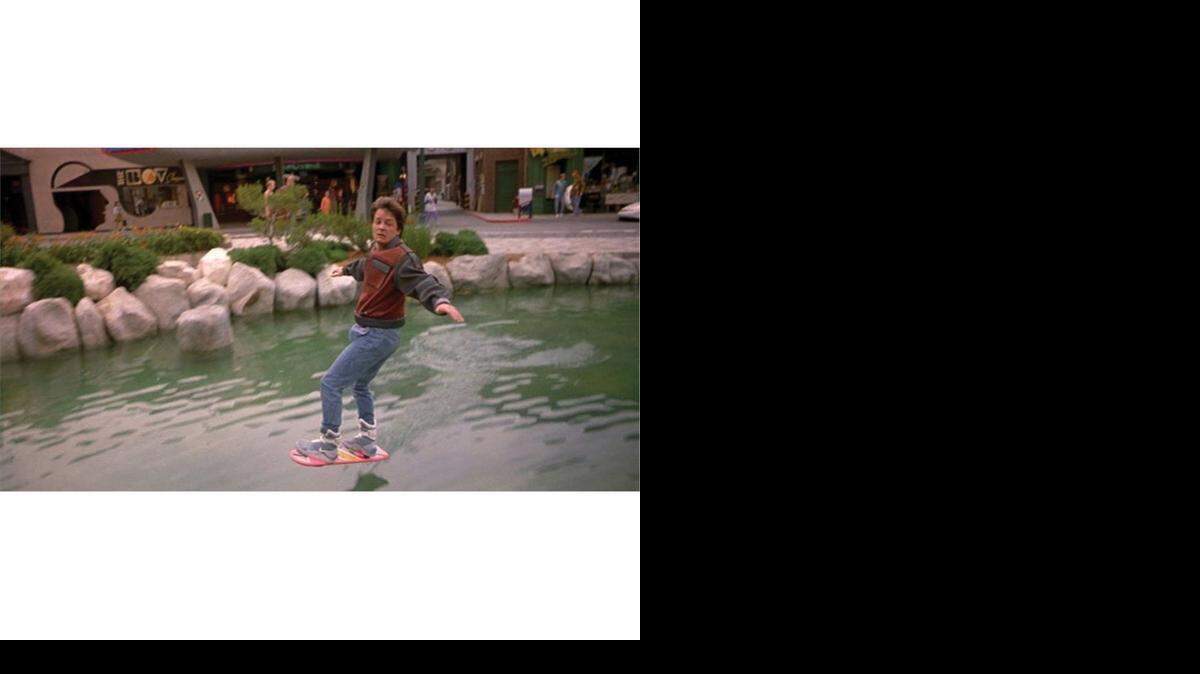
And, finally, in 2043, we could all be riding hoverboards like Marty McFly did in the year 2015 in “Back to the Future 2.”
Don’t laugh. A California start-up unveiled the Hendo Hover prototype last month. Its inventor, Greg Henderson, calls it the “the Model T of hoverboards.” It can’t fly over hedges like in the movie, and it lacks control and directional stability. But it does allow riders to hover smoothly a few inches off the ground.
The board, expected to cost $10,000 when it comes out in about a year, has created quite a stir with technology fans. Recently it surpassed its quarter million dollar goal on Kickstarter in one day.
Currently the prototype needs a metal surface such as copper to work.
But by 2043?
Who knows? We might just ride a hoverboard to the K for the seventh game of the World Series.
To reach feature writer James A. Fussell, call 816-234-4460, or email jfussell@kcstar.com.
This story was originally published November 7, 2014 at 6:00 AM.