Why Florida Scientists Are Putting GPS Collars on Opossums to Track Giant Burmese Pythons
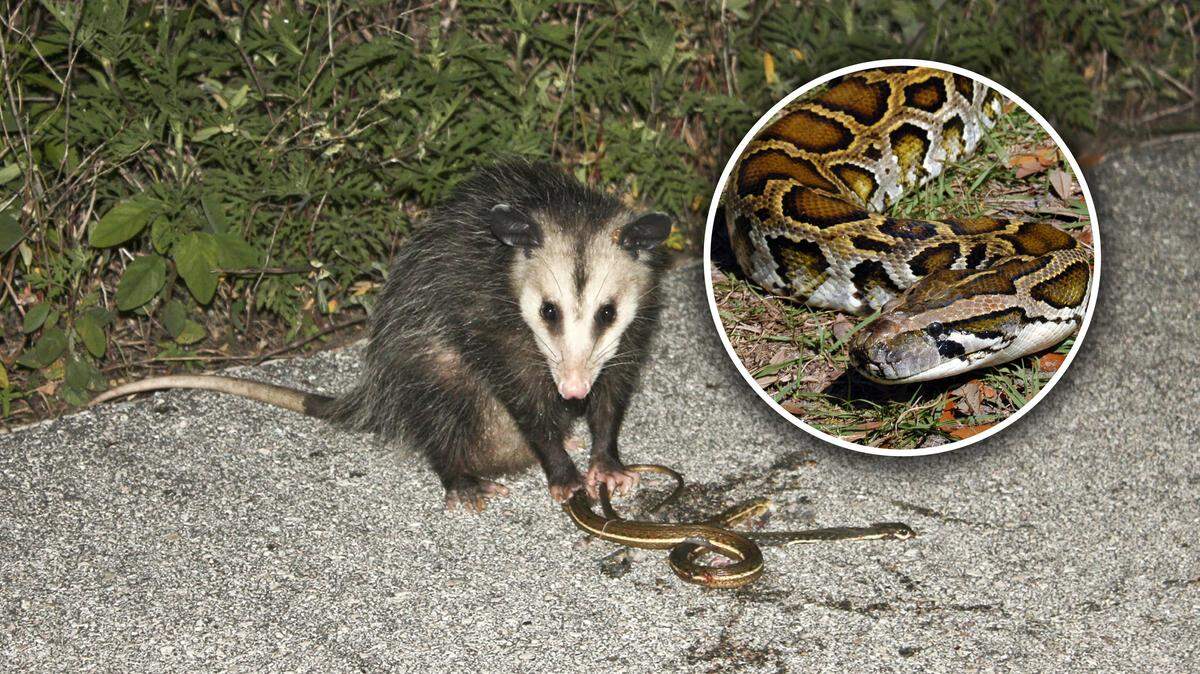
Florida scientists have found an unlikely weapon in their fight against invasive Burmese pythons in the Everglades: opossums fitted with GPS collars.
The strategy relies on a grim fact of life in the Everglades: opossums are one of the Burmese python’s favorite prey. Scientists discovered that when a python swallows a collared opossum whole, the GPS device keeps transmitting from inside the snake. That signal reveals the python’s location to conservation teams, allowing them to find and remove it from the wild.
The method is now helping researchers locate and remove more of the invasive snakes as python populations continue damaging native wildlife across South Florida.
The program is part of a broader effort by conservation teams to control the Burmese python population in the Everglades, where the invasive snakes have established a permanent breeding population and reduced some native mammal species by as much as 99%.
The Accidental Discovery That Launched the Program
Scientists did not set out to track pythons. The strategy was discovered by accident in 2022, when researchers were studying the movement and behavior of small mammals along Florida’s southern coast. As part of that work, they had placed GPS collars on opossums and raccoons to monitor the animals’ activity in the wild.
Then a Burmese python swallowed one of the GPS-tagged animals whole. But the collar did not stop transmitting — it kept broadcasting a signal from inside the snake. That allowed researchers to follow the GPS data to the python’s location, according to the South Florida Sun Sentinel.
What began as routine small-mammal research quickly turned into a new way to find and remove invasive pythons from the Everglades.
Researcher Michael Cove told the South Florida Sun Sentinel in 2023, “We need everything that we can find to remove as many pythons as possible.”
Cove, along with researcher A.J. Sanjar and other conservation teams, expanded the effort to help locate and euthanize invasive pythons across the region.
Researchers now hope to have at least 40 GPS-collared opossums participating in the program by later this summer. Because opossums are one of the most common prey species for Burmese pythons, scientists expect that some of the collared animals will eventually be eaten by the snakes, effectively turning the opossums into indirect tracking devices.
How Burmese Pythons Took Over the Everglades
Burmese pythons are an invasive species in the Florida Everglades and have established a permanent breeding population in South Florida, according to the Conservancy of Southwest Florida. The snakes were introduced through the exotic pet trade in the late 1900s, often through escaped or intentionally released pets.
The first recorded wild Burmese python in South Florida was documented in 1979 in Everglades National Park, according to the U.S. Geological Survey.
Since arriving, the snakes have become top predators in the ecosystem and are severely reducing native mammal populations. Burmese pythons have reduced raccoon populations by 99%, opossums by 98% and bobcats by 88%, contributing to major ecological disruption in the Everglades, according to researchers and wildlife officials.
The Florida Museum of Natural History notes that the pythons have also introduced harmful non-native parasites to Florida and reduced medium-sized mammal populations by more than 90%, significantly changing the Everglades ecosystem.
Burmese pythons continue expanding their range across the state. The U.S. Geological Survey reports that their spread can be measured in miles per year in some regions.
Addressing Criticism of the Approach
Some criticism has emerged over using live opossums as a way to locate pythons, but wildlife officials say the animals are not being placed in additional danger.
Jeremy Dixon told the South Florida Sun Sentinel on April 19, “We’re not putting these animals out there and in harm’s way. Harm’s way is there. We’re just documenting what’s happening.”
Record-Setting Pythons Found In Florida
The size of some Burmese pythons captured in Florida underscores just how firmly the species has established itself in the state.
The heaviest python ever caught in Florida weighed 215 pounds and measured 18 feet long. It was captured in 2022 in Naples by a biologist with the Conservancy of Southwest Florida.
The longest Burmese python ever captured in the state was recorded in July 2023 and measured more than 19 feet, according to the Florida Fish and Wildlife Conservation Commission.
Researchers hope the GPS-collared opossum strategy will help slow the ecological damage by improving how quickly conservation teams can locate and remove the snakes before they continue spreading further into Florida.
This article was created by content specialists using various tools, including AI.